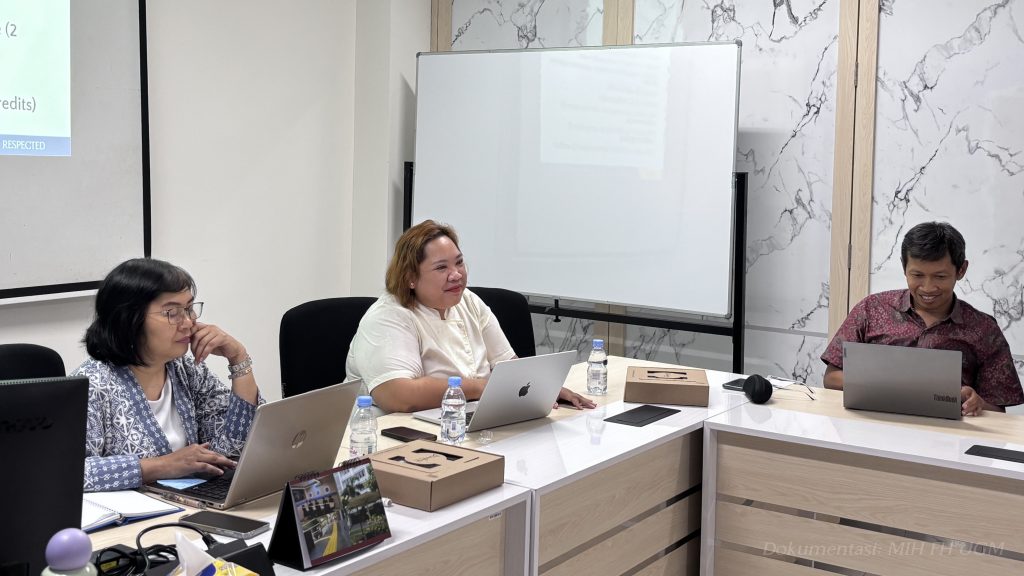
The Master in Laws (LLM) Program at the UGM Faculty of Law hosted an International Exposure Workshop on Friday, February 13, 2026, in Room IV.2.1 of the Faculty of Law. The event was attended by LLM students from the 2024 and 2025 cohorts as part of the effort to strengthen an internationally benchmarked academic environment and to fulfill academic requirements under the International Exposure course.
The workshop featured three resource persons — Herliana, S.H., M.Com.Law., Ph.D., Dr. Mahaarum Kusuma Pertiwi, S.H., M.A., M.Phil., and Bernadus Purnawan, S.S. — who provided a comprehensive overview of the internationalization policy direction of the program, the range of international exposure activities available, and the administrative procedures students must follow.
In her presentation, Herliana emphasized that international exposure is an integral part of the academic standards of the UGM LLM Program. It is intended not merely as a curricular requirement, but as a means of equipping students with a global legal perspective — which has become increasingly important given the cross-border nature of legal issues today, from international commercial disputes and human rights advocacy to the harmonization of global regulations. The vision is to ensure that all students gain international experience, whether through the use of English in academic activities or through active participation in internationally recognized activities — including those organized domestically.
Mahaarum then explained that the International Exposure course carries 3 credit hours and is compulsory, with each student designing their own program of activities in line with their individual interests and academic plans. Qualifying activities include student exchange, double degree, presentation or participation in international conferences, publication in internationally indexed journals, summer courses, research stays, international internships, international competitions, and international elective courses. She stressed that every planned activity must receive prior program approval in order to be recognized as international exposure.
In the final session, Bernadus provided a detailed account of administrative procedures and registration timelines for various programs — including the double degree scheme with the University of Glasgow and Durham University, and student exchange programs with Universiteit Leiden, the University of Groningen, and the Geneva Graduate Institute. He also covered document requirements, the process for submitting activity proposals, and reporting obligations following completion.
The lively Q&A session demonstrated strong student interest — particularly around activity recognition, certificate requirements, relevance to legal specializations, self-funding arrangements, and scheduling during international programs. Through this workshop, students are expected to gain a comprehensive understanding of the concept, mechanisms, and strategies for planning and executing international exposure effectively. The event also reaffirms the commitment of the UGM Faculty of Law's Master in Laws Program to fostering an academically competitive environment with a genuinely international orientation toward student capacity development.
Author: Master in Laws Program, Faculty of Law UGM