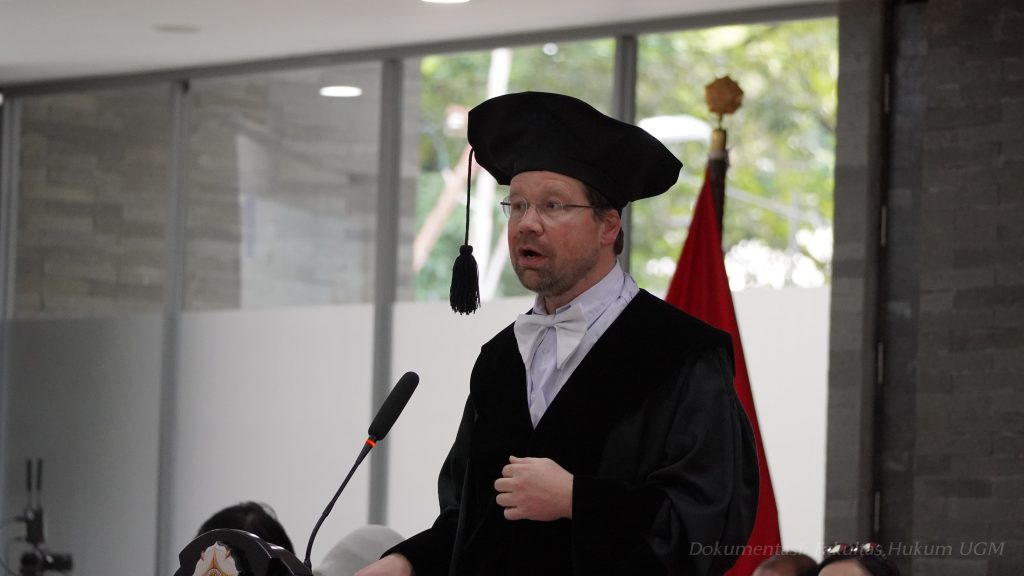
As part of its 80th Dies Natalis celebrations, the Faculty of Law at Universitas Gadjah Mada (FH UGM) held an Academic Oration as part of the Open Senate Session on Friday, February 13, 2026, at the FH UGM Auditorium. The oration was delivered by Prof. W.J. (Ward) Berenschot of the University of Amsterdam, a scholar widely recognized for his research on Indonesian politics and law.
In his oration, Prof. Ward addressed the persistence of colonial legal heritage within Indonesia's contemporary legal system — particularly in the context of agrarian conflicts between palm oil companies and rural communities. He opened his reflection with the historical account of the mutiny aboard the Zeven Provinciën in 1933, which held personal significance as part of his own family history. Through this story, he showed how the colonial logic — which placed the stability of power and economic interests above the rights of communities — shaped the character of law in the Dutch East Indies.
Prof. Ward argued that the colonial legal system was fundamentally designed to support the exploitation of natural resources and protect the interests of colonial rulers. The concept of domein verklaring (domain declaration) in the Agrarische Wet of 1870 — which declared that any land whose ownership could not be proven was property of the state — provided a powerful foundation for state control over land. He argued that this concept continues to resonate in Indonesia's current agrarian law through the principle of State Right of Control (Hak Menguasai Negara/HMN) and the classification of forest zones, which encompasses the majority of Indonesia's land area.
Drawing on collaborative cross-university research that documented 150 conflicts between palm oil companies and communities across four provinces, he demonstrated that agrarian conflict in Indonesia is not merely an administrative problem — it reflects a structural issue rooted in colonial legal design. Weak recognition of the land rights of indigenous peoples and smallholder farmers, a concession system that facilitates corporate access to land, and collusion between political elites and business actors are the principal drivers that perpetuate and complicate the resolution of these conflicts.
He also highlighted how the criminalization of community leaders who protest their situations frequently invokes legal provisions with colonial antecedents — such as regulations analogous to the Coolie Ordinance of the Dutch East Indies era. This demonstrates that legal decolonization cannot be limited to replacing colonial legislation — it must also reach into the practices and paradigms of law enforcement.
The oration affirmed that the work of legal decolonization remains an unfinished academic and political project. Prof. Ward called on the academic community to continue critically examining and reformulating the law so that it genuinely serves the interests of citizens — rather than perpetuating the interests of elites.
The oration is aligned with FH UGM's commitment to the Sustainable Development Goals (SDGs). The themes addressed contribute to: SDG 16 (Peace, Justice and Strong Institutions), through the promotion of legal system reform that is fairer, more transparent, and more accountable, and through stronger protection of community rights in natural resource conflicts; SDG 10 (Reduced Inequalities), by highlighting structural disparities in land access and control between local communities and large corporations; SDG 15 (Life on Land), through reflection on the impact of palm oil plantation expansion on land governance and environmental sustainability; and SDG 8 (Decent Work and Economic Growth), in the context of critiquing an extractive development model that does not necessarily deliver inclusive and equitable economic growth.
Through the momentum of its 80th Dies Natalis, FH UGM reaffirms its role as a space for critical reflection and the development of ideas for legal reform oriented toward social justice, ecological sustainability, and human rights. The oration serves not only as an academic celebration, but as a reminder that legal reform must continue to be directed toward liberation from the colonial legacy that still casts its shadow over legal practice in Indonesia today.