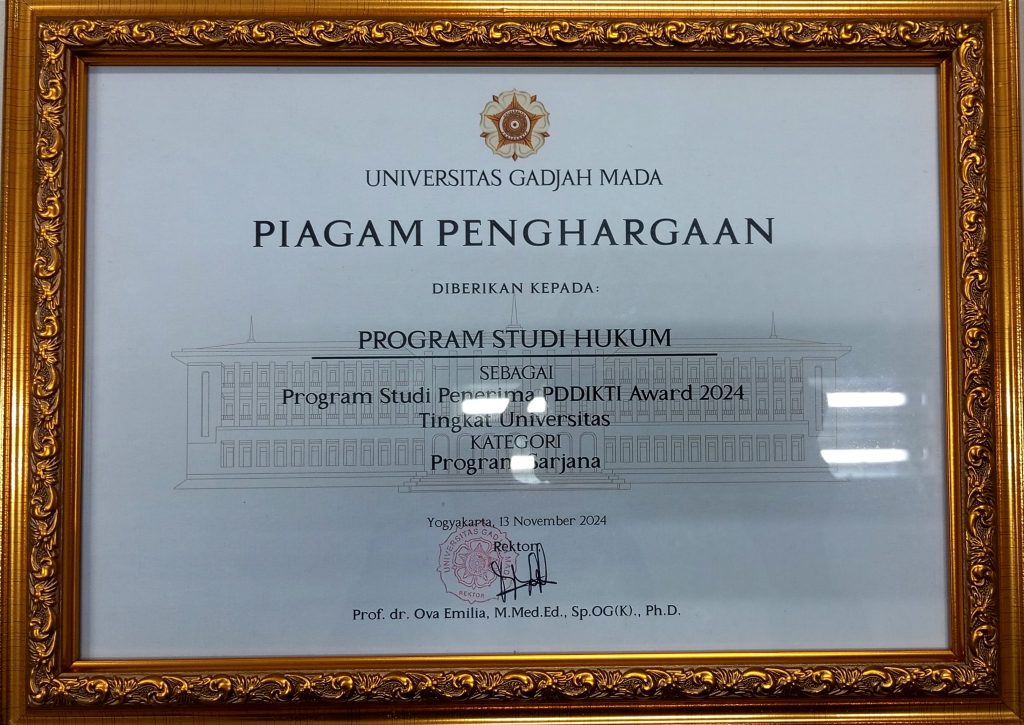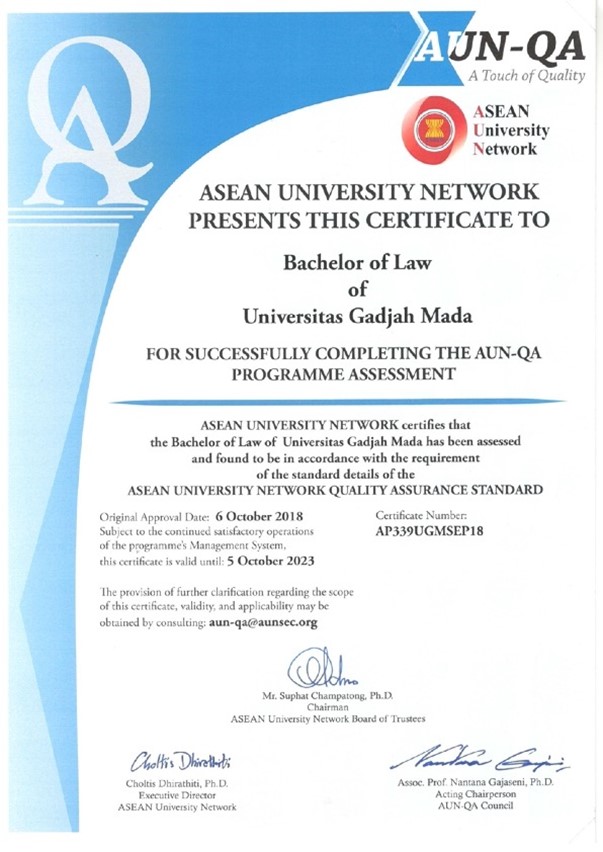
Regular Undergraduate Program

Head of Study Program
Dr. Khotibul Umam, S.H., LL.M.
- Secretary: Dr. Muhammad Fatahillah Akbar, S.H., LL.M.
- Staff :
- Staff :
Building A, 1st Floor, Faculty of Law, Universitas Gadjah Mada
Bachelor's Program
As mandated by Law Number 12 of 2012 concerning Higher Education, the Higher Education Curriculum constitutes an institutional responsibility that must continuously be updated in accordance with evolving needs and developments in science, technology, and the arts, as reflected in the Graduate Learning Outcomes. In the context of revising the curriculum that had been implemented since 2015, the Undergraduate Law Study Program of the Faculty of Law, Universitas Gadjah Mada, has conducted a series of activities since early 2020 to evaluate and revise the curriculum. Curriculum reform in higher education is a routine undertaking that must be carried out in response to developments in science, technology, and the arts (scientific vision), societal needs, as well as the needs of graduate users and stakeholders. The Faculty of Law UGM regularly organizes curriculum workshops for both undergraduate and postgraduate programs as part of its annual Dies Natalis celebrations. However, in early 2020, the Ministry of Education and Culture also introduced a new higher education policy through the “Merdeka Belajar – Kampus Merdeka” (MBKM) program, the implementation and discussion of which continue to evolve. The MBKM policy provides students with opportunities to gain broader learning experiences and new competencies through various learning activities conducted outside their study program. The implementation of this new policy consequently required adjustments and greater flexibility in the curriculum proposals that had previously been formulated.
Vision
A world-class study program that is competitive, innovative, and dedicated to serving the interests of the nation and humanity, inspired by the cultural values of the nation and grounded in Pancasila.
- To organize an excellent law education with international standard and continuous development of legal studies.
- Conducting legal researches that are beneficial to the public.
- To organize public service in order to increase knowledge and law awareness.
- Cooperating with national and international institutions.
- Ability to apply legal knowledge through monitoring and analysis of legal problems that occur and develop in people's lives, in a satisfactory and responsible manner.
- Ability to master the principles, theories and concepts of law in order to be able to apply positive law in finding and providing problem solutions to legal cases that exist in the community, according to the scope of work or profession.
- Ability to solve legal problems according to the scope of work or profession, according to fair legal principles.
- Ability to conduct research in law that mono- and multidiscipline to answer the happening issues in public's livelihood
- Ability to independently, and/or in groups, choose and use appropriate methods to prepare draft legal documents by upholding the ethics of the legal profession.
To establish the Study Program as one of the leading institutions of legal education in Indonesia with an internationally recognized reputation through:
- Providing high-quality legal education to produce outstanding and competent graduates who are capable of responding to contemporary challenges, while fostering professional and highly qualified jurists in their respective fields.
- Producing legal research that serves as a national reference, grounded in local excellence, to support the development of Indonesian law that is responsive to societal needs and contributes to the realization of just and equitable welfare.
- Community service initiatives that sustainably promote an independent and legally conscious society as a prerequisite for a democratic state governed by the rule of law.
- Governance of the Study Program based on integrity, transparency, and accountability to support the effective and efficient utilization of resources.
- Strategic, collaborative, and sustainable partnerships with alumni and institutional partners.
Graduates of S1 (Bachelor of Law) program are expected to master the principles, theories and doctrines of legal studies with the ability to apply them in practice. These competencies are demonstrated by:
- Ability to apply legal knowledge through monitoring and analysis of legal problems that occur and develop in people's lives, in a satisfactory and responsible manner.
- Ability to master the principles, theories and concepts of law in order to be able to apply positive law in finding and providing problem solutions to legal cases that exist in the community, according to the scope of work or profession.
- Ability to solve legal problems according to the scope of work or profession, according to fair legal principles.
- Ability to conduct research in law that mono- and multidiscipline to answer the happening issues in public's livelihood
Ability to independently, and/or in groups, choose and use appropriate methods to prepare draft legal documents by upholding the ethics of the legal profession.
The Undergraduate Law Program of the Faculty of Law, Universitas Gadjah Mada, offers several distinctive advantages compared to undergraduate law programs at other higher education institutions, namely:
First Strength, maturity in the development of legal science. The Faculty of Law, Universitas Gadjah Mada (FH UGM), which reached its 77th anniversary on 17 February 2023, is the first law faculty established by the sovereign Government of the Republic of Indonesia. In its journey to embody the spirit of from good to great faculty of law, through its Regular Undergraduate Law Program, has made significant contributions to the development of the nation and the state, particularly in the advancement of legal science in Indonesia. Many ideas and legal thoughts have emerged, developed, and subsequently spread from FH UGM, which have then been used to strengthen and improve Indonesia’s legal system, in line with FH UGM’s vision to create Bulaksumur School of Legal Thoughts.
Second Strength, comprehensive coverage of legal fields. The Undergraduate Law Program is supported by the organizational structure of the Faculty of Law, Universitas Gadjah Mada, in the form of departments responsible for the development of legal knowledge and serving as implementing units for academic activities. The Undergraduate Law Program is supported by eleven (11) departments, namely:
- Department of Customary Law
- Department of Administrative Law
- Department of Agrarian Law
- Department of Business Law
- Department of International Law
- Department of Islamic Law
- Department of Environmental Law
- Department of Tax Law
- Department of Civil Law
- Department of Criminal Law
- Department of Constitutional Law
With the support of these eleven (11) departments, the Undergraduate Law Program not only covers a broad range of legal fields but also offers in-depth specialization in each area of study managed by the respective departments. This contributes to the high quality of teaching and learning provided by the Undergraduate Law Program.
Third Strength, Clarity of Learning Scope. The Undergraduate Law Program defines its learning scope with an orientation toward the achievement of core graduate competencies, namely: (a) understanding, internalizing, and applying religious values, Pancasila, as well as ethical responsibilities of the legal profession and integrity in social, national, and state life; (b) mastering legal principles, theories, doctrines, and norms at both national and international levels through a monodisciplinary legal research approach; and (c) understanding contemporary legal issues in society at both national and global levels. Accordingly, the learning process in the Undergraduate Law Program has a different focus compared to the master’s level, which is oriented toward legal development, and the doctoral level, which is oriented toward the philosophy of legal science.
- An increase in the number of high-quality and well-balanced prospective student applicants.
- A synergistic learning system that is capable of responding to contemporary challenges.
- Achieving a national and international reputation for the Faculty of Law.
- The realization of legal education that produces higher-quality graduates through the attainment of learning objectives. (outcome based education)
- The availability of qualified and sufficient resources to support the development of research that prioritizes public benefit.
- Achieving high-quality and sufficient research outputs that are aligned with the university’s strategic policy direction.
- Enhanced dissemination of research outputs and publications, along with ensured implementation by users and research partners.
- Strengthening the capacity of the unit responsible for community service activities.
- Enhanced engagement and reach of the Study Program in community service programs, including student participation.
- Enhanced benefits and impact of community service outputs.
- Achieving effective institutional governance and administrative management.
- Effective and optimal human resource management.
- Transparent and accountable financial systems and management.
- Effective management of adequate and environmentally friendly physical resources.
- Effective governance of cooperation based on memoranda of understanding.
- Achieving optimal cooperation in the implementation of the Tridharma of Higher Education.
- An increase in research output productivity.
- Enhanced services and assistance for alumni.
- Enhanced alumni roles and contributions to the implementation of the Tridharma of Higher Education.
- The establishment and effective operation of a Study Program alumni association.