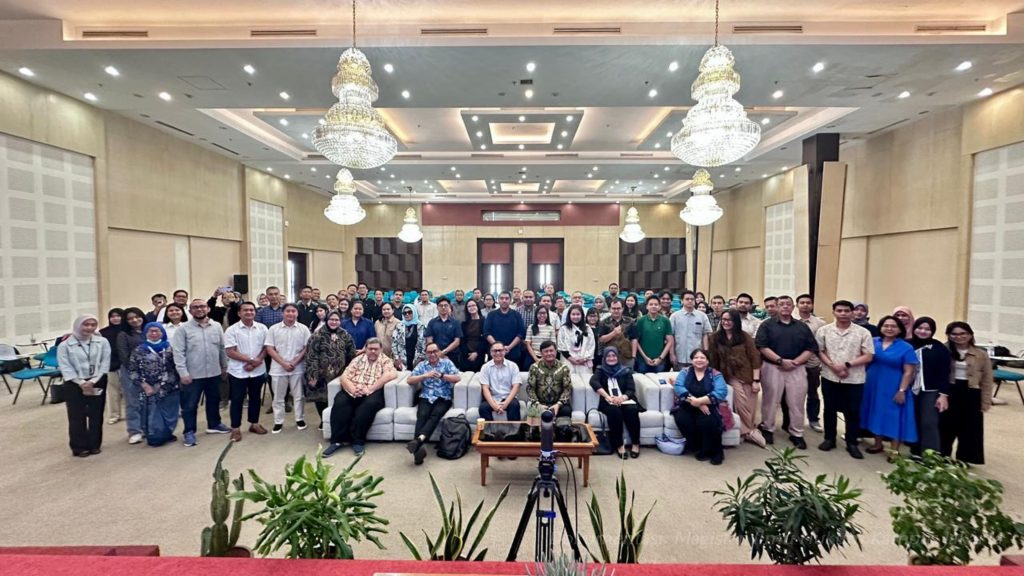
On Saturday, April 4, 2026, the Master of Laws Program (MIH) at UGM's Jakarta Campus successfully organized a national seminar titled "Red Card for Indonesian Capital Market Governance: Unpacking Governance Challenges and Strategies for Capital Market Stability". The event served as a strategic academic forum for critically examining a range of governance issues, global challenges, and the direction of reform in Indonesia's capital market.
The seminar was opened by Prof. Dr. Heribertus Jaka Triyana, S.H., LL.M., M.A., Vice Dean for Research, Community Service, and Information Systems at the UGM Faculty of Law. In his remarks, he emphasized the importance of strengthening legal integrity and certainty in the capital market as the essential foundation for building investor confidence and maintaining the stability of the national financial system.
In the first session, Yanuar Rizky addressed market manipulation and insider trading as serious threats to capital market integrity. He affirmed that a capital market must operate in a fair, orderly, and efficient manner free from unlawful practices such as conflicts of interest, market manipulation, and insider trading. Transparent information disclosure, the strengthening of good corporate governance, and an independent oversight and law enforcement system are central to maintaining public confidence and market efficien
Tara Setyaningtyas, S.E., M.M. then presented on the direction of Indonesia's 2026 capital market reforms amid an increasingly complex global geopolitical landscape. She noted the impact of international conflicts on financial market volatility, including the correction of the Jakarta Composite Index (IHSG) in early 2026. Despite this, Indonesia's capital market fundamentals remain strong, supported by a growing investor base that has now surpassed 24 million. The reform measures taken by the Financial Services Authority (Otoritas Jasa Keuangan/OJK) - including the strengthening of transparency, law enforcement, and market deepening - are key strategies for maintaining stability and competitiveness.
In the following session, Prof. Dr. Drs. Paripurna P. Sugarda, S.H., M.Hum., LL.M. examined the external pressures on the independence and legal certainty of Indonesia's capital market. He noted the scrutiny of international rating agencies such as MSCI, Moody's, and Fitch -- reflecting growing global attention to governance, transparency, and the stability of national economic policy. Strengthening institutional independence and legal certainty is therefore a crucial factor in maintaining the credibility of Indonesia's capital market at the global level.
Prof. Hikmahanto Juwana, S.H., LL.M., Ph.D. highlighted the connection between geopolitical dynamics and market behavior. Global uncertainty fuels speculation, which in turn raises the potential for market volatility. The role of the relevant authority is therefore critical in ensuring transparent information disclosure, rapid policy response, and firm and consistent law enforcement to protect investors and maintain market stability.
The seminar is hoped to contribute concretely to the achievement of SDG 8 (Decent Work and Economic Growth), by strengthening a healthy and integrity-based capital market ecosystem; SDG 16 (Peace, Justice and Strong Institutions), through law enforcement, transparency, and the strengthening of independent and accountable institutions; and SDG 17 (Partnerships for the Goals), through synergy among regulators, academics, and market participants. The event is also hoped to serve as a strategic foundation for the development of policies and capital market reforms oriented toward sustainability, increased investor confidence, and the creation of a financial system that is inclusive, stable, and globally competitive.
Author: Ramzy Oansa Ilham (Part-Timer, MIH Jakarta Campus)