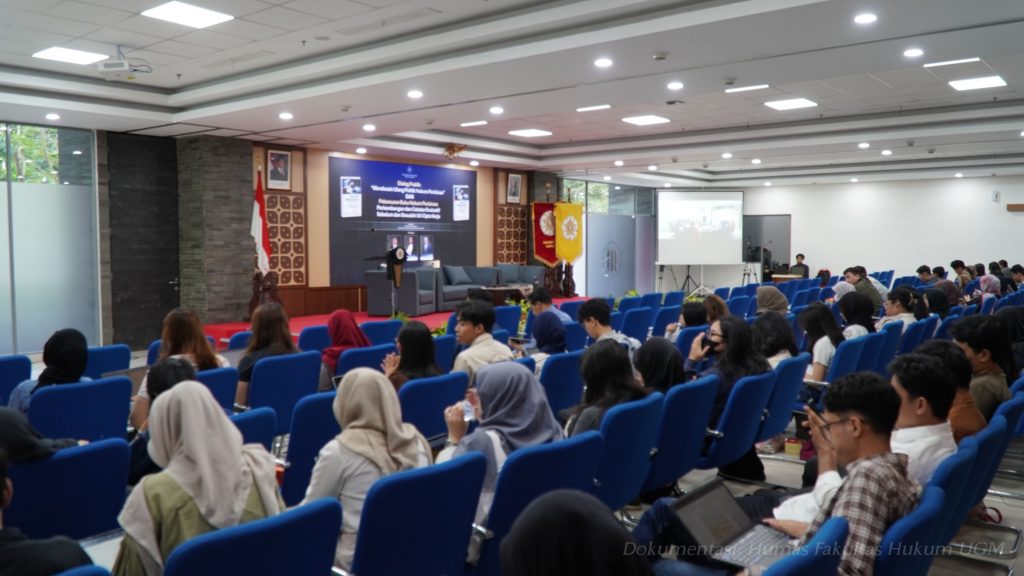
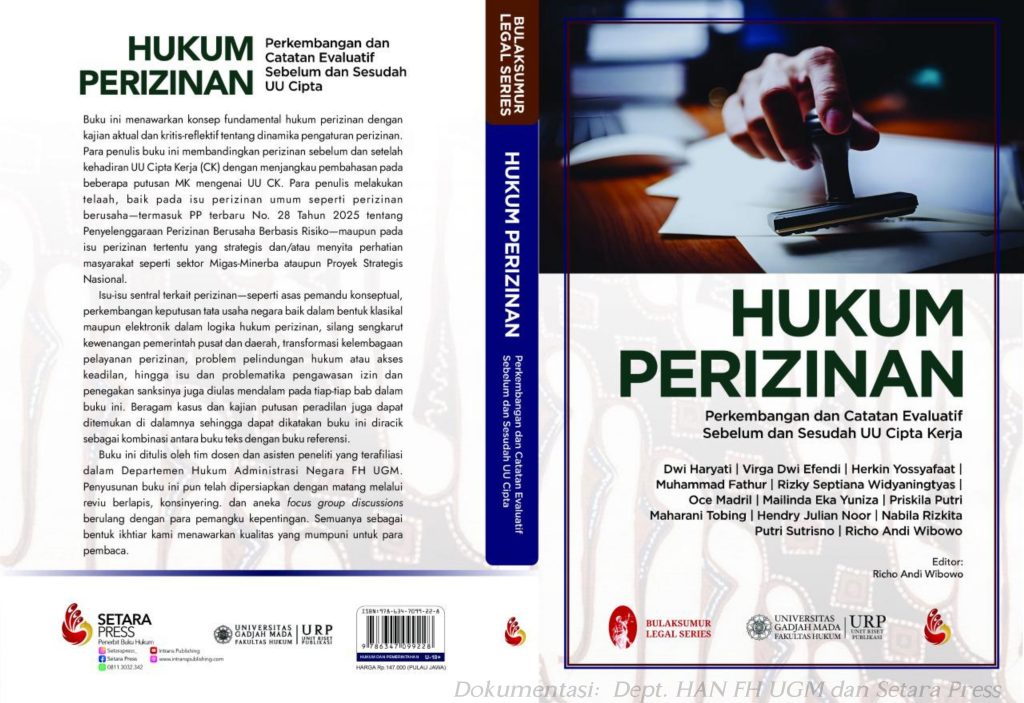
On Saturday (25 April 2026), the Department of Administrative Law (Hukum Administrasi Negara/HAN) of the Faculty of Law, Universitas Gadjah Mada (FH UGM), organized a Public Dialogue themed “Redesigning the Legal Politics of Licensing” as an academic forum to discuss the direction of licensing policies and regulations in Indonesia. The event was also accompanied by the launch of a book entitled Licensing Law: Developments and Evaluative Notes Before and After the Job Creation Law. The program was attended by lecturers, students enrolled in the Licensing Law course from both FH UGM and the Faculty of Law Universitas Brawijaya, as well as members of the public
Held at the Auditorium of Building B, FH UGM, the event featured representatives of the book’s authors from the Department of Administrative Law and three distinguished respondents: Dr. Herdiansyah Hamzah (Lecturer at the Faculty of Law, Universitas Mulawarman), Dr. Dewi Cahyandari (Lecturer at the Faculty of Law, Universitas Brawijaya), and Dr. Enrico Simanjuntak (Judge at the Bandung Administrative Court and guest lecturer at several universities). The forum became a space for critical reflection on the shifting licensing regime in Indonesia, which many consider increasingly detached from the principle of protecting citizens’ rights.
The launched book is the result of collaboration between lecturers and research assistants from the Department of Administrative Law, FH UGM, and was published by Setara Press. The work not only maps regulatory changes normatively but also provides an in-depth examination of the fundamental concepts of licensing law by reviewing various Constitutional Court decisions. In addition to discussing licensing issues generally, the book analyzes strategic sectors that have attracted significant public attention, such as oil and gas, mining, and National Strategic Projects. Its preparation involved a series of focus group discussions and layered review processes to produce a comprehensive study for both academics and legal practitioners.
The Head of the Department of Administrative Law and editor of the book, Dr. Richo Andi Wibowo, explained that the book was written partly in response to criticism from foreign scholars who viewed Indonesian legal education as superficial because it focused only on theory and regulations. Consequently, the book seeks to integrate legal theory, regulatory analysis, problem-based approaches, and case law studies. He emphasized that the essence of licensing law is to prevent undesirable negative impacts. However, this objective becomes unattainable when regulations are continuously relaxed in favor of investment while sidelining ecological concerns and the rights of affected communities, especially when the judiciary’s role in protecting the public is increasingly restricted.
Dr. Richo, who authored the chapter on licensing for National Strategic Projects, also identified the persistence of the outdated “law and development” paradigm. According to him, this paradigm tends to expand executive discretion and authority to facilitate development agendas while diminishing legal protection for individuals, including the judiciary’s role in ensuring such protection. As a result, law is reduced to merely an instrument for facilitating and accelerating development rather than achieving justice.
Melengkapi paparan tersebut, Dr. Oce Madril Complementing this discussion, Dr. Oce Madril highlighted weaknesses in the Online Single Submission (OSS) system, which is often not supported by coherent inter-agency data coordination. In the book, he authored a chapter discussing risk-based licensing through OSS mechanisms. Online Single Submission (OSS) karena sering kali tidak didukung oleh koordinasi data yang koheren antarinstansi pemerintah. Pada buku ini, Oce menuliskan bab tentang Perizinan Berbasis Risiko berbasis OSS.
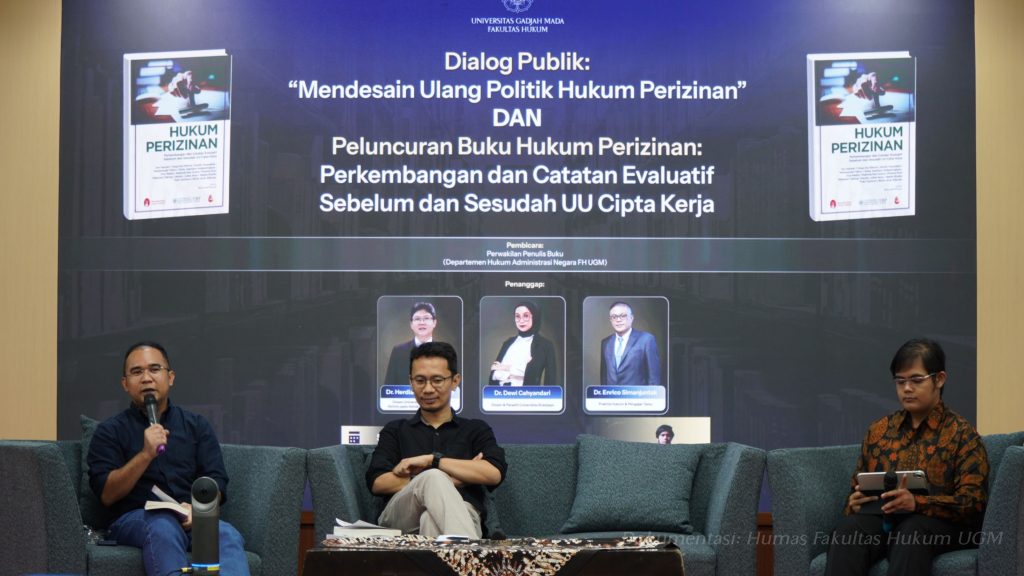
The discussion session continued with critical responses from the invited experts addressing legal issues arising after the implementation of the Job Creation Law. Dr. Herdiansyah Hamzah criticized the current licensing framework for departing from the constitutional principle of the State’s Right to Control (Hak Menguasai Negara/HMN) for the prosperity of the people. He pointed out the paradox of risk-based regulation, where high-risk sectors such as mining are in fact granted easier exploitation through guarantees of automatic concession extensions.
Meanwhile, Dr. Dewi Cahyandari presented findings on the shift of corruption opportunities from regional to central authorities due to licensing centralization. She also highlighted how licensing processes can become instruments of rent-seeking rather than functioning as mechanisms for risk control and gatekeeping. Furthermore, she emphasized the complexity of digital bureaucracy, which still suffers from issues such as the absence of clear Standard Operating Procedures (SOPs) regarding permit rejection mechanisms.
Dr. Enrico Simanjuntak examined the serious issue of the Administrative Court’s (PTUN) loss of authority to adjudicate positive fictitious applications. This condition has created a legal vacuum, leaving citizens without an executing institution to defend their rights when government authorities fail to act. He also underscored inconsistencies in institutional authority when permit revocations are carried out by agencies different from those that originally issued the permits, complicating legal protection for permit holders in administrative disputes.
Through the publication of this book, the Department of Administrative Law FH UGM seeks to offer recommendations for improving Indonesia’s future licensing legal policy by encouraging the Government to return to the principles of prudence and carefulness while providing broader space for the judiciary to protect public interests. This initiative is also aligned with the Sustainable Development Goals (SDGs), particularly SDG 16: Peace, Justice, and Strong Institutions through efforts to strengthen transparent, accountable, and justice-oriented licensing governance. In addition, discussions concerning environmental protection and precautionary principles in licensing support SDG 13: Climate Action and SDG 15: Life on Land, particularly in relation to strategic sectors such as mining, energy, and development projects. Through research-based academic contributions and critical discussions, the Department of Administrative Law FH UGM demonstrates the role of higher education institutions in promoting sustainable, inclusive, and people-oriented public policies.
Complete documentation of the discussion is available through the Kanal Pengetahuan FH UGM. The book may be obtained through Setara Press Customer Service at +62 852-8403-8688.
Authors: Muhammad Fadhlan Surya Nugroho and Richo Andi Wibowo (Department of Administrative Law, FH UGM)