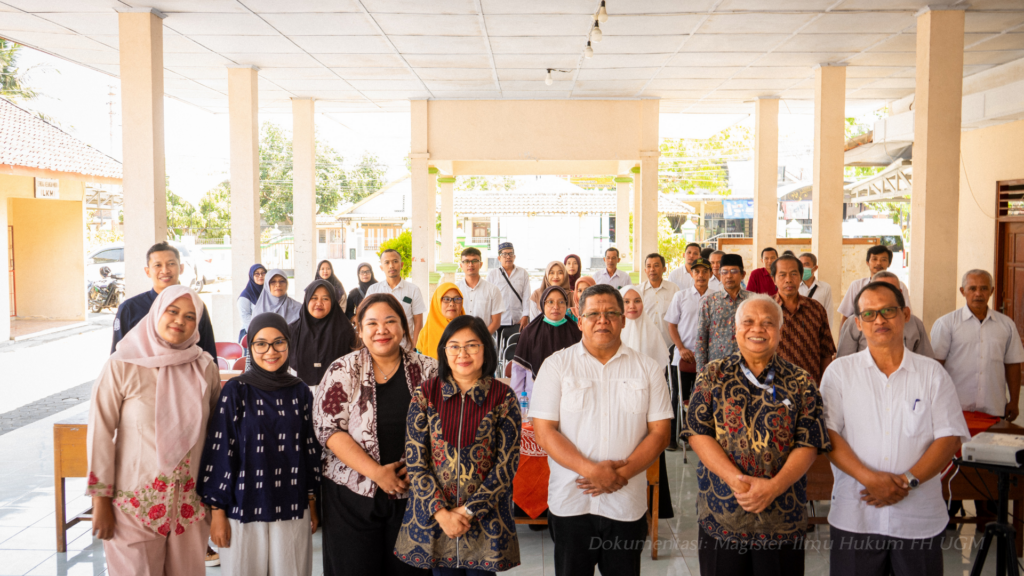
On Wednesday (16/9/2026), the Master of Laws Program (MIH) at the Faculty of Law, Universitas Gadjah Mada (FH UGM), held a legal outreach activity for the community and officials of Margosari Village, Pengasih District, Kulon Progo Regency, Special Region of Yogyakarta.
The activity, held offline from 09.00 to 12.30 WIB, forms part of the implementation of the university's threefold mission (tridharma), particularly community service. The legal outreach was organized as a means of giving the community a better understanding of various legal issues tied to everyday life.
The event opened with remarks from the MIH FH UGM Program and from the Margosari Village officials. It then continued with presentations by speakers with expertise in their respective fields. The program comprised three material sessions followed by a question-and-answer session with the community.
The first session covered cooperatives and the Red and White Village Cooperative (Koperasi Desa Merah Putih), delivered by Dr. Mahaarum Kusuma Pertiwi, S.H., M.A., M.Phil., Ph.D.
Her presentation explained the definition and basic principles of cooperatives, including voluntary and open membership, democratic management, fair distribution of the remaining business proceeds (SHU), limited returns on capital, and the principle of cooperative independence.
The session also discussed the importance of conducting feasibility analyses for cooperative business units. These cover market, technical, management, financial, legal, and social and environmental aspects. This discussion is relevant in giving the community a better understanding of the importance of governance and business management.
The next session was delivered by Dr. Sulastriyono, S.H., M.Si., covering land transactions and inheritance under customary law.
This session explained various forms of land transactions, including outright sale, pawn sale, annual sale, and transactions related to land use such as land leasing and profit-sharing. The presentation also covered the elements of inheritance: the deceased, the inherited estate, and the heirs.
Meanwhile, Nabiyla Risfa Izzati, S.H., LL.M. (Adv)., Ph.D., emphasized that the protection of migrant workers constitutes a state responsibility in guaranteeing the fundamental rights of citizens. She stressed the importance of understanding employment contracts, wage transparency, and the prohibition against withholding personal documents as essential components of legal protection. Eka Putri Endriana, S.H. delivered material on the types of land rights, ownership status and land evidence, mechanisms for transferring rights, and the process of land registration and transfer of title.
The material explained Right of Ownership (Hak Milik), Right to Cultivate (HGU), Right to Build (HGB), and Right of Use (Hak Pakai). The community also gained an understanding of the difference between registered and unregistered land, including the standing of documents such as Letter C, Girik, Petok D, and the Certificate of Physical Possession. It further explained the difference between a Sale and Purchase Binding Agreement (PPJB) and a Deed of Sale and Purchase (AJB), as well as the stages of the rights transfer process up to the issuance of the certificate.
The next session was delivered by Sekar Paramesti Justiciari, S.H., covering marriage law, marital property, divorce, inheritance law, and dispute resolution and legal services.
The discussion covered the foundations and requirements of marriage, provisions on unregistered marriage (nikah siri), interfaith marriage, polygamy, and mixed marriage. The community also received an explanation of the difference between joint property and inherited property, as well as the rules on marital separation agreements.
The final session was delivered by Prof. Herliana, S.H., M.Com.Law., Ph.D., on Alternative Dispute Resolution (APS). The material explained the difference between resolving disputes through litigation and through alternative dispute resolution outside the courts.
The community was introduced to several forms of APS: negotiation, mediation, and arbitration. Negotiation is carried out through direct communication between the parties to reach an agreement, while mediation involves a third party acting as a facilitator. The session also explained simple lawsuits, which can be used for cases of breach of contract or unlawful acts with a claim value of up to Rp500 million, as presented during the activity.
After all the material was delivered, the event continued with a question-and-answer session. The people of Margosari Village raised a number of legal issues directly tied to everyday life.
Questions included those on community status and data collection based on deciles, electronic land certificates, the status of children in marriage and divorce, the presence of newcomers in the village area, the rights of adopted children in inheritance, the standing of inherited property, land sale and purchase transactions and the tax object value (NJOP), the purchase of land for private road access, and problems with lost Letter C documents.
Beyond land and inheritance issues, the community also asked about the management and financing of the Village Cooperative, including responsibility, funding, and complaint mechanisms should problems arise in its implementation.
The MIH FH UGM legal outreach in Margosari Village is expected to give the community and village officials a better understanding of the law. Through this activity, the community can obtain information on legal provisions and gain an understanding of the various mechanisms available when facing legal problems.
The activity forms part of MIH FH UGM's contribution to carrying out the university's threefold mission, particularly in the aspect of community service, by providing legal education relevant to the problems the community faces.
Author: Master of Laws Program, Faculty of Law, Universitas Gadjah Mada