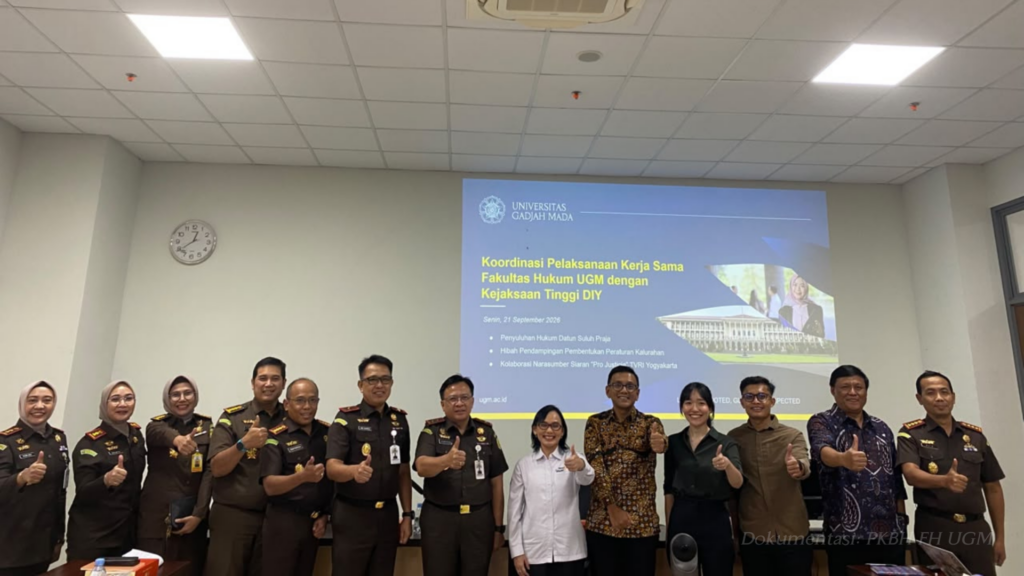
The Faculty of Law of Universitas Gadjah Mada (FH UGM), through the Legal Consultation and Aid Center (PKBH), in collaboration with the Yogyakarta Special Region High Prosecutor’s Office (Kejati DIY), held a Coordination Meeting on the Implementation of Collaborative Programs on Monday, 21 September 2026, at Room B.5.5, Faculty of Law UGM. The meeting formed part of efforts to strengthen the sustainability of the collaboration between FH UGM and Kejati DIY in the areas of community engagement, legal education, and assistance in addressing legal and social issues at the kalurahan level. The meeting was attended by Prof. Dr. Heribertus Jaka Triyana, S.H., LL.M., M.A., Vice Dean for Research, Community Engagement, and Information Systems of FH UGM; Prof. Adrianto Dwi Nugroho, S.H., Adv.LL.M., LL.D., Vice Dean for Academic Affairs, Student Affairs, and Cooperation; Virga Dwi Efendi, S.H., LL.M., Secretary of PKBH FH UGM; Florencia Irena Gunawan, S.H., LL.M.(Adv), Secretary of the Partnership and Development Unit (PDU) of FH UGM; Sri Kuncoro, S.H., M.Si., Head of the Yogyakarta Special Region High Prosecutor’s Office; Andi Suharlis, S.H., M.H., Deputy Head of the Yogyakarta Special Region High Prosecutor’s Office; as well as the Heads of District Prosecutor’s Offices across the Yogyakarta Special Region.
Prof. Dr. Heribertus Jaka Triyana, S.H., LL.M., M.A. stated that the collaboration with Kejati DIY has helped FH UGM improve the targeting of its legal education and community engagement activities. Dahliana Hasan, S.H., M.Tax., Ph.D. further noted that the collaboration is expected to be developed into a best practice model that can be shared through regional networks, including the ASEAN Social Justice Network. In line with this vision, Sri Kuncoro, S.H., M.Si. emphasized the importance of eliminating sectoral silos among law enforcement institutions by making integration a key principle in developing the collaboration.
This development is further directed through a multiple helix approach, which extends collaboration beyond universities and law enforcement institutions to involve a broader range of stakeholders from both the legal and non-legal sectors. In the legal sector, the collaboration encompasses legal education, assistance in drafting Kalurahan Regulations, and strengthening the resolution of legal issues through a restorative justice approach. Meanwhile, non-legal sectors are involved in addressing the social and economic factors underlying legal issues, including through coordination with local governments, kalurahan authorities, the Manpower Office, Vocational Training Centers, communities, and the business sector.
In addition, each District Prosecutor’s Office in the Yogyakarta Special Region raised a number of strategic issues that could be developed through collaborative programs, including strengthening rehabilitation governance, assistance in drafting Kalurahan Regulations, preventing violence and social issues within communities, managing village development and economic activities, as well as strengthening preventive efforts against youth violence and delinquency at the kalurahan level. These issues provide a basis for identifying pilot projects and forms of assistance that are better suited to the needs of communities in each respective area.
The implementation of the Coordination Meeting on the Collaborative Programs between FH UGM, Kejati DIY, and the District Prosecutor’s Offices across the Yogyakarta Special Region aligns with the objectives of the Sustainable Development Goals (SDGs), particularly SDG 4 on Quality Education, through efforts to strengthen the legal knowledge and capacity of communities through legal education and community engagement activities. The collaboration also supports SDG 16 on Peace, Justice, and Strong Institutions by strengthening legal awareness, access to justice, preventive measures, and legal and governance practices that are responsive to the needs of communities at the kalurahan level. Furthermore, the development of collaborative programs involving universities, law enforcement institutions, kalurahan governments, and other stakeholders reflects the spirit of SDG 17 on Partnerships for the Goals, particularly in establishing sustainable cross-sector partnerships to address various legal and social issues within communities. Through strengthened synergy, FH UGM, Kejati DIY, and the District Prosecutor’s Offices across the Yogyakarta Special Region are committed to developing community engagement initiatives that can respond to social issues in a sustainable manner. This collaboration also forms part of the implementation of the Tri Dharma of Higher Education, particularly in ensuring that university contributions have a direct and meaningful impact on communities while promoting more collaborative legal and governance practices in the Yogyakarta Special Region.
Author: Rysma Nathania (PKBH FH UGM)