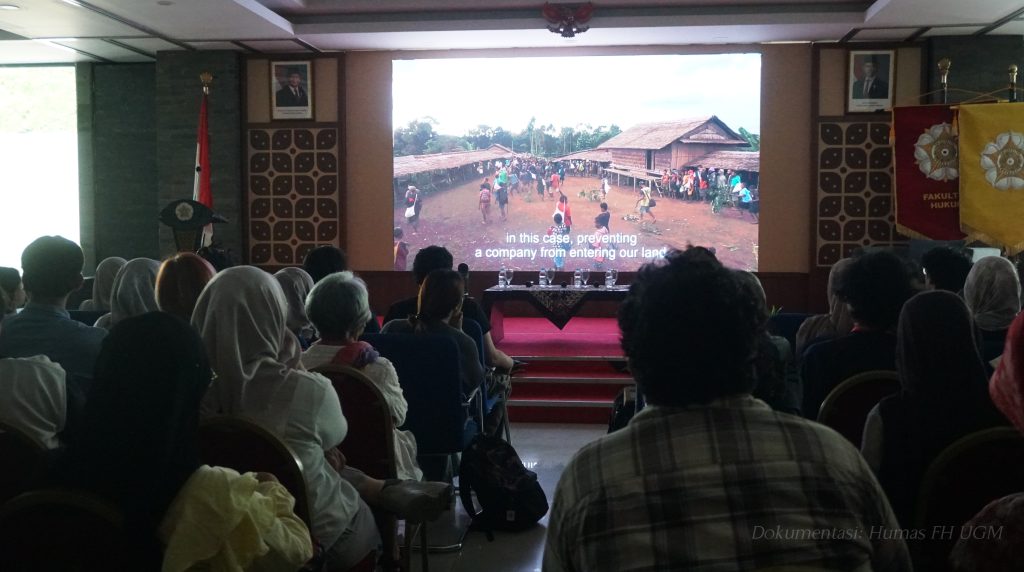
The Djojodigoeno Center for Customary Law Studies, in collaboration with the Center for Restoration and Regeneration Studies (CERRES), the Center for Law and Social Justice Studies (LSJ), and Dema Justicia, organized a public screening and discussion entitled “Pesta Babi: Colonialism in Our Time” on Wednesday, 13 May 2026, at 2:00 PM WIB in the Auditorium of Building B, Faculty of Law, Universitas Gadjah Mada (UGM)
The event attracted significant enthusiasm, with more than 250 participants attending, including students, academics, and members of the public. The program began with opening remarks from the Master of Ceremony, followed by a welcoming address delivered by the Vice Dean for Research, Community Service, and Information Systems of the Faculty of Law UGM, Heribertus Jaka Triyana. In his remarks, he expressed appreciation for the organization of the event and warmly welcomed all attendees before inviting the audience to proceed directly to the film screening.
The film screening lasted approximately 90 minutes and concluded with enthusiastic applause from the audience. Following the screening, the event continued with a public discussion moderated by Laksmi A. Savitri. The discussion featured speakers from diverse academic and social backgrounds who offered various perspectives on the issues raised in the film.
The first speaker, Michella Gitanova, a student at the Faculty of Law UGM representing DEMA Justicia, emphasized the importance of increasing awareness of humanitarian issues among Generation Z. She noted that although violence and injustice occur continuously in society, such conditions should never be normalized. She also highlighted the importance of utilizing the privileges of younger generations, particularly access to the internet and digital media, as tools for advocacy, information dissemination, and strengthening solidarity on humanitarian issues.
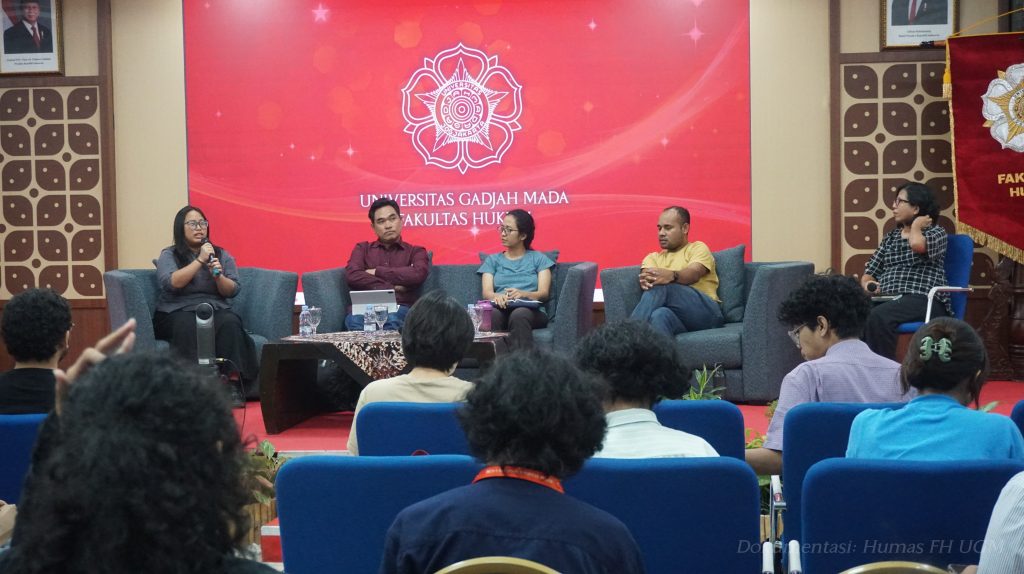
The second speaker, IGAM Wardana, a lecturer in Environmental Law at the Faculty of Law UGM, explained that the film illustrated the phenomenon of legalized deforestation. According to him, such practices contradict the government’s Net Zero Emission (NZE) targets. He argued that current food and energy self-sufficiency programs tend to benefit certain groups rather than genuinely addressing environmental and food crises. Furthermore, he stressed that law alone cannot resolve environmental destruction and the oppression of communities if legal systems remain primarily oriented toward economic interests.
The third speaker, Sartika I. Pardani, a lecturer in Customary Law at the Faculty of Law UGM, highlighted that Pesta Babi demonstrated the existing gap between legal norms and their implementation in society. She explained that law should not merely be understood as written regulations but also as lived experiences within communities. The film, according to her, portrays how community experiences themselves constitute a form of law capable of demanding that the government fulfill its obligations to provide justice for society.
The final speaker, Ferinando S. Yokit, a literacy activist from Simpul Papua and a member of an Indigenous Papuan community, urged participants to uphold justice in both thought and action. He emphasized that Papuan communities require solidarity from broader Indonesian society to resist ecological and cultural colonization. In addition, he offered a critical reflection on the phrase “Pesta Babi” used as the film’s title, explaining that the term does not fully and accurately represent the Indigenous Papuan rituals portrayed in the film.
Several audience members also actively participated in the discussion session by sharing their reflections on Pesta Babi: Colonialism in Our Time. One participant, Dori, a member of Generation Z, shared the experience of a friend who felt powerless in the face of ongoing human rights violations against Papuan communities. According to Dori, such feelings emerged from a deep sense of hopelessness regarding the possibility of meaningful change in the country.
Through this public screening and discussion, the Faculty of Law UGM seeks to contribute academically while strengthening dialogue between legal norms and social realities, particularly concerning state-led food and energy self-sufficiency programs. The event also supports several Sustainable Development Goals (SDGs), including SDG 10 (Reduced Inequalities) through the protection of Indigenous communities from policies that conflict with Indigenous rights; SDG 15 (Life on Land) through advocacy for the protection of Indigenous living spaces and customary territories; and SDG 16 (Peace, Justice, and Strong Institutions) by promoting access to justice through advocacy grounded in empirical realities. Furthermore, the collaborative discussion involving academics, researchers, students, and the public reflected the spirit of SDG 17 (Partnerships for the Goals).
Writer: Eka Putri Endriana