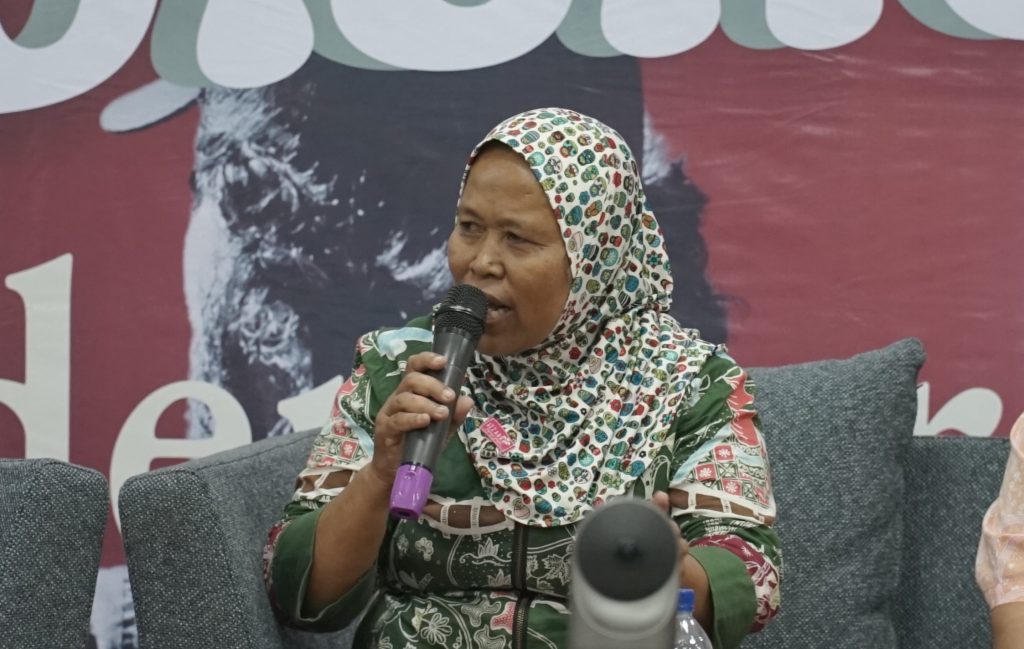
The UGM Faculty of Law, through the Center for Law and Social Justice (LSJ), held the second installment of the book discussion series “Hearing the Voices of Victims” on Thursday (September 21, 2023). On this occasion, the LSJ had the opportunity to collaborate with the UGM Student Executive Board (BEM KM), DEMA Justicia, and the Forestry Student Association (LEM Kehutanan). The event, held at the UGM Faculty of Law Auditorium, aimed to foster empathy for those whose rights have been denied and to broaden perspectives on justice and human rights within the realm of education. This aligns with Sustainable Development Goal (SDG) 4—quality education—and SDG 16—peace, justice, and strong institutions.
The book discussed in this series is titled “Small Notes from a Small Person for a Small Person,” written by Kawit. Kawit himself is one of the victims of the eviction that took place in the Parangkusumo area. In addition to Kawit, this discussion featured three other speakers: Rikardo Simarmata from the Djojodigoeno Center for Customary Law Studies at the Faculty of Law, UGM; Eko Teguh Paripurno from the Center for Disaster Research and Mitigation at UPNVYK; and Stevanus Hizkia, Chair of DEMA Justicia.
In this discussion, the focus is on the pros and cons of land ownership by the Royal Palace, particularly in Yogyakarta. This is a long-standing issue that has been reignited by the evictions in the Parangkusumo area.
“As far as I recall, there have been six evictions in Parangtritis… starting in 2007. They’ve used various terms to avoid making it sound like an eviction. There’s ‘evacuation,’ ‘reorganization,’ ‘restructuring,’ and ‘enforcement.’ If any residents refuse, they’re labeled as not wanting to be ‘reorganized.’ This means residents defending their rights are equated with people who don’t want to be ‘reorganized’ or ‘regulated.’” Kawit shared his account of the evictions. “Hundreds of homes have been demolished since 2007, and many residents still haven’t been provided with alternative housing,” Kawit continued during the discussion.
Eko Teguh opined, “It is the government’s obligation to reorganize the area, ensuring that residents are provided with alternative housing.” The discussion concluded that the pros and cons regarding the sultanate’s land have always existed and no common ground has yet been reached; the solution simply requires correction. Land ownership disputes can only be resolved through mutual respect between the community and the palace.
We must collectively recognize that land rights, when fully controlled by those other than the people, are part of deeply rooted feudal practices. What good is the economy if the people themselves are dying? Efforts to develop tourism should respect residents’ socioeconomic rights and preserve the community’s traditional knowledge regarding access to coastal resources. Socioeconomic sustainability is expected to bring about intergenerational justice for future generations.
Author: LSJ
Editor: Public Relations