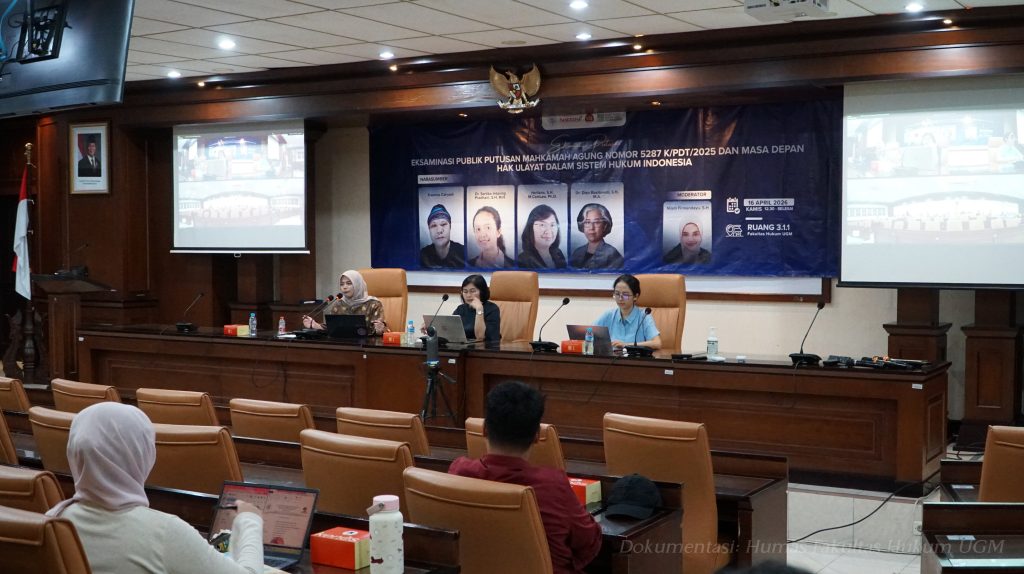
The Djojodigoeno Centre for Adat Law Studies, in collaboration with the Centre for Democracy, Constitutional Law, and Human Rights (PANDEKHA) and the Centre for Law and Social Justice (LSJ), held a Public Judicial Examination (Eksaminasi Putusan) titled "Public Examination of Supreme Court Decision No. 5287 K/Pdt/2025 and the Future of Communal Land Rights (Hak Ulayat) in the Indonesian Legal System". The event was held on Thursday, April 16, 2026, in Room 3.1.1 of the Faculty of Law, Universitas Gadjah Mada. It was a follow-up to the preparation of a Decision Annotation Paper titled "Annotation of a Decision Beyond Formal Legal Recognition: Supreme Court Decision No. 5287 K/Pdt/2025 on Communal Land and the Existence of Customary Law Communities".
The event was opened with remarks from Prof. Dr. Heribertus Jaka Triyana, S.H., LL.M., M.A., Vice Dean for Research, Community Service, and Information Systems at the UGM Faculty of Law. He expressed the hope that the public examination would open new perspectives and opportunities for the protection of the rights of customary law communities (masyarakat hukum adat) and communal land, through an interdisciplinary approach.
The examination featured a number of examiners from diverse institutions and academic disciplines. The first examiner, Herliana, S.H., M.Com.Law., Ph.D., a lecturer in civil law at FH UGM, critically examined questions of class action standing and the standard of proof in civil law. She identified an inconsistency in the application of the class action mechanism, noting that the panel of judges had applied the class action framework on an individual rather than collective basis. She further noted a shift in the Supreme Court's civil evidentiary standard - from formal evidence to empirical evidence.
The next examiner, Dr. Sartika Intaning Pradhani, S.H., M.H., a lecturer in customary law at FH UGM, addressed the question of the existence of customary law communities and communal rights. She identified two key criteria used in Supreme Court Decision No. 5287 K/Pdt/2025 to determine the existence of customary law: that customary law is rooted in established practice, and that it constitutes unwritten law. She noted that the Court assessed the existence of customary law communities not merely through a formal legal lens, but on the basis of empirical reality.
Researcher at the Institute for Judicial Independence Studies (Lembaga Kajian & Advokasi Independensi Peradilan), Dr. Dian Rositawati, S.H., M.A., affirmed that the Court's interpretation was not contrary to law -- it was, in fact, precisely the application of law as an instrument for protecting a vulnerable group: the customary law community. She did, however, offer a critical note: the award of compensation to customary law communities does not automatically restore the living spaces that have been appropriated by corporations.
The final examiner, Erasmus Cahyadi, representing the National Alliance of Indigenous Peoples (Aliansi Masyarakat Adat Nasional), affirmed that the proof of a customary law community's existence should not be filtered solely through a formal legal lens, but should also draw on historical and empirical approaches -- as was precisely the method applied by the Court in this decision.
Decision Annotation Paper: ugm.id/PaperAnotasiPutusanSukuAnakDalam
Paper Anotasi Putusan: ugm.id/PaperAnotasiPutusanSukuAnakDalam
Authors: Eka Putri Endriana and Ursula Lara Pagitta (Djojodigoeno Centre for Adat Law Studies)