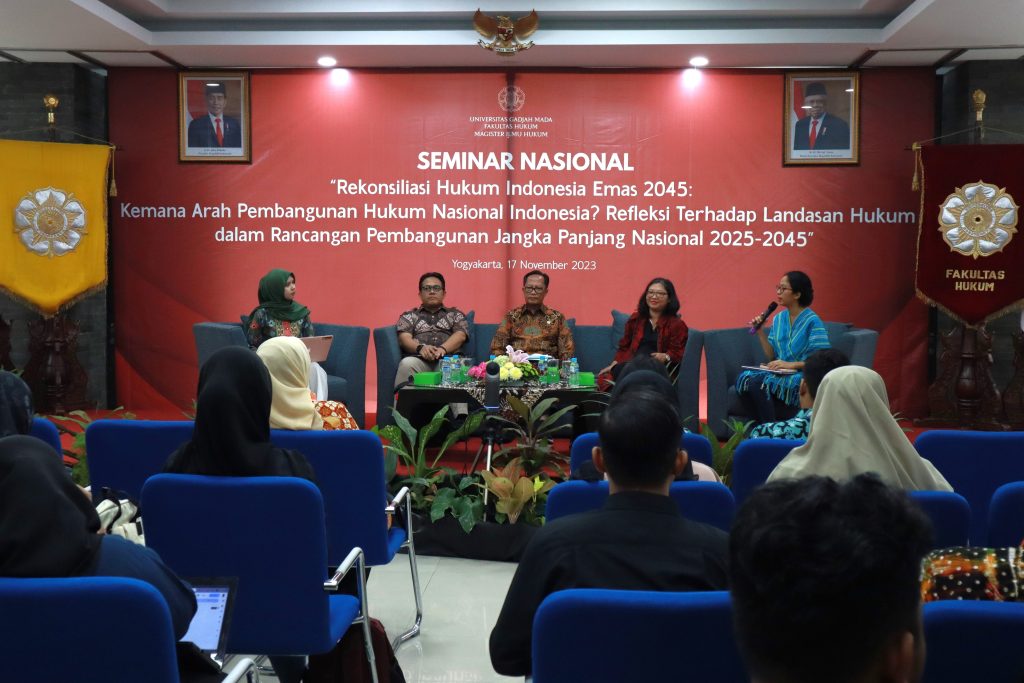
The Master’s Program in Legal Studies held a national seminar reflecting on national legal development on Friday (November 17, 2023). The seminar, held at the Auditorium of the Faculty of Law UGM, was titled “Reconciliation of Indonesian Law in 2045: What is the Direction of National Legal Development in Indonesia? Reflection on Legal Foundations in the National Long-Term Development Plan 2025—2045.” Three speakers were present at the seminar: Dr. Sugeng Purnomo, S.H., M.H., R.M. Dewo Broto Joko P., S.H., LL.M., and Sri Wiyanti Eddyono, S.H., LL.M.(HR)., Ph.D.
As the first speaker, Sugeng Purnomo, the Chairman of the Law Reform Acceleration Team, discussed the legal acceleration team established according to the Coordinating Minister for Political, Legal, and Security Affairs Decree No. 63/2023. This team comprises government officials, academics, practitioners, and community leaders divided into four working groups based on their expertise. The four working groups are focused on judicial and law enforcement, agrarian and natural resource sectors, prevention and eradication of corruption, and legislative affairs.
“What is produced? Short and medium-term recommendations according to the tasks of the ministries,” Sugeng Purnomo stated. He elaborated on the issues raised by each working group. Working Group 1 pertains to human resources that must begin with good recruitment. Strengthening Law Enforcement Officers (APH) also needs to be carried out. In Working Group 2, 60% of public complaints reported to the Ministry of Political, Legal, and Security Affairs are related to agrarian issues and mining. In Working Group 3, discussions on asset confiscation had not been conducted since May. Finally, Working Group 4 focuses on legislation, emphasizing the importance of openness regarding public participation so that the public has broader opportunities.
The discussion continued with R.M. Dewo Broto Joko P., S.H., LL.M., the Director of Law and Regulation at the National Development Planning Agency (Bappenas). “The National Long-Term Development Plan (RPJPN) and the National Medium-Term Development Plan (RPJMN) 2025-2029 in the field of law and regulation are drafted based on input from the community and inclusive academics,” Dewo Broto explained. Bappenas strives to accommodate the law reform acceleration team, which can then be followed up in more detail with specific outputs and recommended actions.
Following research into the recommendations, several proposals were incorporated into the RPJPN and RPJMN. The Bappenas Minister is tasked with discussing the RPJPN and RPJMN with the House of Representatives. It is hoped the RPJPN can be ratified before the House's term ends and implemented by the elected president. However, discussions are still ongoing as they await input from stakeholders.
“The RPJPN envisions a Golden Indonesia, with the hope that by 2045 it will be a nation established in the Nusantara IKN, advanced, sovereign, just, and prosperous. It will also have political, economic, and cultural superiority and become a cultural-maritime axis of the world,” Dewo Broto continued. To realize the vision of a Golden Indonesia, the RPJPN framework serves as a grand strategy based on Pancasila. This is also based on the vision of a free, sovereign, just, and prosperous Indonesia, considering both external and internal factors in accordance with the 1945 Constitution, leading to five target visions for a free Indonesia.
According to Sri Wiyanti Eddyono, S.H., LL.M.(HR)., Ph.D., a lecturer at the Faculty of Law UGM and the third speaker, technocratic documents are not commonly read and are not easy to digest. However, through discussions and dialogues, they can be reviewed from the perspective of academics who often deal with cases and direct handling that cannot be separated from many aspects. In real life, what is presented in technocratic documents is far removed from society, such as how the law can be purchased. If one does not have a position, justice cannot be attained.
“Real legal problems include weaknesses in law enforcement, such as corruption and money laundering issues, while domestic violence occurs every day. For example, there are cases where victims have reported but their cases are not processed, leading to fatalities. Handling domestic violence cases is not taken seriously and is considered a burden by law enforcement officers. The number of hidden crimes is extraordinarily high,” Sri Wiyanti stated.
In addition to domestic violence cases, cases involving migrant workers who are victims of human trafficking or cyber cases are significant but receive insufficient attention, according to academics. These cases are often overlooked due to the absence of legal documents or instruments.
“Sexual violence is already addressed by law and the new Criminal Code, but its implementation still applies restorative justice practices that are unlikely to restore victims. Bappenas's legal documents only strengthen the criminal justice system to ensure the legal system functions. Assistance rights exist under the TPKS Law, but its implementation is also limited, providing help only to the poor. The lack of adequate accommodations for disabilities makes processing cases very challenging, as services are not yet ready, and this issue has not yet been discussed in the RPJMN 2025-2029. Meanwhile, inclusion is a crucial issue for all Indonesian society,” Sri Wiyanti added.