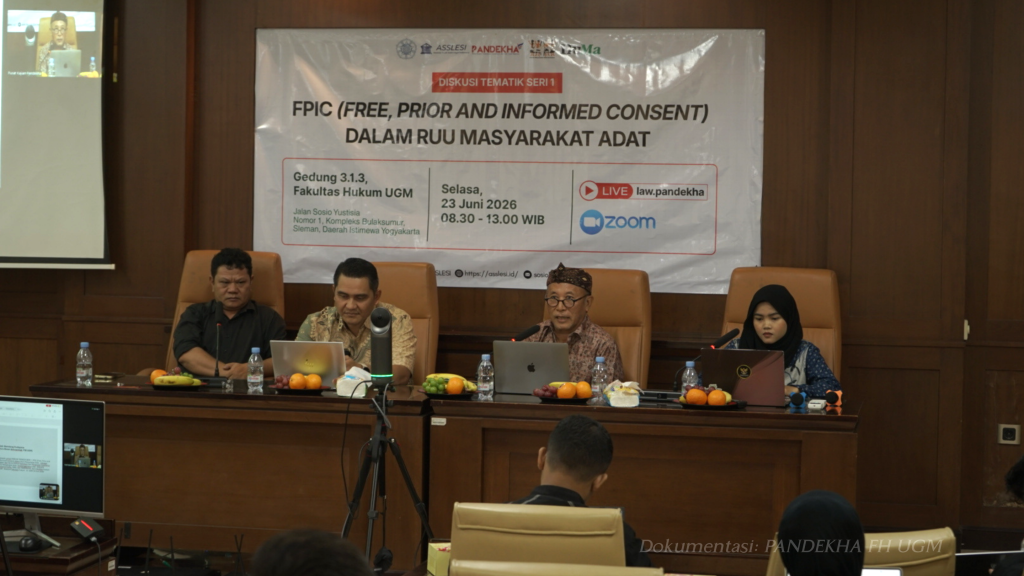
The Center for Democracy, Constitution, and Human Rights Studies (Pandekha) of the Faculty of Law, Universitas Gadjah Mada (UGM), together with the Indonesian Association of Socio-Legal Studies (ASSLESI), the Indigenous Peoples Alliance of the Archipelago (AMAN), and the Indonesian Association for Community and Ecological-Based Law Reform (HuMa), organized a public discussion themed Strengthening the Free, Prior, and Informed Consent (FPIC) Principle in the Improvement of the Draft Indigenous Peoples Bill. The discussion examined the gap between constitutional recognition of indigenous peoples and their involvement in national development processes, including projects categorized as National Strategic Projects (PSN). The activity was held on Tuesday (23/06/2026) at the Faculty of Law UGM and served as the first series of a discussion program planned to be conducted at several universities as material for preparing a policy brief to be submitted to the House of Representatives (DPR).
The discussion featured several speakers, namely Dr. Yance Arizona, S.H., M.H., M.A., Head of Pandekha FH UGM and Presidium Member of ASSLESI; Prof. Dr. Bambang Hudayana, M.A., Lecturer of Anthropology at the Faculty of Cultural Sciences (FIB) UGM; Dr. Bernadinus Steni, S.H., M.H., Member of HuMa; and Erasmus Cahyadi, S.H., Deputy for Politics and Law at AMAN. The discussion was moderated by Rismawati Nur, S.H., from Pandekha FH UGM and opened with an introduction by Muhammad Arman, Director of Policy, Law, and Human Rights Advocacy at AMAN.
The first speaker, Dr. Yance Arizona, S.H., M.H., explained in his presentation that FPIC is a mechanism that guarantees indigenous peoples the right to receive complete information and the opportunity to determine their involvement in development plans within their customary territories, including the right to approve or reject such plans. According to him, this concept initially developed in the medical field through the practice of informed consent between doctors and patients before medical procedures were carried out.
The speakers explained that the urgency of FPIC is not merely limited to an administrative approval process but also includes the protection of traditional rights, mitigation of potential agrarian conflicts, development accountability, prevention of dispossession of living spaces, balancing power relations between indigenous communities and capital owners, and compliance with national and international legal standards. Historically, international regulations related to FPIC have developed through ILO Convention No. 169 of 1989, the United Nations Declaration on the Rights of Indigenous Peoples (UNDRIP) of 2007, the Convention on Biological Diversity (CBD) of 1992, and the Nagoya Protocol. Among these four instruments, ILO Convention No. 169 has not yet been ratified by Indonesia, while UNDRIP is supported by Indonesia as a political declaration without a formal ratification mechanism. Meanwhile, CBD was ratified through Law No. 5 of 1994, and the Nagoya Protocol was ratified through Law No. 11 of 2013. In addition, several business and financial standards, such as the Roundtable on Sustainable Palm Oil (RSPO), Forest Stewardship Council (FSC) principles, and social safeguard policies of the World Bank and Asian Development Bank, also serve as references in FPIC practices within the private sector.
Dr. Yance Arizona, S.H., M.H., emphasized that although the 1945 Constitution of the Republic of Indonesia does not explicitly regulate FPIC, its principles are reflected in several articles, including Article 28G paragraph (1) concerning the right to protection from threats, Article 28F concerning the right to information, Article 28H concerning the right to a healthy environment and property rights, Article 1 paragraph (2) concerning popular sovereignty, and Article 28C paragraph (2) concerning the right to collectively advocate for interests. At the statutory level, Law No. 2 of 2012 on Land Acquisition only regulates consultation mechanisms for determining compensation, which he argued cannot yet be categorized as FPIC because it is not based on absolute consent and is only focused on compensation amounts. The same issue was identified in the DPR’s draft version of the Indigenous Peoples Bill, which is considered to position indigenous peoples’ participation merely as a consultation process without providing room for rejection, while also failing to integrate FPIC into licensing processes, guarantee representation of vulnerable groups, or establish an independent institution to verify and supervise FPIC implementation.
Dr. Bernadinus Steni, S.H., M.H., added that FPIC implementation in practice faces technical challenges due to differences in the characteristics of resources, for example between land and forests and resources such as water, lakes, and cross-regency groundwater basins involving claims from communities across regions. In projects such as ecosystem restoration and mining, the consent process needs to be conducted iteratively and in stages, rather than only once, considering that the impacts of an activity may extend beyond the administrative boundaries of a village or regency. He emphasized the importance of establishing district-level institutions to facilitate grievance mechanisms, strengthening indigenous communities’ capacity to negotiate and understand information, developing legal frameworks that support recognition of land rights and participation, and ensuring adequate funding for institutional strengthening.
Meanwhile, Prof. Dr. Bambang Hudayana, M.A., explained from an anthropological perspective that the state often views customary law communities uniformly, even though they are culturally diverse and their traditional leadership structures have strong connections with their communities. He identified three types of relationships between indigenous governance systems and the state: indigenous communities that function entirely as self-governing communities, a combination of self-governing communities and village governments, and village governments with dominant state control over customary institutions. According to him, the first type provides the greatest possibility for implementing FPIC fully, although representative indigenous organizations are still needed to ensure that decision-making processes are not controlled by local elites vulnerable to influence from government or corporate interests.
Erasmus Cahyadi, S.H., concluded the discussion by emphasizing that the most fundamental principles of FPIC are non-discrimination and respect for indigenous peoples’ right to self-determination. He highlighted that FPIC implementation is not merely a veto right but the result of meaningful consultation and continuous dialogue, including opportunities for renegotiation when necessary. He also noted that Indonesian law has not fully adopted indigenous peoples’ right to FPIC, resulting in government and business actors often consulting with customary institutions established by local governments since the 1970s, which may not necessarily represent the actual interests of indigenous communities.
The discussion also included an interactive question-and-answer session between participants and speakers, deepening discussions on various aspects of FPIC implementation within the context of Indonesian law and practice. The speakers recommended that the Indigenous Peoples Bill explicitly and definitively adopt FPIC norms, integrate them into licensing and spatial planning systems, guarantee representation of vulnerable groups, establish independent mediation mechanisms involving the National Human Rights Commission (Komnas HAM), and provide effective complaint mechanisms by referring to lessons from the Philippines’ Indigenous Peoples Rights Act (IPRA) of 1997.
This discussion is expected to enrich the substance of the ongoing deliberation of the Indigenous Peoples Bill at the DPR while encouraging the creation of regulations that are more responsive to indigenous peoples’ rights. The forum also served as a collaboration platform between academics, students, civil society organizations, and indigenous peoples’ networks in promoting natural resource governance that is more participatory, transparent, and respectful of human rights.
The implementation of this public discussion also supports the achievement of Sustainable Development Goals (SDGs), particularly SDG 16 on Peace, Justice, and Strong Institutions, which emphasizes recognition of indigenous peoples’ rights, including the right to self-determination and meaningful participation in decision-making as important elements of inclusive and accountable institutions. This discussion is also relevant to SDG 10 on Reduced Inequalities, which highlights reducing inequality through recognition, security of land rights, and equal representation of indigenous peoples within state governance structures.
Author: Muhammad Imam Maulana (PANDEKHA)