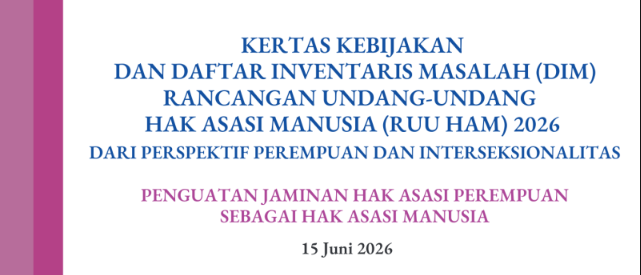
The writing team of the Law, Gender and Society Studies Center at the Faculty of Law, Universitas Gadjah Mada (LGS FH UGM) has completed a policy paper on the Draft Law on Human Rights currently being prepared by the Ministry of Human Rights. The 228-page document contains an academic study as well as a Problem Inventory List (DIM) on the Ministry of Human Rights' version of the Human Rights Bill, and was completed as of 1 July 2026. The writing team consists of Sri Wiyanti Eddyono, Afifah Nur Hidayati, and Nasywa Intan Ramadhanty.
The policy paper was prepared as a foundational study for the National Commission on Violence against Women (Komnas Perempuan) in responding to the Human Rights Bill. Komnas Perempuan facilitated consultation forums with its network and stakeholders and provided funding support, but as emphasized in the document's disclaimer, the contents of the writing are the academic responsibility of its authors. The study was conducted from March to June 2026 through literature review, review of laws and regulations, review of Komnas Perempuan's internal policies, and focus group discussions with retired Commissioners of Komnas Perempuan, Komnas HAM, the National Commission on Disability, the National Commission for Child Protection, and the Women's Network.
The study departs from the assessment that the revision of Law No. 39 of 1999 on Human Rights opens a policy window to reform the regulation of women's rights, which has so far been partial and lagging behind international standards. The current law is considered to place women primarily within marital relations and reproductive functions, without a definition of discrimination against women aligned with Article 1 of CEDAW, without a framework for temporary special measures, and without recognition of gender-based violence as a form of human rights violation. Although the Ministry of Human Rights claims the revision contains fundamental changes to the protection of human rights defenders and the institutional framework of Komnas HAM, according to this study the issue of women's rights does not yet appear to be a main focus.
The urgency is illustrated by the data. Throughout 2025, the number of cases of gender-based violence against women was recorded at 376,529, an increase of 14.07 percent compared to 330,097 cases in 2024. The study also affirms that human rights violations against women are not limited to violence, but include discrimination in the fulfillment of reproductive and sexual rights, wage gaps, weak political representation, and the non-recognition of care work.
To test the quality of regulation, the writing team compared the Human Rights Bill with three models in other countries: the Magna Carta of Women of the Philippines, South Africa's PEPUDA, and South Korea's Framework Act on Gender Equality. All three contain an explicit definition of discrimination against women aligned with Article 1 of CEDAW. By contrast, both Law No. 39 of 1999 and the draft Human Rights Bill are still considered general or gender-neutral. The study concludes that effective regulation of women's rights requires a combination of four elements: a well-targeted definition, explicit and sectoral recognition of rights, operational acceleration instruments, and an adequate institutional system and not one of the four is adequately present in either document.
On the aspect of intersectionality, the study highlights the experiences of indigenous women facing layered discrimination due to both gender identity and status as indigenous peoples. Komnas Perempuan's documentation throughout 2024 recorded nine groups of indigenous women who experienced gender-based violence, spread from Maluku, Bali, West Sumatra, Lampung, North Sumatra, East Nusa Tenggara, South Papua, Central Kalimantan, to the Riau Islands. Most occurred in the context of natural resource conflicts as well as agrarian and spatial conflicts, and some were in national strategic project areas. The study also notes the obstacles faced by indigenous women in registering marriages because regulations have not accommodated the diversity of belief communities.
Women Human Rights Defenders (WHRDs) receive particular attention. Komnas Perempuan data for 2023 and 2024 shows that violence experienced by WHRDs is dominated by psychological forms, such as threats, intimidation, and criminalization. The perpetrators cut across sectors, from corporations, police, the military, government, community organizations, to the closest relations such as husbands. The issues they defend include natural resource conflicts, agrarian conflicts, sexual violence, gender identity diversity, HIV and AIDS, and evictions. This pattern, according to the study, indicates efforts at silencing that take place not only in the public sphere but also in the private realm.
The sharpest finding concerns institutional design. The study compares the authority of four national human rights institutions in the Human Rights Bill and finds a wide gap. Komnas HAM is regulated in 25 articles and is the only institution with the authority to investigate and conduct inquiries, issue forced summons, form ad hoc teams, submit amicus curiae briefs, and issue binding recommendations. Meanwhile, Komnas Perempuan and KPAI are each regulated in only four articles, and the National Commission on Disability in three articles, with functions that are promotive and advisory in nature. The most substantive matters for these three institutions working procedures, financing, and membership criteria are delegated back to Presidential Regulations, so that the independence promised by the foundation of the law is considered to become partial in practice.
Differences in nomenclature are also questioned. The Human Rights Bill refers to Komnas HAM as an Independent State Institution, while Komnas Perempuan, KPAI, and KND are referred to only as Independent Institutions. According to the study, this distinction has the potential to obscure the position of the three institutions as part of the organization of the state in the field of human rights. Nevertheless, the study acknowledges one important development: for the first time, Komnas Perempuan will obtain a direct regulatory basis in a national human rights law, after having so far relied only on a Presidential Regulation.
The policy paper closes with twelve recommendations. Among them: the Human Rights Bill needs to contain a definition of discrimination against women aligned with Article 1 of CEDAW, including layered discrimination; place women as subjects of rights in their own right and not merely absorbed into the cluster of vulnerable groups; adopt a temporary special measures clause; recognize gender-based violence as both a form of discrimination and a human rights violation; affirm the principle of state due diligence over violations by non-state actors; integrate a gender perspective into the regulation of human rights defenders; and provide integrative references to the Domestic Violence Law, the Anti-Trafficking Law, and the Sexual Violence Law so that the Human Rights Law as an umbrella is not narrower than the laws it shelters. The last four recommendations focus on affirming the status and strengthening the authority of Komnas Perempuan in accordance with the Paris Principles.
In addition to the academic study, this document contains a DIM on the Ministry of Human Rights' version of the Human Rights Bill, occupying more than half of its pages, containing proposed changes to article-by-article formulations.
The policy paper can be downloaded at di sini.
Author: Zamrotul Miftakhus Laili