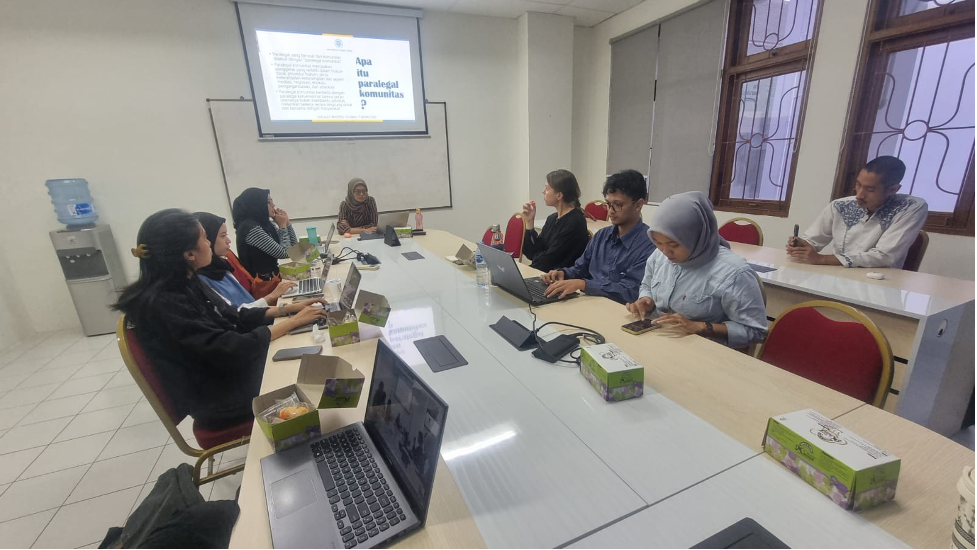
The Study Center for Law, Gender & Society (LGS) Faculty of Law UGM held a Sharing Session Volume 2 with the theme “PEKKA Community Paralegal Role in Improving Women Access to Justice”on Friday (28/06/2024). This activity aimed to present the LGS research result with Foundation for the Empowerment of Women Heads of Households (Yayasan Pemberdayaan Perempuan Kepala Keluarga) (PEKKA) in identifying Paralegal Community role in improving women access to justice. The field research was conducted in 3 provinces, those are North Sumatra, West Java, and West Nusa Tenggara. The data was collected through the Focus Group Discussion (FGD), deep interview,, and observation with involving 55 Paralegal communities, 45 communities have been assisted, 67 participants from government agencies, and 5 non-government partners.
Both Researcher Annisa Ayuningtyas S.H., LL.M. and Khoirunissa Sri Yudyaningrum, S.H. are pointed as the discussion starter as well in this event. The moderator for this event itself was the LGS researcher, Arimbi Fajari Furqon, S.H.
This event was opened with the presentation from Annisa Ayuningtyas regarding the conceptual framework and the Paralegal Community position in Indonesian legal framework. According to the research, the Community itself has not yet been well recognized in the existing laws and regulations. The Paralegal Community role is recognized in the regulation, but not on the several context such as becoming an assistance for the domestic violence victims, human trafficking victims, sexual violence victims, and as the assistance for woman facing the law as well. According to the role, the Paralegal Community also known with their policy as the “Village Paralegal” for the “Desa Sadar Hukum” (Legally Aware Village) program that was aimed to improve the knowledge in terms of legal awareness and non-litigation dispute settlement. Furthermore, in terms of providing legal aid and legal services, the Legal Aid Law and the regulations under it only cover Community Paralegals in a limited way, namely Community Paralegals who are members of Legal Aid Providers.
In reality, based on the research, the Paralegal Community is having a different form of organization and more comprehensive role for the public. Since 2005, PEKKA Foundation has actively improved the Community Paralegal in legal empowerment program. Until the mid year of 2022, there are 620 Paralegal Communities that spread in 54 districts/cities. Khoirunnissa explained that Paralegal Community have a variety of profiles in terms of marriage, occupation, and level of education status. They are also participating in various roles, such as legal consultation, legal and psychological assistance for the victims, advocacy, community organizing,socialization and education. These roles are carried out according to the needs of the local community and the capabilities of the Community Paralegals in their respective areas. The assistance provided is quite diverse, but the most dominant is assistance in processing population administration documents and assisting victims of domestic violence. In carrying out their roles, Community Paralegals face several challenges in efforts to improve women's access to justice, including inadequate operational support, a lack of recognition of the existence of Community Paralegals, relationships with the government that are still not participatory and accommodating, limited knowledge of the Community Paralegals in the legal field, and minimal recording and documentation of cases.
LGS then provided several recommendations for the development of the Community Paralegal program, including increasing the intensity of training to build capacity and serve as a means for evaluation and monitoring. LGS also advocated for legislation that recognizes and protects Community Paralegals when assisting victims and women in conflict with the law. This research is expected to provide an understanding of the crucial role of Community Paralegals in improving women's access to justice.hus fostering stronger recognition for Community Paralegals. Recognition, protection, and development of Community Paralegals are a key component of fulfilling the UN Sustainable Development Goalsspecifically SDG 16 on peace, justice, and strong institutions, and SDG 5 on gender equality.
LGS expressed its gratitude to the PEKKA Foundation, Community Paralegals, the government, and other parties who participated in this research. LGS is committed to continuing to participate in efforts to empower and protect Community Paralegals to achieve women's access to justice..
Writer : Arimbi Fajari Furqon