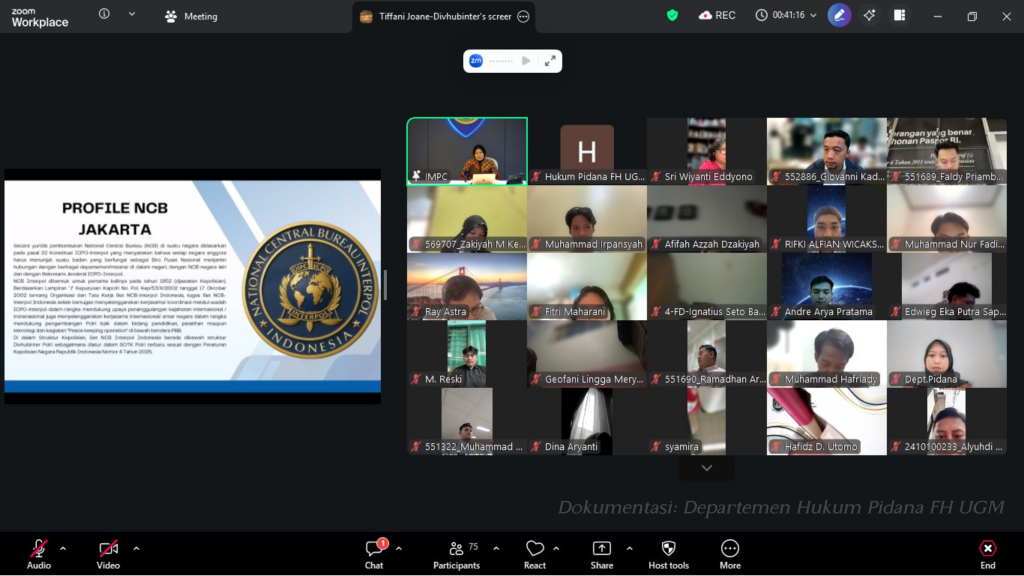
The Faculty of Law at Universitas Gadjah Mada (FH UGM), in collaboration with NCB Interpol Indonesia, hosted a guest lecture titled "Investigation and Prosecution of Transnational Crime Involving the Jurisdiction of Other States" on Friday, May 22, 2026. The event served as an important forum for discussion on the escalating and increasingly complex threat posed by transnational crime, which by its very nature crosses state jurisdictions.
In his presentation, Inspector General Amur Chandra Juli Buana, S.H., M.H., Head of the International Relations Division (Kadiv Hubinter) of the Indonesian National Police, represented by Commissioner Retno Prihawati, S.Sos., S.I.K., M.H., Ph.D., NCB Interpol Jakarta Adjutant at the International Relations Division of Polri, emphasized that advances in digital technology, the mobility of people, and economic globalization have been the primary drivers behind the surge in various forms of cross-border crime -- including human trafficking (Tindak Pidana Perdagangan Orang/TPPO), online scam operations, money laundering, narcotics trafficking, and cybercrime. Addressing these offenses cannot be achieved unilaterally by any single state; it requires rapid and effective international coordination through cooperation among global law enforcement agencies.
The guest lecture also drew attention to the high rate of Indonesian nationals implicated in online scam operations across Southeast Asia. Based on data presented during the session, more than 20,000 cases of Indonesian citizens in distress were recorded between 2021 and 2026, with thousands suspected of being victims of human trafficking. This reality underscores the seriousness of transnational crime as a direct threat to the protection of Indonesian citizens abroad.
Beyond the mechanisms of international cooperation through Interpol, the resource person also addressed the challenges surrounding the issuance of Interpol Red Notices, differences in legal systems across jurisdictions, and bureaucratic obstacles in the process of cross-border law enforcement. Against this backdrop, strengthening the capacity of law enforcement personnel, harmonizing regulations, and building a deeper understanding of transnational crime among the younger generation were all identified as pressing needs in the face of increasingly sophisticated criminal methods.
The event, attended by both undergraduate and postgraduate students of FH UGM, is hoped to deepen academic understanding while opening up a practical perspective on the importance of international collaboration in maintaining security and law enforcement in a globalized era. The lecture also supports the achievement of the Sustainable Development Goals (SDGs) -- specifically SDG 16 (Peace, Justice, and Strong Institutions), through the strengthening of understanding on effective, accountable, and internationally cooperative law enforcement in addressing transnational crime. The discussions on human trafficking, money laundering, and cybercrime are equally connected to efforts in human rights protection and the security of citizens at the global level. The collaboration between a higher education institution and an international law enforcement body such as NCB Interpol Indonesia also reflects the implementation of SDG 17 (Partnerships for the Goals), through the reinforcement of cross-institutional synergy in addressing the increasingly complex legal and security challenges of the global landscape.
Author: Uun Zahrotunnisa (Part-Timer, Department of Criminal Law)