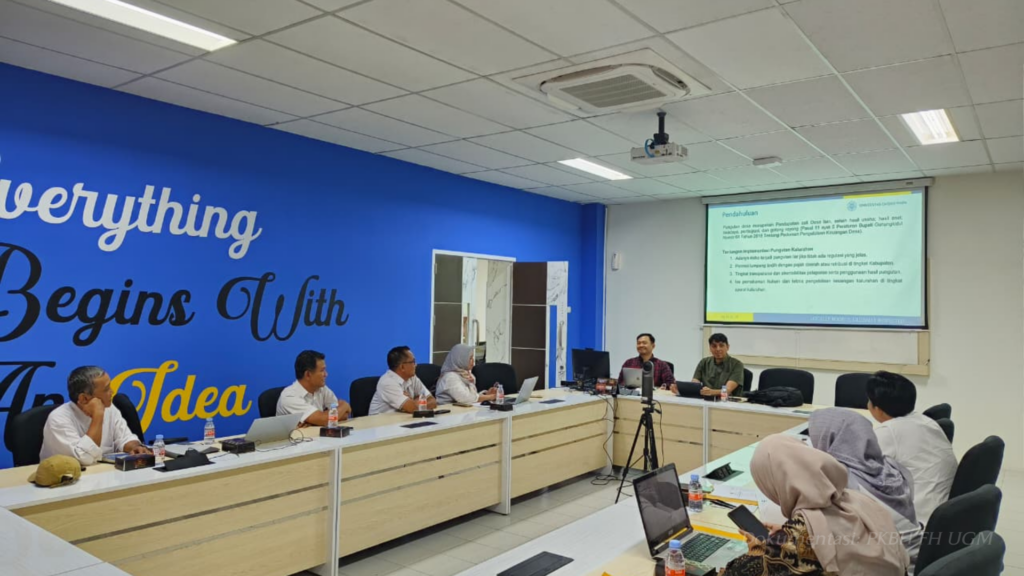
The Legal Aid and Consultation Center of the Faculty of Law, Universitas Gadjah Mada (PKBH FH UGM), in collaboration with the Yogyakarta Special Region High Prosecutor’s Office (Kejati DIY), organized a legal counseling program to assist the Government of Bendung Village, Gunungkidul Regency, in drafting a Village Regulation on Levies. The activity was held on Wednesday (16 September 2026) at the FH UGM Research Center Room and was attended by Bendung Village officials, representatives from Kejati DIY, and academics from the Faculty of Law, Universitas Gadjah Mada.
The activity was conducted as part of efforts to provide legal assistance for village governments in establishing regulations that address local needs while remaining consistent with applicable laws and regulations. Through this program, the Government of Bendung Village is expected to develop a Village Regulation on Levies with a strong legal foundation, legal certainty, and support for transparent and accountable village financial management.
During the assistance program, FH UGM lecturers conducted an academic review of the draft Village Regulation. The review focused on identifying legal aspects that require improvement, including issues related to authority, levy objects, management mechanisms, and potential legal risks arising from its implementation. Meanwhile, Kejati DIY provided input concerning the prevention of criminal risks and emphasized the importance of ensuring that every levy has a clear legal basis.
As the reviewer, Prof. Dr. Zainal Arifin Mochtar, S.H., LL.M. emphasized that the regulation of village levies must be carefully formulated to prevent overlapping authority with local governments. “Village Regulations must be designed to avoid overlapping with the authority of the Regional Government. The use of nomenclature and terminology must be carefully formulated to prevent conflicts of authority,” he stated.
The discussion focused on strengthening the legal basis of village levies, aligning the subjects and objects of levies with the provisions of the Regulation of the Governor of the Special Region of Yogyakarta, and ensuring that levy objects do not overlap with regional taxes or retributions. The use of certain phrases in the draft regulation was also reviewed to prevent ambiguity and potential jurisdictional issues.
Furthermore, the review team encouraged the village government to regulate substantive matters directly through the Village Regulation rather than delegating too many provisions to the Village Head Regulation. From a governance perspective, the implementation of non-cash payment mechanisms was also recommended to improve transparency and minimize the risk of irregularities. Prof. Zainal further emphasized the importance of proper financial recording to ensure that levy revenues are not left outside the village treasury for an extended period.
The discussion also addressed the utilization of village treasury land for the Merah Putih Village Cooperative (KDMP), particularly regarding the legal status of asset utilization, cooperation mechanisms, and the division of authority and responsibilities among relevant institutions. This issue is important to ensure that the utilization of village assets is conducted based on accountability principles and does not create legal problems in the future.
Through this activity, PKBH FH UGM and Kejati DIY hope that the Government of Bendung Village can establish a Village Regulation on Levies that provides legal certainty, strengthens village governance, and prevents potential abuse of authority. Collaboration between academics, law enforcement officials, and village governments represents a strategic effort to promote transparent, accountable, and community-oriented village administration.
Author: Dandi Jayusman