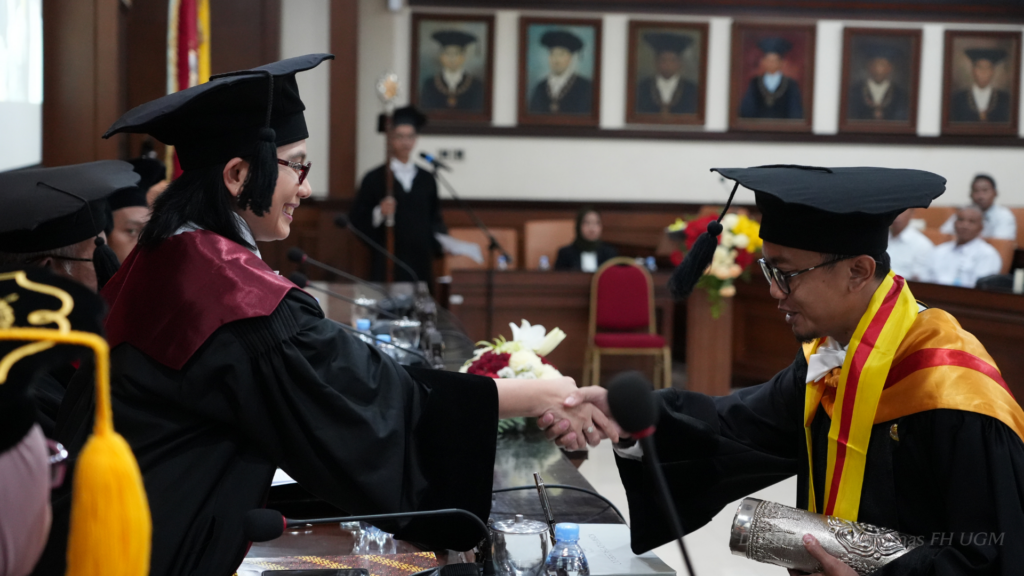
Uncertainty over whether an error in filing a tax return (SPT) will be resolved through an administrative fine or taken straight into the criminal realm remains a specter for the business world in Indonesia. So far, the absence of firm sectoral parameters has often triggered disparities in the actions of law enforcement officials and created the risk of double punishment for a single legal event. Departing from this practical and academic unease, Agung Pamula Ariyanto, A.Md.Tk., S.H., M.H. successfully defended his dissertation in the Open Examination of the Doctoral Program in Legal Studies at the Faculty of Law, Universitas Gadjah Mada (PDIH FH UGM) on Wednesday (16/9/2026) in Room III.1.1, Building 3, 1st Floor, FH UGM.
In his dissertation titled "Prospects for the Application of the Una Via Principle in Determining the Path of Tax Law Enforcement in Indonesia," Agung highlighted the imbalance in orientation among Tax Auditors, Civil Servant Investigators (PPNS) of the Directorate General of Taxes (DJP), and Prosecutors in responding to incorrect tax returns. Referring to empirical data and court rulings, cases with similar substance can be decided administratively in one region but end in a prison sentence in another. Although the reform of national criminal law through Article 613 paragraph (3) of the Criminal Code has mandated the priority of correctional measures and administrative sanctions, this principle is considered to remain merely a declaratory norm without measurable operational criteria in the Law on General Provisions and Procedures for Taxation (UU KUP).
In response to this legal vacuum, Agung offers a breakthrough in the form of a modified una via principle based on integrative proportionality, adapted from the discourse of modern jurisprudence in Belgium and the European region. This concept establishes that the state must choose one main punitive path for a single violation event while still prioritizing the administrative path as long as the recovery of state revenue is deemed adequate. To avoid arbitrary discretion, Agung formulates five stages: an operational test (pre-enforcement test), the early establishment of an Integrated Assessment Team across institutions, a procedural lock mechanism, a limited right of complaint for taxpayers, and the integration of risk parameters into the DJP's digital Coretax and Compliance Risk Management (CRM) system.
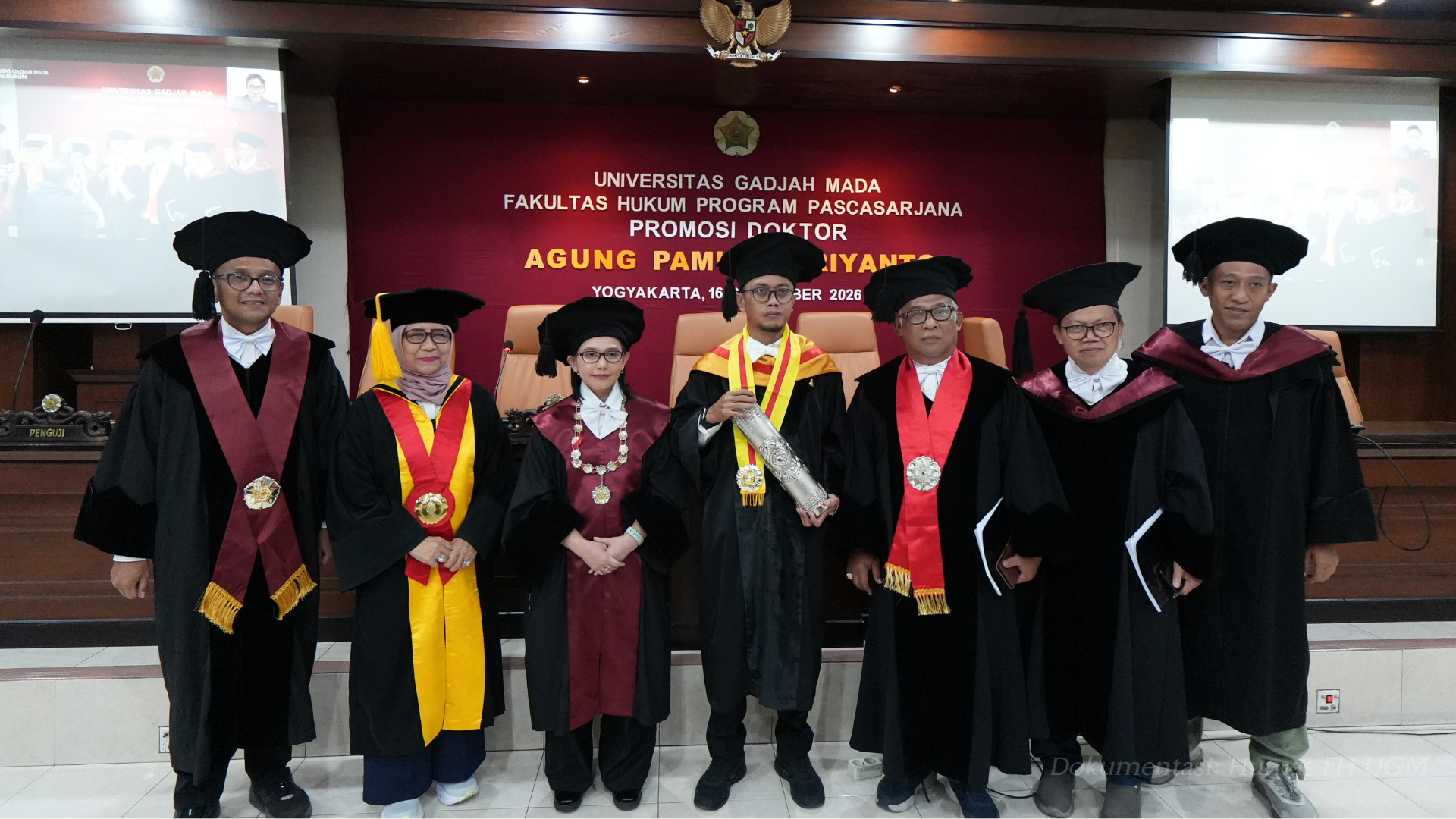
The open examination was chaired by the Vice Dean for Academic Affairs, Student Affairs, and Cooperation at FH UGM, Prof. Adrianto Dwi Nugroho, S.H., Adv.LL.M., LL.D., as Chair of the Board of Examiners. The promoter team consisted of Professor of Criminal Law at UGM, Prof. Dr. Marcus Priyo Gunarto, S.H., M.Hum., as Promoter, and the Dean of FH UGM, Dahliana Hasan, S.H., M.Tax., Ph.D., as Co-Promoter. The other examiners included Dr. Arvie Johan, S.H., M.Hum., Dr. Sigid Riyanto, S.H., M.Si., Dr. Hendry Julian Noor, S.H., M.Kn., as well as a guest examiner from Universitas Sebelas Maret, Prof. Dr. Hartiwiningsih, S.H., M.H. The successful defense of his dissertation confirms Dr. Agung Pamula Ariyanto, A.Md.Tk., S.H., M.H. as the 285th doctor from the Faculty of Law UGM and the 7,409th doctoral graduate at Universitas Gadjah Mada.
The ideas in this dissertation make a tangible contribution to supporting the achievement of the Sustainable Development Goals (SDGs). Under the pillar of SDG 16 (Peace, Justice, and Strong Institutions), this research strengthens the protection of taxpayers' human rights against abuse of power by officials while building a transparent and accountable tax justice system. In addition, this concept supports SDG 8 (Decent Work and Economic Growth) and SDG 17 (Partnerships for the Goals) by safeguarding the sustainability of the business climate from the threat of over-criminalization, securing state revenue optimally, and strengthening integrated institutional coordination between tax authorities and the prosecution service in Indonesia.
Author : Wisnu Arya Audanta (Part-Time Staff, Doctoral Program in Law)