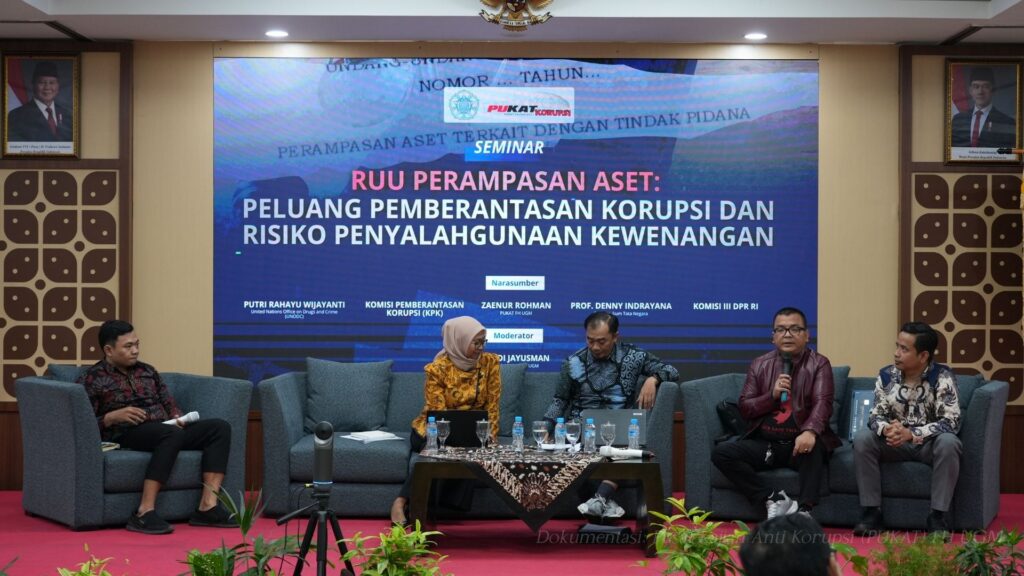
The Center for Anti-Corruption Studies (PUKAT) at the Faculty of Law, Universitas Gadjah Mada (UGM), held a seminar titled "Asset Forfeiture Bill: Opportunities for Corruption Eradication and Risks of Abuse of Authority." The seminar discussed the development of the Asset Forfeiture Bill (RUU Perampasan Aset), the strengthening of asset recovery mechanisms for proceeds of crime, and the opportunities and risks of applying non-conviction-based forfeiture mechanisms in corruption eradication. The event took place on Monday (14/09/2026) at the Auditorium of Building B, Faculty of Law UGM, Yogyakarta.
The seminar featured a number of speakers: Putri Rahayu Wijayanti from the United Nations Office on Drugs and Crime (UNODC); Imam Akbar Wahyu Nuryamto, Head of the Regulatory Planning Section at the Legal Bureau of the Corruption Eradication Commission (KPK); Zaenur Rohman, a researcher at PUKAT FH UGM; and Prof. Denny Indrayana, a constitutional law expert. The discussion was moderated by Dandi Jayusman, a researcher at PUKAT FH UGM. The event was also attended online by the leadership and several members of Commission III of the House of Representatives of the Republic of Indonesia (DPR RI) from the DPR RI Building, Senayan, Jakarta, including Habiburokhman, S.H., M.H., as Chair of Commission III of the DPR RI, who also gave remarks in the forum. The event opened with remarks from the Chair of PUKAT FH UGM, Hasrul Halili, S.H., M.A.
The first speaker, Putri Rahayu Wijayanti from UNODC, explained that a number of concepts in the Asset Forfeiture Bill are inspired by international commitments, particularly the United Nations Convention against Corruption (UNCAC), which Indonesia ratified through Law No. 7 of 2006 on the Ratification of the United Nations Convention Against Corruption, 2003. According to her, asset recovery is a series of processes encompassing tracing, seizure, securing, management, forfeiture, and return of assets. Indonesia still has a number of legal gaps in meeting UNCAC standards, including those related to the execution of forfeiture rulings from foreign courts, asset management, freezing or seizure based on requests from foreign authorities, and strengthening the Mutual Legal Assistance (MLA) mechanism.
Putri also elaborated on the non-conviction-based forfeiture (NCB) mechanism as an instrument that fills the void when forfeiture through the criminal route cannot be carried out, for instance because the perpetrator has died, is a fugitive, has immunity, or is unknown, while assets derived from the crime are still found. Unlike conviction-based forfeiture, which is oriented toward individual accountability, NCB is in rem in nature, with the asset as the object of the case. Even so, its application must still guarantee due process of law and protection of the right to property.
Beyond NCB, the discussion also covered the concepts of illicit enrichment and unexplained wealth. Illicit enrichment relates to a significant increase in wealth that cannot be reasonably explained based on lawful income, while unexplained wealth focuses on a mechanism to request an explanation regarding the source of wealth disproportionate to income. Putri also emphasized that the effectiveness of asset recovery does not stop at seizure and forfeiture, but encompasses the ability of law enforcement to trace assets, conduct financial investigations, preserve asset value, and manage them until they can be returned or utilized optimally.
Habiburokhman, S.H., M.H., as Chair of Commission III of the DPR RI, explained that Commission III has conducted public hearings (RDPU) involving academics, students, experts, practitioners, and civil society to gather aspirations in drafting the Asset Forfeiture Bill. Commission III also conducted working visits to a number of regions and received various public proposals. In its deliberations, several issues remain matters of concern, including the scope of criminal offenses, the relationship between in rem and in personam mechanisms, the protection of third parties and fugitives, and the institutional design for asset management. Commission III targets the Asset Forfeiture Bill to be passed in December 2026
Habiburokhman emphasized the importance of maintaining a balance between the need to maximize the recovery of state losses and the protection of human rights. The Asset Forfeiture Bill must not become an instrument for abuse of power, including to silence critics or to eliminate political opponents. Therefore, the institutional design for asset management is one of the important issues still under discussion, particularly to prevent the concentration of authority in a single institution.
Meanwhile, Prof. Denny Indrayana viewed the Asset Forfeiture Bill from the perspective of constitutional law and legal politics. He highlighted five issues: inconsistency in the legislative process, transparency, the substance of the Bill, the potential emergence of new entry points for corruption, and the risk of criminalization. According to him, meaningful public participation needs to be accompanied by openness of the Bill's draft so that the public can provide substantive input. He also emphasized the importance of strengthening anti-corruption institutions, protecting witnesses and victims, and preventing the criminalization of critics.
From the KPK's perspective, Imam Akbar Wahyu Nuryamto, Head of the Regulatory Planning Section at the KPK Legal Bureau, explained that current asset forfeiture practice still relies on conviction-based mechanisms. Law No. 31 of 1999 on the Eradication of the Crime of Corruption, as amended by Law No. 20 of 2001 on the Amendment to Law No. 31 of 1999 on the Eradication of the Crime of Corruption, has regulated a number of asset recovery mechanisms. However, these mechanisms have not fully answered the need for asset recovery when criminal proceedings cannot continue.
Imam added that regulatory reform needs to fulfill the UNCAC mandate, including provisions on bribery in the private sector, trading in influence, and illicit enrichment. The KPK proposes that illicit enrichment be placed as substantive criminal law through an amendment to the Anti-Corruption Law, while the Asset Forfeiture Bill regulates the formal mechanism for asset recovery. The KPK also emphasized the importance of distributing authority and checks and balances so that the authority to trace, seize, assess, manage, and return assets is not concentrated in a single institution.
Zaenur Rohman, a researcher at PUKAT FH UGM, added that the Bill needs to provide clarity on the legal model to be used, particularly the position of illicit enrichment, unexplained wealth, and NCB forfeiture. PUKAT, together with the KPK and UNODC, recommends that illicit enrichment be regulated through an amendment to the Anti-Corruption Law, while NCB be positioned as a complementary mechanism to criminal proceedings. He also highlighted the need to anticipate virtual assets and crypto assets, to open the Bill's draft officially to the public, and to apply functional differentiation so that asset management authority is not concentrated in a single institution.
The discussion then continued with an interactive question-and-answer session between participants and speakers. The session deepened the discussion on the non-conviction-based forfeiture mechanism, the regulation of illicit enrichment and unexplained wealth, the protection of third parties, asset management, the division of authority between institutions, and the potential for abuse of authority. The forum also became a space for participants to express views on the balance between the effectiveness of asset recovery and the protection of human rights.
This seminar is expected to enrich the discussion of the Asset Forfeiture Bill currently being processed at the DPR RI while encouraging a transparent and participatory legislative process. Input from academics, civil society, law enforcement institutions, and legislators is important so that the Bill can strengthen the recovery of assets derived from crime without creating an excessive concentration of authority or new room for abuse of power. Openness of the Bill's draft and adequate oversight mechanisms are also needed to ensure that public expectations for the Bill's passage are followed by an effective legal design that continues to provide protection for human rights.
The holding of this seminar is also expected to support the realization of the Sustainable Development Goals (SDGs), particularly SDG 16 on Peace, Justice, and Strong Institutions, which places the development of effective, accountable, and inclusive institutions as an important part of sustainable development. Strengthening asset recovery, legislative transparency, public participation, and checks and balances mechanisms are also relevant to SDG 10 on Reduced Inequalities through guarantees of equal legal protection and the prevention of abuse of power in the asset forfeiture process.
Author : Muhammad Imam Maulana (PUKAT FH UGM)