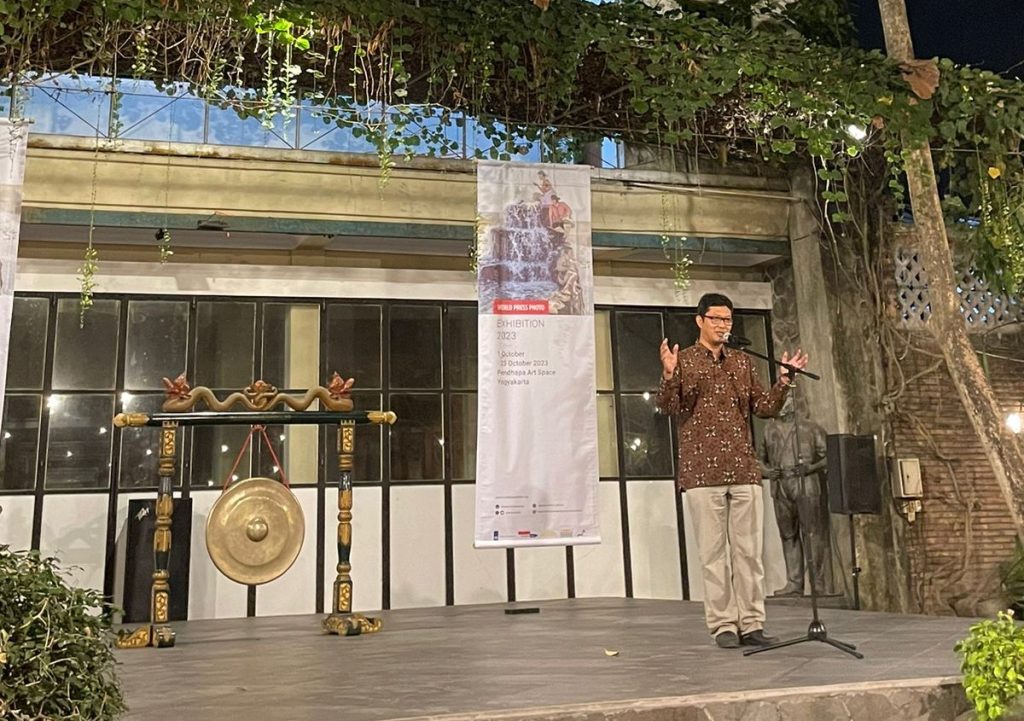
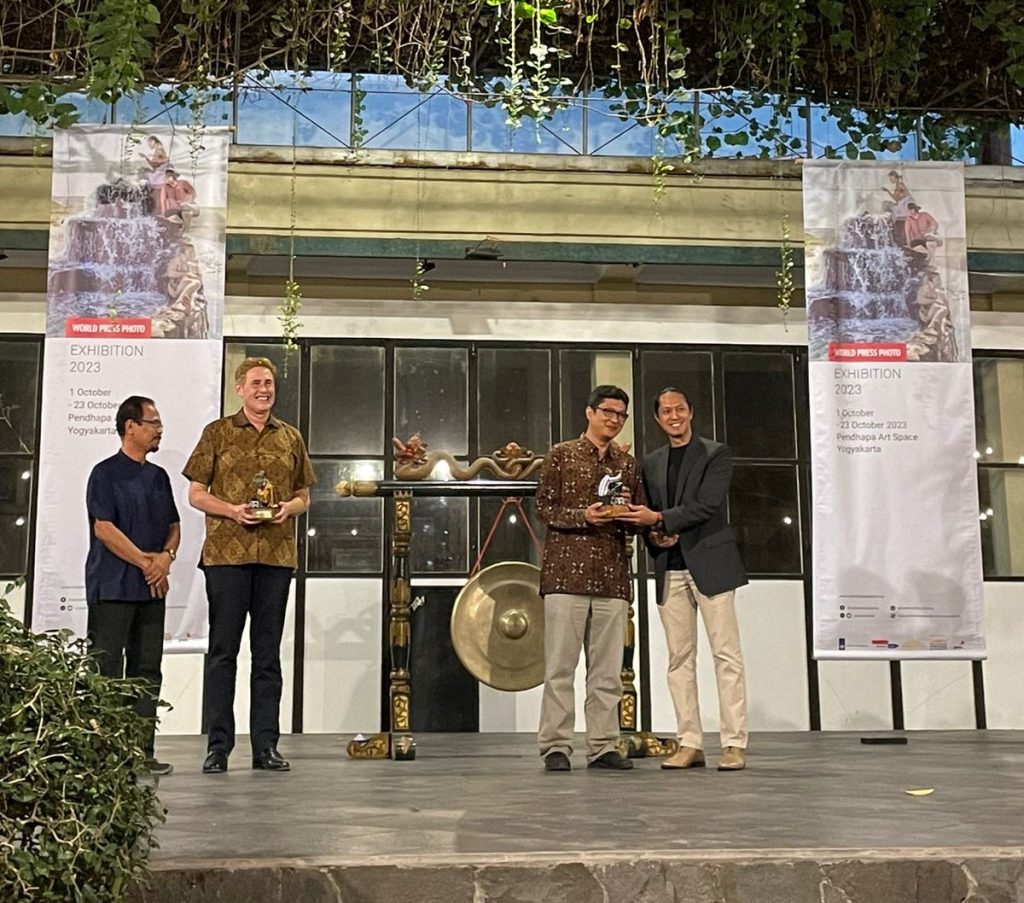
The World Press Photo 2023 exhibition is back in Indonesia. Following its successful run at Erasmus Huis in Jakarta in September 2023, the exhibition continues at Pendhapa Art Space in Yogyakarta from October 1 to 23, 2023. The opening of the 2023 World Press Photo exhibition in Yogyakarta was marked by the striking of a gong by Mr. Nicolaas de Regt, Director of Erasmus Huis at the Embassy of the Kingdom of the Netherlands.
The World Press Photo 2023 exhibition is back in Indonesia. Following its successful run at Erasmus Huis in Jakarta in September 2023, the exhibition continues at Pendhapa Art Space in Yogyakarta from October 1 to 23, 2023. The opening of the 2023 World Press Photo exhibition in Yogyakarta was marked by the striking of a gong by Mr. Nicolaas de Regt, Director of Erasmus Huis at the Embassy of the Kingdom of the Netherlands.
Herlambang shared a story about impunity, the most serious obstacle to conveying the fundamental message of the rule of law and democracy—including press freedom—in Indonesia today. In Indonesia, impunity persists due to weak law enforcement and the significant influence of politics on the judicial system. Therefore, it is not surprising that there are many acts of violence targeting journalists and media outlets in the field. The most common forms of violence throughout 2022 were physical violence, terror and intimidation, as well as reporting bans and threats. In addition, there were systematic digital attacks such as doxing, hacking, lawsuits, the removal of news reports and photos, and even the destruction or confiscation of work equipment. As reported by the Independent Journalists Association (AJI), attacks on journalists in 2022 totaled 61 cases, affecting 97 journalists and 14 media organizations. This figure represents an increase from the previous year’s 43 cases.
“The worsening situation isn’t just about Indonesia. Impunity and attacks on journalists are still occurring around the world,” Herlambang added.
According to the United Nations Educational, Scientific and Cultural Organization (UNESCO), killings of journalists and other media workers increased by 50 percent in 2022, with a total of 87 journalists and media workers killed globally. This represents a sharp increase from the average number of deaths among journalists and other media workers. Previously, there were 58 killings per year from 2019 to 2021. The Office of the United Nations High Commissioner for Human Rights (OHCHR), in collaboration with UNESCO and the International Labor Organization, noted an increase in the number of female journalists killed from 6 to 10 (more than 67 percent). Women are even more frequently targeted by threats and harassment in the digital sphere.
Therefore, impunity will inevitably lead to more violence—and even killings—which undermines social justice, the rule of law, and the judicial system. Ending impunity for crimes against journalists is one of the most urgent issues for ensuring freedom of expression and access to information for all citizens. Press freedom is essential for building a democratic society, as well as for ensuring transparency and accountability on the part of public authorities and the government.
Ten years ago, the UN General Assembly designated November 2 as the “International Day to End Impunity for Crimes Against Journalists” through General Assembly Resolution A/RES/68/163. The resolution urges Member States to implement firm measures to combat the current culture of impunity. The date was chosen to commemorate the killing of two French journalists in Mali on November 2, 2013. This is supported by the UN Action Plan on the Safety of Journalists and the Issue of Impunity, which takes a multi-stakeholder and holistic approach. It brings together UN agencies, national authorities, the media, and civil society organizations.
Herlambang concluded his keynote speech with two points: legal protection for journalists in Indonesia and a message of optimism for bringing about change in society through photojournalism.
Legal protection for journalists in the practice of their profession is regulated by Law No. 40 of 1999 on the Press. These safeguards are further reinforced by Press Council Regulation No. 5 of 2008 on Standards for the Protection of the Journalism Profession, as well as the Norms and Standards of the Indonesian National Commission on Human Rights (Komnas HAM) Regulation No. 5 of 2021 on Freedom of Opinion and Expression. This is certainly a positive development for the protection of journalism and press freedom.
“As we know, photographs have the power to evoke emotions, tell hidden stories, and capture everyday life in ways that can transform society. Photographs also capture moments; they can inspire people to take action, raise awareness about fundamental issues, and mark events that are meaningful to humanity. World Press Photo is one of the most prestigious photojournalism contests in the world. World Press Photo winners are widely recognized for their excellence in conveying visual stories. Moreover, photography is also about the learning process—translating the values of society. It is not merely about knowing and understanding, but also about educating from the heart. “And finally, these photos possess immense power to transform society by documenting important events, raising awareness about critical issues, and inspiring people to take action—especially in the current context—regarding efforts toward the Sustainable Development Goals, particularly those related to climate justice, ending wars, opposing authoritarian regimes, and promoting solidarity movements for humanity,” concluded Herlambang.
Author: LSJ
Editor: Public Relations