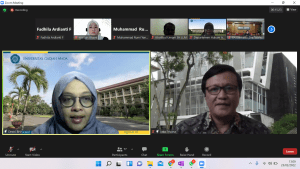
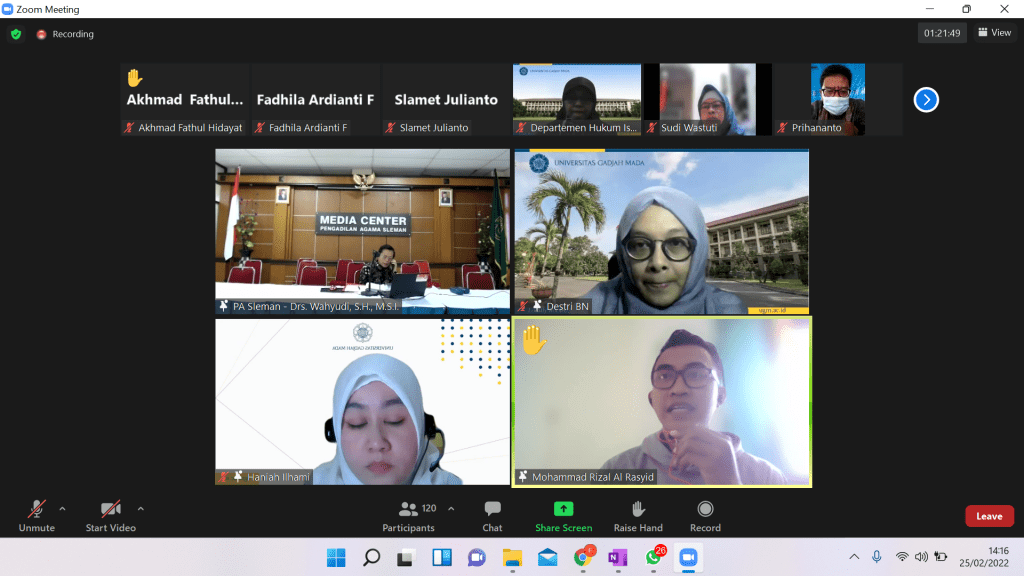
As part of implementing one of the Tri Dharma Perguruan Tinggi (the "three pillars of higher education") — Community Service — the Department of Islamic Law, in collaboration with the Sleman Religious Court, held a Legal Outreach session on Friday, February 25, 2022, titled "Marriage Dispensation and Its Legal Issues in Society." Held online, the session drew 117 attendees from a range of backgrounds, including students, legal practitioners, and the general public. This 3rd installment featured two speakers: Haniah Ilhami, S.H., LL.M. (lecturer, Department of Islamic Law, FH UGM) and Drs. Wahyudi, S.H., M.Si. (Judge, Sleman Religious Court).
The speakers gave an in-depth look at marriage dispensation, broadly explaining how it's regulated within Indonesia's legal system and how that regulation has evolved. So far, marriage dispensation has been addressed across several regulations: Law No. 1/1974 on Marriage, Book II of the Supreme Court's Technical Guidelines on Religious Court Administration and Procedure, regional regulations, Law No. 16/2019, and Supreme Court Regulation (Perma) No. 5/2019. The speakers also explained that marriage dispensation functions almost like a double-edged sword: on one hand, judges must act in the best interest of a child under 19; on the other, they must weigh whether granting the dispensation would produce a greater benefit than withholding it. The presentation also noted that a marriage dispensation can only be requested where there's a very urgent reason, no other option exists, and the marriage is genuinely unavoidable — all of which must be backed by sufficient supporting evidence. These two elements are considered fundamental to properly understanding a child's circumstances before a dispensation request is treated as a genuine "emergency exit."
Readers wanting more detail on this session's marriage dispensation material can download the materials via the link provided at bit.ly/Materiluhkum3 .