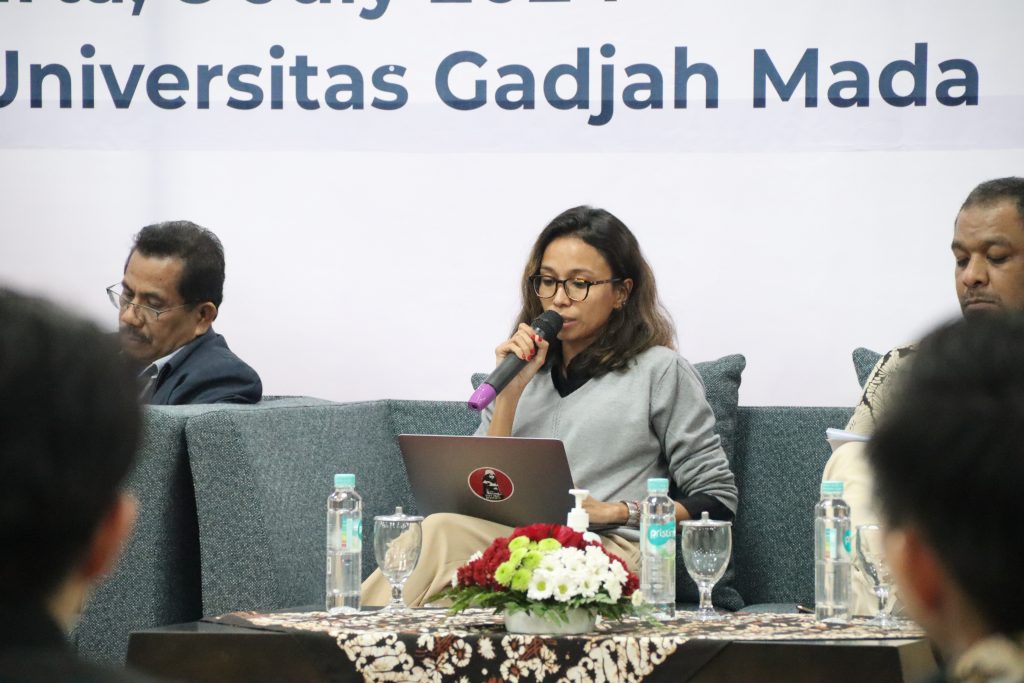
The panel titled "Timor-Leste–Indonesia Reconciliation" brought the Timor-Leste–Indonesia Workshop at AAS-in-Asia 2024 to a close, concluding a rich series of discussions held at the Auditorium of the UGM Faculty of Law. The event was a collaborative endeavor between the Swedish International Development Cooperation Agency (SIDA), Centro Nacional Chega! (CNC) Timor-Leste, and the UGM Faculty of Law. Held on Monday, July 8, 2024, the closing panel convened scholars and experts from leading international and national institutions to examine the reconciliation process between Indonesia and Timor-Leste.
Moderated by Lia Kent of the Australian National University, the panel featured Hugo Fernandes (CNC, Timor-Leste), Berta Antonieta Tilman (independent researcher, Timor-Leste), Yoseph Yapi Taum (Universitas Sanata Dharma, Indonesia), Fidelis Magalhães (University of Oxford, UK), Ehito Kimura (University of Hawai'i), Muhadi Sugiyono (UGM, Indonesia), and Made Supriatma (ISEAS–Yusof Ishak Institute, Singapore).
Hugo Fernandes opened the discussion by stressing the importance of historical acknowledgment and honest education for younger generations as a means of fostering genuine understanding of the past. He drew attention to the role of the Commission for Truth and Friendship (Komisi Kebenaran dan Persahabatan/CTF), noting that while the body had secured formal recognition from Indonesia, its key recommendations including reparations for victims have yet to be fully implemented.
Berta Antonieta Tilman highlighted the complexity of the reconciliation process in Timor-Leste, with particular focus on violence against women during the Indonesian occupation. She called for sincere historical acknowledgment and inclusive participation in the reconciliation process conditions she argued are essential to preventing the mistakes of the past from being repeated.
Echoing Tilman's concerns, Yoseph Yapi Taum emphasized that meaningful reconciliation must encompass transitional justice through both formal legal mechanisms and customary (adat) processes, in order to bring together communities fractured by conflict and prevent further divisions. He also stressed the importance of a harmonious relationship between Indonesia and Timor-Leste as a foundation for lasting peace.
Fidelis Magalhães argued that reconciliation must be felt by all layers of society — not only at the elite level. He underscored the need for consistency between political rhetoric and actual reconciliation policy, while remaining attentive to the ever-shifting political dynamics at play.
Ehito Kimura, speaking on transitional justice and collective memory, observed that while public recollection of past human rights violations tends to fade over time, legal frameworks can still serve as a meaningful component of a substantive reconciliation process in Indonesia.
Muhadi Sugiyono spoke to the pragmatic approach underpinning the Indonesia–Timor-Leste reconciliation effort, with an emphasis on restorative justice. He also highlighted Timor-Leste's prospective membership in ASEAN as an important step toward reinforcing reconciliation and fostering positive political developments across the region.
Closing the discussion, Made Supriatma delivered a pointed reminder that genuine reconciliation between Indonesia and Timor-Leste cannot be achieved without justice. He criticized the entrenched culture of impunity in Indonesia, where perpetrators of human rights violations have faced no legal accountability and have, in many cases, continued to hold positions of power a reality that fundamentally obstructs authentic reconciliation.
Taken together, the workshop painted a frank portrait of both the progress made and the work that remains in the Indonesia and Timor-Leste reconciliation process. While strides have been taken, the panel made clear that achieving reconciliation that is truly just and inclusive for both nations will require sustained commitment, political will, and above all, a willingness to confront the past with honesty and accountability.