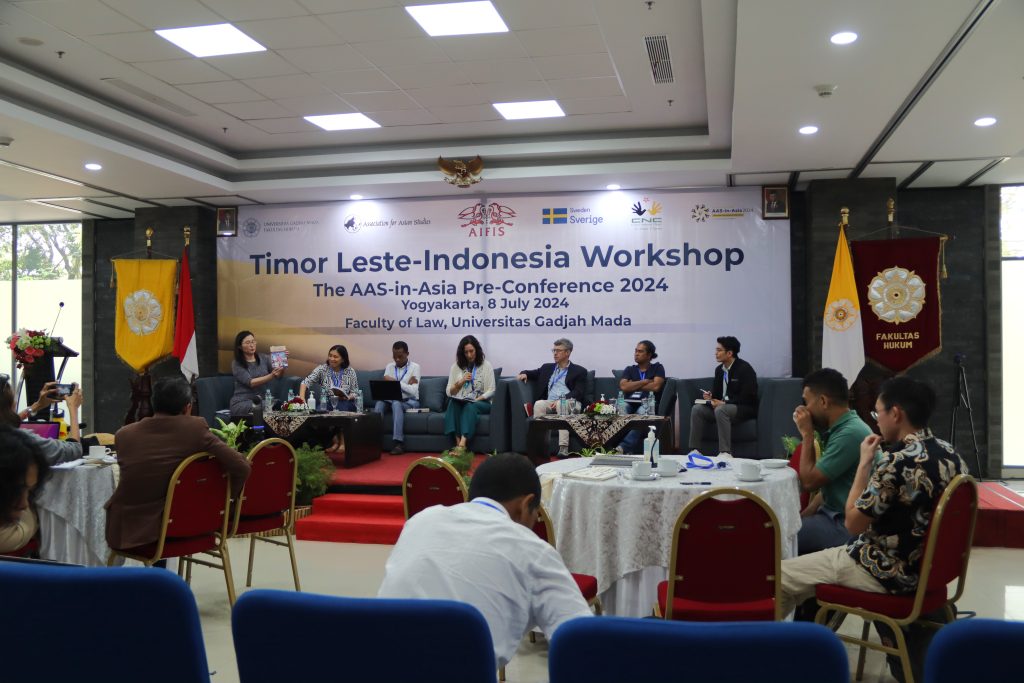
On Monday, July 8, 2024, the second panel of the Timor-Leste–Indonesia Workshop at AAS-in-Asia 2024 took place, centering on a book discussion titled "Tsuchiya, 'Emplacing Timor-Leste' Discussion." The workshop was co-organized by the Swedish International Development Cooperation Agency (SIDA), Centro Nacional Chega! (CNC) Timor-Leste, the UGM Faculty of Law, and UGM, as part of the AAS-in-Asia Conference 2024 themed "Global Asias: Latent Histories, Manifest Impacts."
The panel was moderated by Eunsook Jung of the University of Wisconsin and featured an impressive roster of scholars, including Marisa Ramos Gonsalves from the University of Coimbra, Portugal; Vannessa Hearman from Curtin University, Australia; Josh Trindade from the University of Melbourne, Australia; David Webster from Bishop's University, Canada; Ivo Gonsalves from the Australian National University; and the book's author, Kisho Tsuchiya from Kyoto University, Japan.
The discussion centered on Tsuchiya's book, Emplacing East Timor: Regime Change and Knowledge Production, which makes a significant contribution to Timorese historical scholarship through its use of diverse perspectives and methodologies. The work examines how Timor-Leste and its people have been positioned within socio-political hierarchies and international relations by various interpretive communities, and underscores the importance of engaging with a wide range of critical historical sources while crafting inclusive historical narratives.
Marisa Ramos Gonsalves challenged Tsuchiya on his positioning within historical interpretive communities and called for greater engagement with Timorese community sources, including oral histories. Vannessa Hearman praised Tsuchiya's effort to complicate the notion of Timorese identity by accounting for Portuguese, Dutch, and Indonesian policies in the post-World War II period, while calling for more nuanced, multi-archival, and methodologically diverse historical research.
Josh Trindade commended the book as a comprehensive work offering fresh insights into Timorese history and culture, though he noted some differences in interpretation regarding certain terms and political structures. David Webster, by contrast, flagged the potential risk of the book's analytical framework inadvertently sidelining Timorese agency in the writing of their own history. Webster also addressed efforts at reconciliation between Timor-Leste and West Timor and the relevance of language-based community concepts.
Ivo Gonsalves raised the concept of "autonomous history" in Tsuchiya's work, questioning whether it represents a form of negative identification or an attempt to reclaim historical narratives. He also challenged the framing of 450 years of Portuguese colonialism, suggesting that Timor-Leste's government might more accurately characterize the nation's history as 500 years of dispossession and colonialism. Gonsalves stressed the importance of knowledge transfer between outside researchers and local communities, as well as the role of national liberation movements such as RENETIL in shaping resistance strategies.
In his closing response, Dr. Kisho Tsuchiya engaged thoughtfully with the critiques and commendations offered. He noted that his book was not written solely for specialists but was also intended to be accessible to general readers as a narrative work. He reflected on the personal motivations behind the book, shaped by his experiences as an idealistic student and a United Nations officer in Timor-Leste, and discussed how those experiences led him to examine the UN and human rights activists as part of a broader colonial lineage.
Tsuchiya acknowledged gaps in his work, including insufficient attention to the voices of ordinary people, and welcomed these as avenues for further research. He encouraged young scholars to build upon, and critically engage with his work in their own studies of Timor-Leste. He closed the session with warm gratitude for the opportunity to share his research in such a rich intellectual forum.