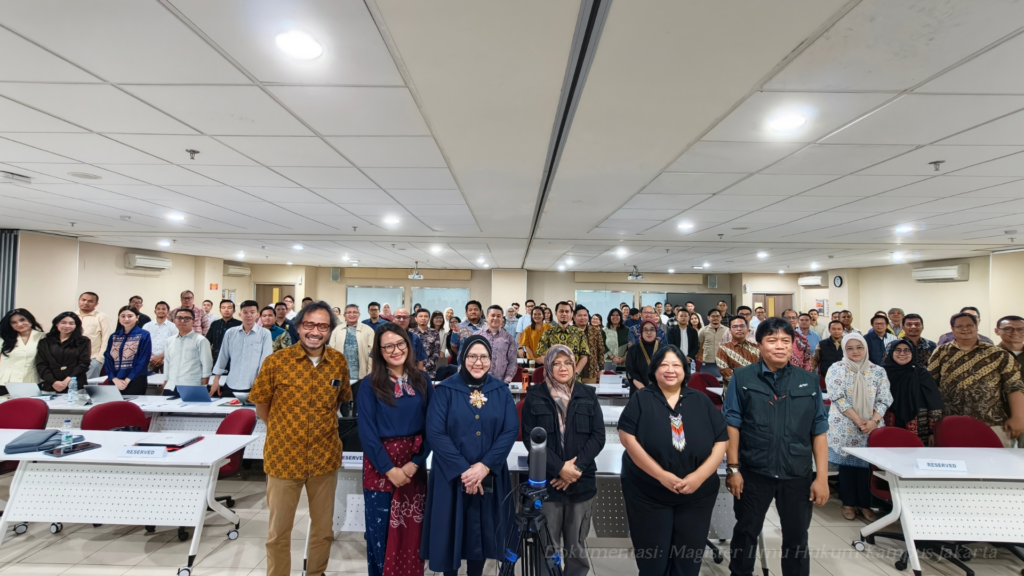
Jakarta — The Master of Laws Program (Jakarta Campus) at the Faculty of Law, Universitas Gadjah Mada, held a National Seminar titled "Fire, Smoke, and Justice: Forest and Land Fires in Indonesia between Natural Disaster, Corporate Interests, and Human Rights Violations" on Saturday (26/9/2026).
The seminar served as an academic space to discuss forest and land fires (karhutla) comprehensively, not only as a matter of disaster and environmental damage, but also as a question of governance, land use, corporate activity, law enforcement, community protection, and environmental recovery. The seminar featured three complementary perspectives: those of regional government, law enforcement, and academia. The speakers were Dr. Afni Zulkifli, M.Si., Regent of Siak; Dr. Dwi Januanto Nugroho, S.Hut., M.B.A. from the Directorate General of Forestry Law Enforcement; and Dr. Totok Dwi Diantoro, S.H., M.A., LL.M., a lecturer in the Department of Environmental Law at the Faculty of Law, Universitas Gadjah Mada.
From the regional government perspective, Dr. Afni Zulkifli discussed regional government policies and challenges in preventing and tackling forest and land fires. The discussion covered area management, particularly peatland areas, coordination between central and regional governments, the limits of regional authority, and the importance of collaboration in preventing and handling fires. Post-fire issues also received attention, particularly the management and recovery of areas after fires and after actions taken against corporate permits.
Dr. Dwi Januanto Nugroho then outlined the issue from the perspective of law enforcement and corporate accountability. Handling forest and land fires is not only about imposing criminal sanctions, but also covers administrative and civil instruments. Law enforcement needs to be placed within a framework of supervision and prevention, given that environmental and forestry crimes have complex characteristics, their impacts can last a long time, and they are not always easy to see or prove. The effectiveness of law enforcement therefore also requires an approach that takes into account social, ecological, and governance aspects.
This perspective was then complemented by Dr. Totok Dwi Diantoro, who framed forest and land fires as a socio-ecological crisis and a matter of human security. The impacts of fires are felt not only through ecosystem damage, but also affect public health, livelihoods, economic activity, food security, mobility, and quality of life. The success of handling fires, therefore, cannot be measured solely by how many sanctions are imposed, but also by the ability of law and policy to prevent recurring fires, protect communities, ensure accountability, and restore ecological functions and the lives of affected communities.
This line of discussion shows that forest and land fires are a multidimensional problem requiring a cross-sectoral approach. Prevention, law enforcement, community protection, and environmental recovery need to be carried out in an integrated manner involving government, law enforcement officials, businesses, communities, and universities.
This approach is also in line with the Sustainable Development Goals (SDGs), particularly SDG 3 on Good Health and Well-being; SDG 13 on Climate Action; SDG 15 on Life on Land; and SDG 16 on Peace, Justice, and Strong Institutions. Handling forest and land fires is therefore directed not only at imposing sanctions for violations, but also at strengthening prevention, protecting public health and livelihoods, restoring ecosystems, and building sustainable environmental governance.
The National Seminar "Fire, Smoke, and Justice" is expected to strengthen the space for dialogue among academics, government, law enforcement, businesses, and communities in building a more comprehensive understanding of and approach to forest and land fires in Indonesia. Through this approach, law enforcement is expected to go hand in hand with environmental protection, the fulfillment of community rights, ecosystem recovery, and the achievement of sustainable development.
Author : Ramzy Oansa Ilham