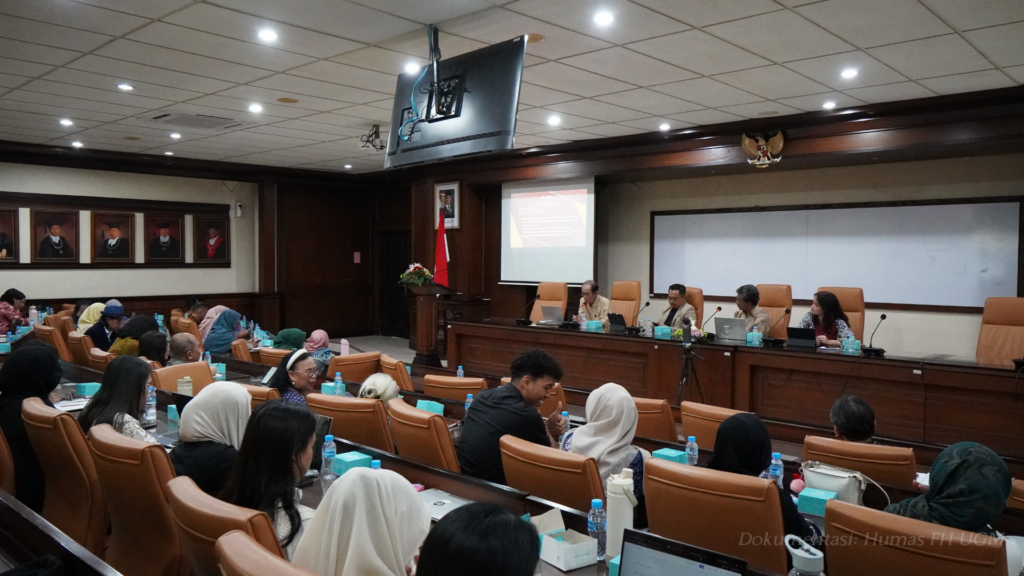
The Department of Agrarian Law at the Faculty of Law UGM held a Public Discussion titled "Land Acquisition for Public Interest: Meaning, Norms, and Reality" on Saturday (26/9/2026) in Room 3.1.1, Faculty of Law, Universitas Gadjah Mada. The event was held in honor of the retirement of Rafael Edy Bosko, S.H., MIL., who served as a lecturer in the Department of Agrarian Law at FH UGM for 36 years and 7 months. The theme raised in this public discussion is also closely tied to the field he has long pursued: land acquisition for public interest. The discussion also served as a space for reflection on the development of agrarian law following the 66th anniversary of Law No. 5 of 1960 on the Basic Principles of Agrarian Law.
The Public Discussion featured a number of speakers: Prof. Dr. Imam Koeswahyono, S.H., M.Hum., Professor of Agrarian Law at Universitas Brawijaya; Dzikri Ashary, S.E., M.Ec.Dev. MAPPI (Cert), Chair of the Land Valuation Compartment of the Indonesian Society of Appraisers (MAPPI); and Rafael Edy Bosko, S.H., MIL., a lecturer in the Department of Agrarian Law with expertise in land acquisition for public interest. The event was also attended by various invited guests from academia and practice, including representatives of the Regional Office of the National Land Agency (BPN) of the Special Region of Yogyakarta; the Land Offices of Gunung Kidul, Kulon Progo, and Bantul Regencies; the Association of Land Deed Officials (IPPAT); lecturers from various universities; as well as family and colleagues of Rafael Edy Bosko, S.H., MIL.
The event opened with remarks by Dr. Rikardo Simarmata, S.H., Head of the Department of Agrarian Law at FH UGM. The discussion session was then guided by Alifa Prasasti Rahmaningrum, S.H., M.H., a lecturer in the Department of Agrarian Law at FH UGM. In her introduction, she noted that the background of this public discussion stems from the phenomenon of shifting meaning, norms, and reality in land acquisition for public interest. This is evident from the increasingly broad scope of public interest provisions through the Job Creation Law and its implementing regulations, as well as the proliferation of land acquisitions labeled National Strategic Projects.
The first speaker, Rafael Edy Bosko, presented aspects of land acquisition for public interest from the perspective of its meaning, through historical, legal, and philosophical approaches. The concept of land acquisition for public interest grants the State the authority to take over land from those who control or own it. There are three important pillars: public interest, compensation, and due process. However, the interpretation of the public interest pillar has begun to shift from public use to public purpose. This situation is compounded by provisions in the Job Creation Law and Government Regulation No. 19 of 2021, which open opportunities for community groups with a dominant economic or political position to become beneficiaries of land acquisition for public interest.
Prof. Imam Koeswahyono further discussed the aspects of public consultation and the payment of adequate and fair compensation, in terms of norms, implementation, and options for improvement. Public consultation practice remains a mere formality of participation and does not place the parties on an equal footing. The objection mechanism for compensation calculations is also not yet optimal, as it emphasizes only the consignment solution. As a result, the number of agrarian conflicts arising from land acquisition for public interest continues to rise. He proposed several ways out: a paradigm shift that views land not merely as an object of development but also as a living space; broadening the meaning and forms of compensation; placing the parties on an equal footing; and ensuring that public consultation and deliberation on compensation are carried out through meaningful participation.
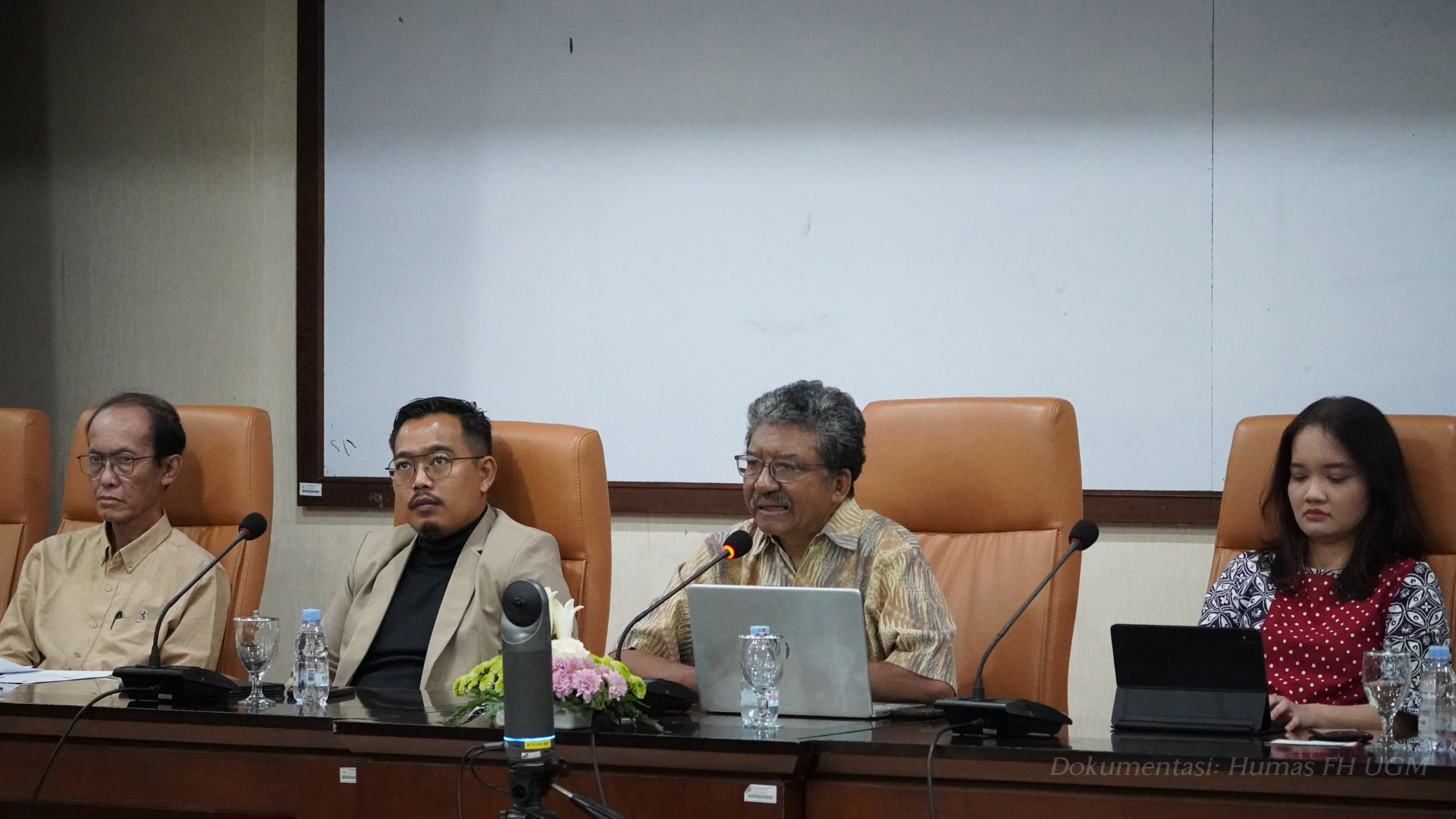
The third speaker, Dzikri Ashary, emphasized the norms and implementation of land valuation in the land acquisition process for public interest. His presentation covered the work of summarizing land valuation activities, the objects of valuation (physical and non-physical), the stages of valuation in the land acquisition process, and illustrations of its calculation. In practice, there are various obstacles in calculating the objects of valuation due to mismatched data provided, objections from rights holders, social impacts of development that have not been accommodated, and the absence of norms that adequately regulate the calculation of ulayat land and customary forests that have not been designated by the competent authority.
After the presentation sessions, the event continued with discussion and a question-and-answer session. Participants showed great enthusiasm, sharing various views on the issue of land acquisition for public interest and raising questions about the expanding list of activities classified as public interest, comparisons of land acquisition regulations, and land acquisition practices carried out in the name of National Strategic Projects.
The event then continued with tributes in honor of Rafael Edy Bosko's retirement, delivered by Dr. Jur. Any Andjarwati, S.H., M. Jur., representing the Department of Agrarian Law at FH UGM, and Daniel Tatag, S.H., a close friend of Rafael Edy Bosko, S.H., MIL., since their university days. The Public Discussion closed with the presentation of certificates, plaques, and seminar kits to the moderator and speakers by Dr. Rikardo Simarmata, Head of the Department of Agrarian Law at FH UGM.
The holding of this Public Discussion reflects FH UGM's commitment to encouraging the development of knowledge and critical dialogue on land acquisition for public interest from the perspective of meaning, norms, and reality. The discussion on public interest, public consultation, compensation, and land valuation also supports the achievement of the Sustainable Development Goals (SDGs), particularly SDG 10 (Reduced Inequalities), through strengthening equal access and protection of community rights in the land acquisition process. The emphasis on the importance of equal standing among parties and meaningful participation in public consultation is also in line with efforts to reduce inequality in development processes and decision-making that affects communities.
Furthermore, the discussion on land acquisition for public interest in relation to development and spatial planning is linked to SDG 11 (Sustainable Cities and Communities), particularly in promoting inclusive and sustainable development. Meanwhile, the involvement of academics, practitioners, land agencies, professional organizations, and students in this forum reflects the spirit of cross-sectoral collaboration supporting SDG 17 (Partnerships for the Goals) in promoting fair, participatory, and sustainable land acquisition governance.
Materi Diskusi Publik: http://ugm.id/materidiskusipublik2026
Writer: Eka Putri Endriana