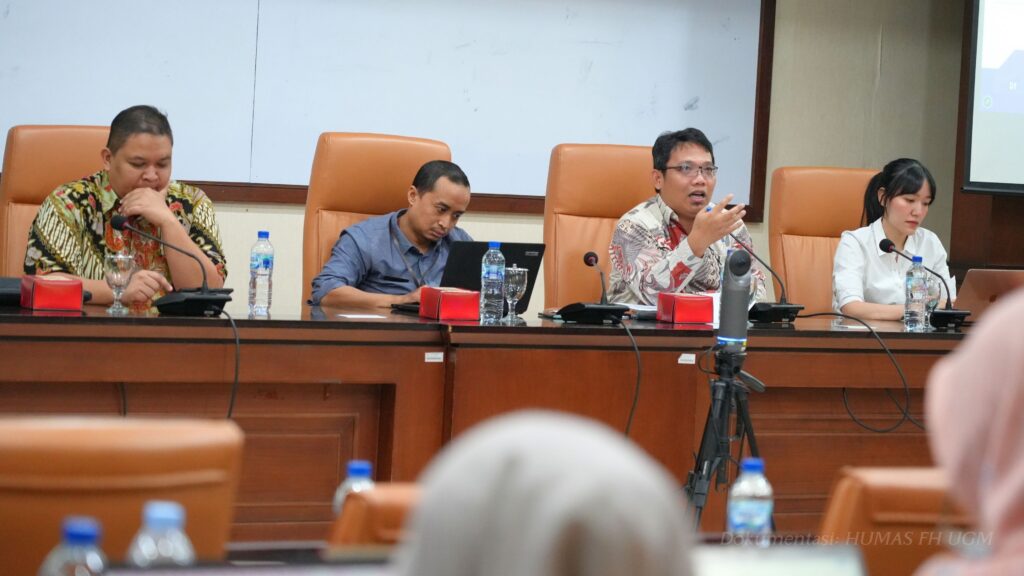
The Faculty of Law, Universitas Gadjah Mada (FH UGM), together with the Legal Bureau of the Ministry of National Development Planning/National Development Planning Agency (Kementerian PPN/Bappenas), held a Thematic Discussion on the Regulatory Impact Analysis (RIA) method in the formation of laws and regulations in Room 3.1.1, Building III, FH UGM, on Friday (25/9/2026). The event was held after the signing of cooperation between the two in the context of Strengthening National Development Planning Capacity in the Legal Field.
The thematic discussion forms part of the two institutions' cooperation series and serves as a space for exchanging knowledge and experience between academics and practitioners on the application of the RIA method in the lawmaking process.
The event featured the Head of the Legal Bureau of Kementerian PPN/Bappenas, Ari Prasetyo, S.H., M.A., M.P.A., as the kick-off speaker. It then welcomed Dr. Dian Agung Wicaksono, S.H., LL.M., a lecturer at FH UGM, as the first speaker, followed by the second speaker, Gerenda Nurwulan, S.H., M.H., a Junior Expert Legislative Drafter at the Legal Bureau of the DIY Regional Government. The discussion was guided by Florencia Irena Gunawan, S.H., LL.M., a lecturer at FH UGM, as moderator.
Participants followed the discussion enthusiastically and were actively involved. This was evident from the number of questions and responses addressed to the speakers, particularly on the application of Regulatory Impact Analysis (RIA) in the formation of laws and regulations. The discussion was interactive, with an exchange of views among academics, practitioners, and participants on the challenges and the need to strengthen analysis in the regulatory drafting process.
The activity is in line with FH UGM's commitment to supporting the achievement of the Sustainable Development Goals (SDGs), particularly SDG 16 – Peace, Justice and Strong Institutions, through strengthening the capacity and quality of lawmaking and the development of effective, accountable, and responsive institutions. It also supports SDG 17 – Partnerships for the Goals through strengthening collaboration between universities and government institutions in developing knowledge and capacity in the fields of law and national development planning.