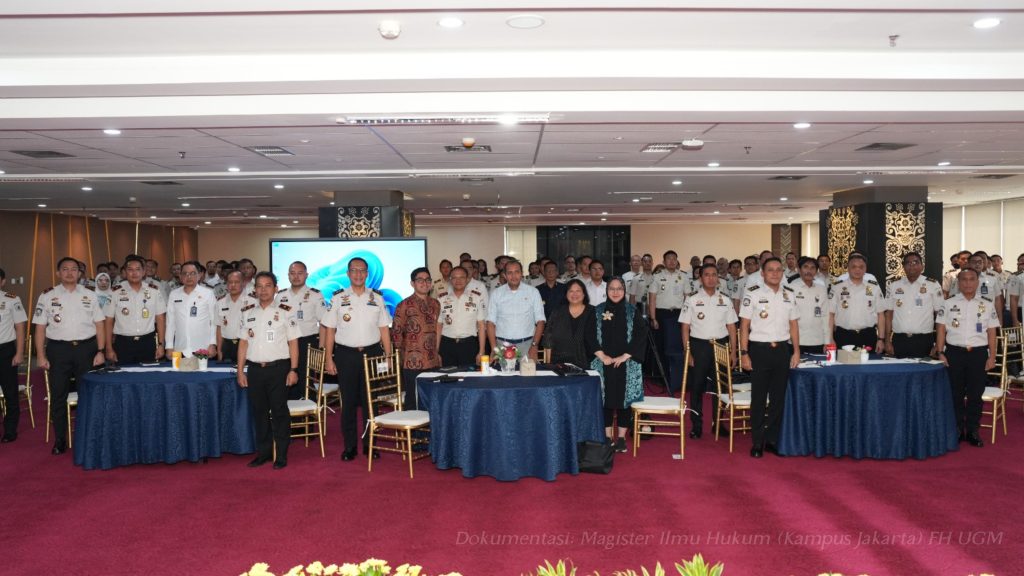
The Master of Laws Program (MIH) at UGM\'s Jakarta Campus in collaboration with the Directorate General of Immigration, Ministry of Immigration and Corrections held a legal outreach session under the theme "Immigration Law Enforcement Following the Entry into Force of the 2026 Code of Criminal Procedure (KUHAP)". The event, held on Wednesday, February 25, 2026, forms part of an effort to strengthen law enforcement officials\' understanding of the changes to the national criminal procedure system following the entry into force of the new 2026 Code of Criminal Procedure — particularly in relation to immigration law enforcement and the position of Civil Servant Investigators (Penyidik Pegawai Negeri Sipil/PPNS) within the national criminal justice system.
This legal outreach session is in line with the Sustainable Development Goals (SDGs) Professional, transparent, and accountable immigration law enforcement is a critical component of achieving good governance and a just legal system, as mandated by SDG 16 (Peace, Justice and Strong Institutions).
The event was attended by the Head of the MIH Program (Jakarta Campus), Dina Widyaputri Kariodimedjo, S.H., LL.M., Ph.D., Program Secretary, Dr. Agustina Merdekawati, S.H., LL.M.; lecturers from the UGM Faculty of Law; and senior officials from the Directorate General of Immigration. The resource persons were Prof. Dr. Edward O.S. Hiariej, S.H., M.Hum., Deputy Minister of Law of the Republic of Indonesia; Brigjen Pol. Yuldi Yusman, S.E., M.Si., Acting Director General of Immigration; Dr. Sigid Riyanto, S.H., M.Si., lecturer at the UGM Faculty of Law; and Dr. Handry Julian Noor, S.H., M.Kn., also a lecturer at the UGM Faculty of Law.
In his presentation, Prof. Eddy explained that the entry into force of the new Code of Criminal Procedure in 2026 is part of a broader reform of the national criminal justice system — aimed at strengthening human rights protection, enhancing the professionalism of law enforcement, and creating a more transparent and accountable criminal process. The reforms directly affect immigration law enforcement, particularly with regard to investigative authority, the use of evidence, detention mechanisms, and inter-agency coordination. Immigration law enforcement was characterized as a specialized branch of the criminal justice system, given its direct connection to the monitoring of the movement of people into and out of national territory. Accordingly, harmonization is needed between the new Code and immigration legislation — particularly concerning arrest and detention powers, the use of electronic evidence, and the protection of suspects\' and witnesses\' rights — to ensure legal certainty and compliance with the principle of due process of law.
Nabiyla Risfa Izzati, S.H., LL.M.(Adv)., Ph.D. emphasized that the protection of migrant workers constitutes a state responsibility to guarantee the fundamental rights of citizens. She stressed the importance of understanding employment contracts, wage transparency, and the prohibition against withholding personal documents as essential Brigjen Pol. Yuldi Yusman, Acting Director General of Immigration, explained that the entry into force of the 2026 Code of Criminal Procedure brings with it consequences for the strengthening of the professionalism of immigration investigators, as well as for improved coordination with other law enforcement agencies — particularly the Police and the Prosecutor\'s Office. Civil Servant Investigators in the immigration service retain attributive investigative authority, including the power to examine witnesses and suspects, conduct searches, carry out seizures, and prepare case files. However, all such powers must be exercised within the framework of the integrated investigation system in accordance with the Code of Criminal Procedure. He also noted that administrative instruments remain the primary means of preventive and corrective immigration control — positioning criminal law as ultimum remedium or a measure of last resort, to be applied only when administrative law enforcement is no longer adequate. Immigration law enforcement following the 2026 Code of Criminal Procedure must therefore be understood as an integrated system that combines administrative and criminal authority.
Dr. Sigid Riyanto explained that the new Code of Criminal Procedure, enacted under Law No. 20 of 2025, was driven by the need to modernize the national criminal procedure system in line with developments in society and technology — in keeping with the legal maxim, het recht hinkt achter de feiten aan, which recognizes that law often lags behind the development of events in society. The new Code clarifies the positions of investigators and senior investigators, including the formal recognition of PPNS as part of the national criminal justice system. It also introduces important changes in the law of evidence, expanding the types of admissible evidence beyond witness testimony, expert testimony, documents, circumstantial evidence, and the defendant\'s statement — to also include physical exhibits, electronic evidence, judicial observation, and other relevant forms of proof. The new Code further expands the range of coercive measures available to investigators, such as arrest, detention, search, seizure, wiretapping, asset blocking, and travel bans — all subject to stricter judicial oversight to ensure accountability in law enforcement.
Dr. Handry Julian Noor explained that, following the entry into force of the new Code of Criminal Procedure, the position of Immigration Civil Servant Investigators has been both strengthened and reorganized within the national criminal justice system. Immigration law enforcement must be understood as a system situated at the intersection of administrative law and criminal law. In this context, immigration violations may give rise to either administrative or criminal liability, depending on the nature and severity of the offense. Administrative law enforcement plays an important role in maintaining immigration order through preventive and repressive measures, including administrative sanctions such as deportation, bans on departure and entry, and the cancellation of residence permits.
He further explained that the investigative authority of Immigration Civil Servant Investigators is attributive in nature, grounded in sector-specific legislation, but must be exercised in accordance with the national criminal procedure rules and within the framework of coordination with Police investigators. One of the most important aspects of exercising PPNS authority is the ability to determine the boundary between administrative violations and criminal offenses — a determination that must be based on normative provisions, the sufficiency of initial evidence, and proportionality considerations. In the exercise of their authority, PPNS are required to adhere to the principle of legality, the protection of suspects' rights, the General Principles of Good Governance (Asas-Asas Umum Pemerintahan yang Baik), and the principles of “una via”, and “ne bis in idem”, — positioning criminal law as the instrument of last resort in immigration law enforcement.
Accordingly, this legal outreach session not only advances understanding of the changes to national criminal procedure, but also contributes to strengthening the capacity of law enforcement officials in building a professional, accountable, and just enforcement system. Immigration law enforcement that is aligned with the principles of the new Code of Criminal Procedure and the values of the SDGs is expected to support orderly migration governance, the protection of human rights, and the development of strong and sustainable legal institutions in Indonesia.
Author: Ramzy Oansa Ilham (Part-Timer, MIH UGM Jakarta Campus