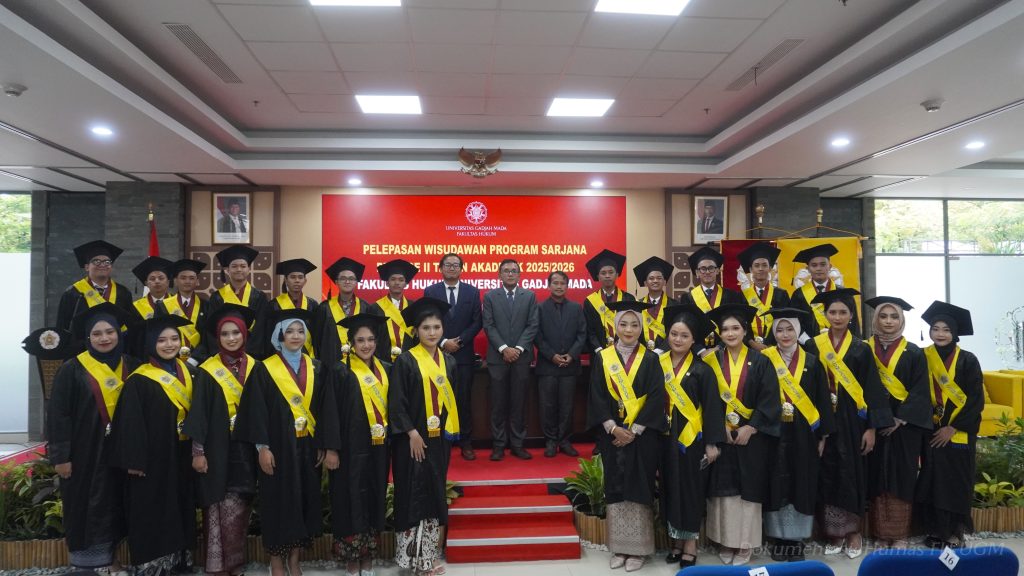
The Faculty of Law at Universitas Gadjah Mada (FH UGM) held the Undergraduate Graduation Ceremony, Period II, Academic Year 2025/2026 on Wednesday, February 25, 2026, at the FH UGM Auditorium. The graduation ceremony is an important milestone for graduates who have completed their academic journey and are ready to step into the professional world. The proceedings were held in a dignified atmosphere and attended by the faculty leadership, lecturers, parents, and all graduating students.
The event was opened by Prof. Adrianto Dwi Nugroho, S.H., Adv.LL.M., LL.D. Vice Dean for Academic Affairs, Student Affairs, and Partnerships. Also present were Dr. Khotibul Umam, S.H., LL.M. Chair of the Undergraduate Program, and Dr. Muhammad Fatahillah Akbar, S.H., LL.M., Secretary of the Undergraduate Program.
The ceremony continued with the presentation of academic transcripts to the graduates. The transcripts for the top graduate with the highest Grade Point Average (GPA) were presented directly by Prof. Adrianto, followed by the Chair and Secretary of the Program presenting transcripts to graduates in their respective graduation honor categories. The moment served as a symbol of appreciation for the hard work, dedication, and academic integrity demonstrated by students throughout their studies.
The ceremony also featured an address from the graduating Aldilla Gizca Pramugi, the top graduate, who completed her studies with a GPA of 3.98. Alongside Aldilla, a total of 43 graduates (63.8%) received the highest honor of Cum Laude.
The graduation ceremony reflects FH UGM's commitment to the Sustainable Development Goals (SDGs) — in particular SDG 4 (Quality Education). The academic achievements of the graduates are a measure of the institution's success in producing highly skilled and competitive graduates. Furthermore, law graduates have a strategic role in contributing to SDG 16 (Peace, Justice and Strong Institutions), — expected to strengthen the rule of law, improve access to justice, and help build transparent and accountable institutions. Equipped with the academic competencies and values of integrity instilled during their studies, these graduates are hoped to become agents of change in building a legal system that is both just and sustainable.