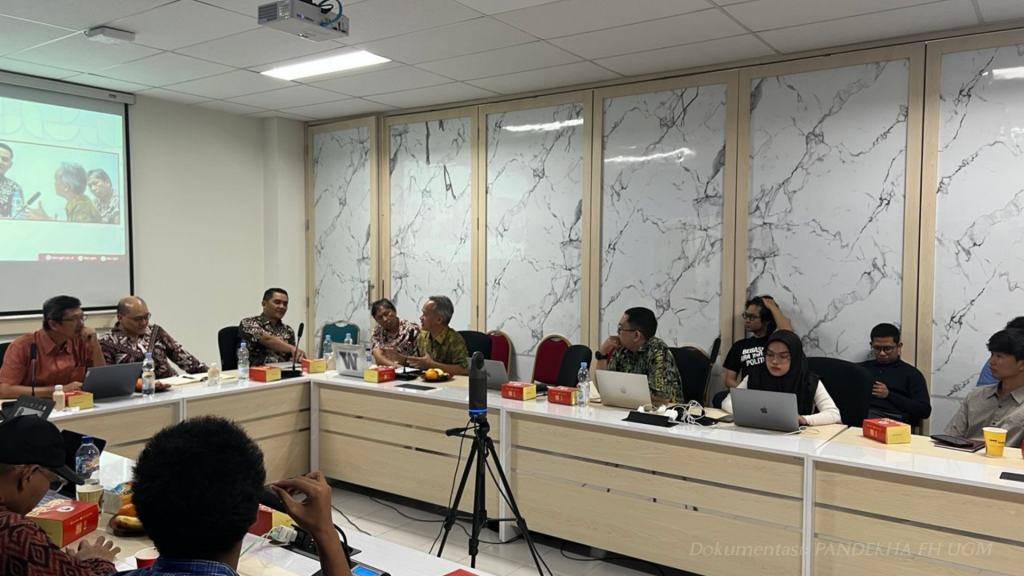
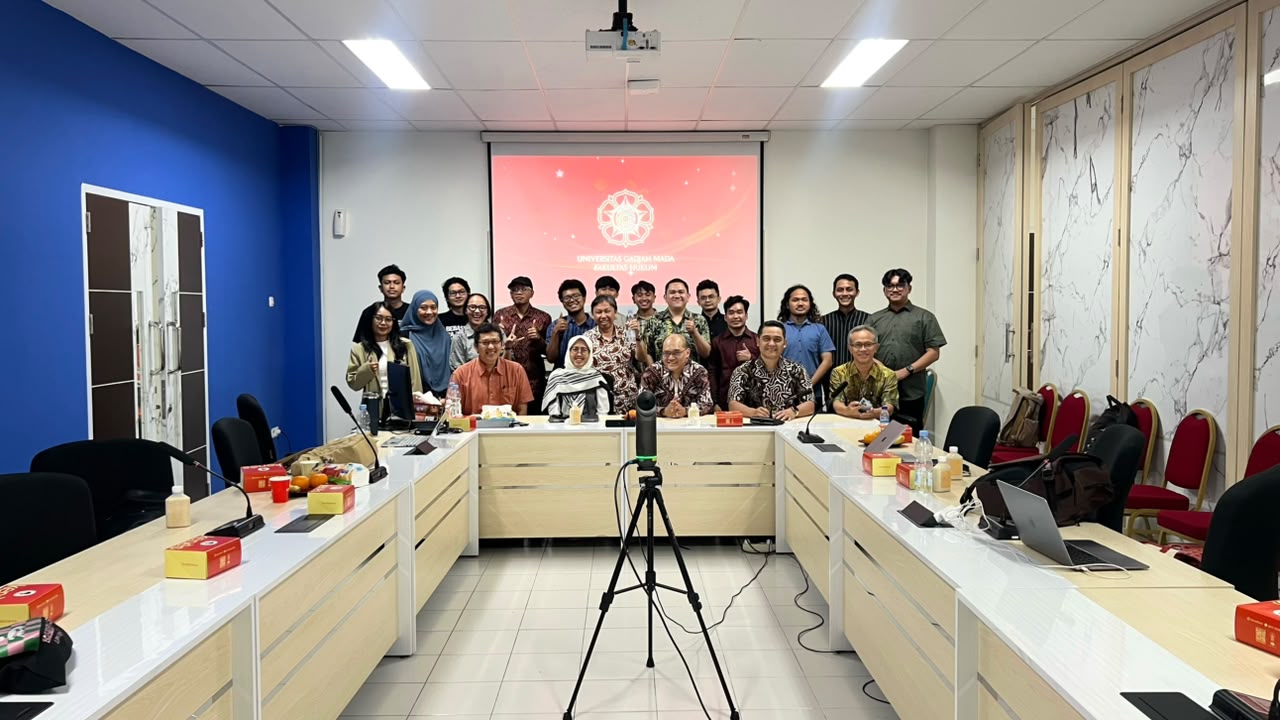
The Department of Constitutional Law at the Faculty of Law, Universitas Gadjah Mada (FH UGM), in collaboration with the Center for Democracy, Constitution, and Human Rights Studies (PANDEKHA FH UGM), the Center for Law and Social Justice Studies (LSJ FH UGM), and the Indonesian Socio-Legal Studies Association (ASSLESI), held a hybrid academic discussion and book review titled “Democracy and The Rule of Law in Indonesia: A Legal Philosophical Analysis” on Thursday, 23 July 2026. The event took place in the Study Center Room, Building IV, 2nd Floor, FH UGM, with limited in-person attendance and was also broadcast via Zoom. Approximately 100 academics, researchers, and students attended the discussion. The event examined the critical ideas of Father Stefanus Hendrianto, Ph.D., an alumnus of FH UGM who now pursues an academic career in the United States, concerning post-Reformasi Indonesian democracy. According to him, Indonesian democracy is not experiencing democratic backsliding, but has instead remained stagnant since the beginning. He therefore proposed that each generation should draft an entirely new constitution every 20 years.
Dr. Herlambang P. Wiratraman, Chair of the Center for Law and Social Justice Studies (LSJ FH UGM), moderated the discussion, which featured three UGM academics as respondents: Laras Susanti, Ph.D., from LSJ FH UGM; Dr. Yance Arizona, Chair of PANDEKHA FH UGM; and Prof. Andi Omara, Chair of the Department of Constitutional Law at FH UGM. Each respondent offered critical reflections on Father Stefanus’s ideas.
In his presentation, Father Stefanus rejected the term “democratic backsliding,” which has recently become popular among observers. He argued that the term logically presupposes the existence of a previously strong democratic foundation or significant democratic progress. In his view, the quality of Indonesian democracy over the past 25 years since the Reformasi era has largely remained stagnant at the same level, trapped in a Schumpeterian model of democracy focused primarily on elite electoral competition without sufficient public civic virtue.
He also criticized the 1945 Constitution, which he characterized as authoritarian and originally intended as a temporary document, yet continuously maintained to the present day. The constitutional amendment process from 1999 to 2002, in his view, failed to produce a clear constitutional identity and left Indonesia trapped in what he termed a “minimalist rule-of-law state.” Father Stefanus further argued that the current government practices authoritarian constitutionalism, whereby legal instruments are used repressively to serve short-term political interests.
As a way forward, Father Stefanus proposed drafting an entirely new constitution every 20 years, rather than merely introducing a fifth amendment to the 1945 Constitution. Drawing on the ideas of Thomas Jefferson, he argued that each generation should not be bound by the outdated constitution of previous generations, but should instead be given the opportunity to design its own constitutional order. According to him, this idea would return Indonesia to the spirit of Aristotelian Republicanism, which places civic virtue and everyday political participation at the heart of democracy, rather than reducing democracy to voting during elections.
Father Stefanus emphasized that changes to the constitutional system would be meaningless without the emergence of “new human beings”—namely courageous citizens and enlightened leaders. He therefore argued for deep and sustained political and civic education from an early age, so that society does not easily fall into short-term materialistic pragmatism.
Father Stefanus also invited the audience to reconsider prevailing views of the parliamentary democracy period of the 1950s, which is often portrayed as a dark chapter in Indonesian history. In his view, that period was instead the golden age of Indonesian republican democracy, marked by civilian supremacy and respect for democratic rules without the domination of a single political force.
Responding to the presentation, Laras Susanti offered a more optimistic perspective. She argued that the book opens space for younger generations to rethink constitutionalism, while highlighting the resilience of the women’s movement as an example of a civil society force that has consistently influenced legal policy across changing political regimes.
Andi Omara highlighted the gap between legal texts and their implementation in practice. According to him, no matter how well a constitution is drafted on paper, its implementation ultimately depends on those who hold the authority to interpret and enforce it. He emphasized the need for caution regarding potential unintended consequences in drafting a new constitution and suggested revisiting the historical records of the Constituent Assembly of 1955–1959 as an alternative reference beyond the dominant currents of contemporary constitutional thought.
Adapun Prof. Andi Omara menyoroti jarak antara teks hukum dan realitas implementasinya di lapangan. Menurutnya, sebaik apa pun rumusan konstitusi di atas kertas, pelaksanaannya tetap bergantung pada pihak yang memegang otoritas untuk menafsirkan dan menjalankannya. Ia mengingatkan pentingnya kehati-hatian terhadap kemungkinan unintended consequences dalam perancangan konstitusi baru, serta menyarankan agar publik menengok kembali catatan sejarah Dewan Konstituante 1955–1959 sebagai referensi alternatif di luar arus pemikiran konstitusional yang dominan saat ini.
The discussion served as a reflective space for the UGM academic community to reassess the direction of Indonesia’s constitutional reform. It also reaffirmed that constitutional law studies must continue to move beyond legal texts and engage with fundamental questions concerning the quality of democracy and civic education. The Indonesian-language version of the book is scheduled to be published by Gramedia at the end of 2026.
The organization of this book discussion also reaffirmed the continued commitment of the FH UGM academic community and its partners to supporting the achievement of the Sustainable Development Goals (SDGs). Critical discussion on the rule of law, constitutional renewal, and the strengthening of constitutional institutions directly contributes to SDG 16 (Peace, Justice and Strong Institutions) by promoting reform-oriented thinking toward transparent, just, and accountable legal governance. Furthermore, the emphasis on political and civic education for future generations aligns with the spirit of SDG 4 (Quality Education), particularly in fostering critical, ethical, and capable citizens who can contribute to the sustainability of Indonesian democracy.
Author : Mochamad Adli Wafi (Pandekha FH UGM)