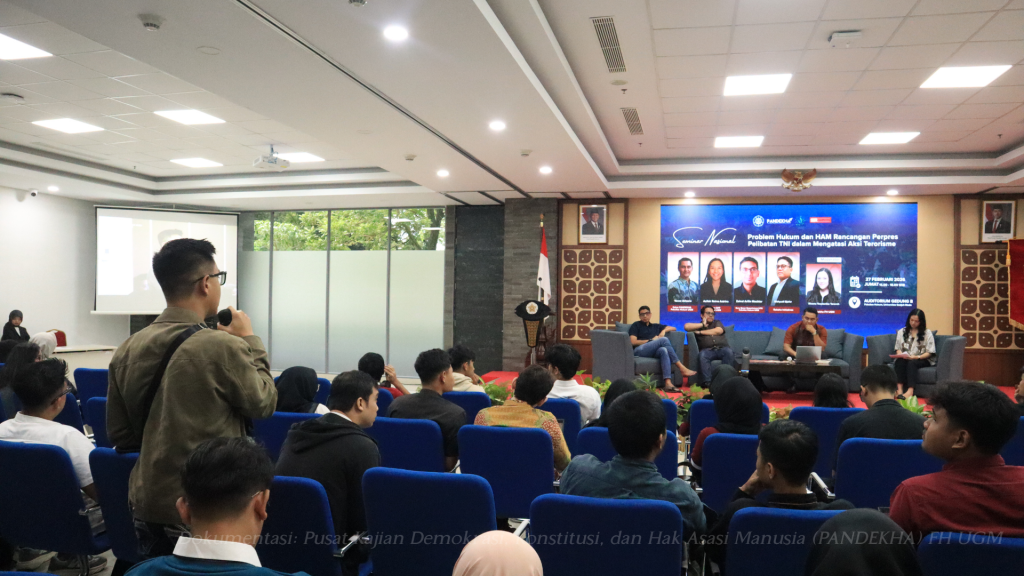
The Centre for Democracy, Constitutional Law, and Human Rights (PANDEKHA) at the Faculty of Law, Universitas Gadjah Mada together with Raksha Initiatives, and the , Civil Society Coalition for Security Sector Reform, organized a National Seminar on the highly topical and strategically important theme "Legal and Human Rights Problems in the Draft Presidential Regulation on Military Involvement in Countering Terrorism”.
The event was held at the Auditorium of Building B, Faculty of Law, Universitas Gadjah Mada, on Friday, February 27, 2026. The seminar critically examined the constitutional law and human rights dimensions, as well as the constitutional implications, of the proposed involvement of the Indonesian National Armed Forces (TNI) in counter-terrorism operations — situating these within the framework of the rule of law and democracy.
The seminar featured four resource persons from a range of backgrounds: Wahyudi Djafar, S.H., M.H., (Co-founder of Raksha Initiatives; Member of the Working Group on Intelligence & Security Agencies Oversight in SSA): Azifah Retno Astrina, S.I.P., M.P.S., Department of Politics and Government, Faculty of Social and Political Sciences, UGM; Prof. Dr. Zainal Arifin Mochtar, S.H., LL.M., Professor of Constitutional Law, FH UGM; and Dr. Yance Arizona, S.H., M.H., M.A., Chair of PANDEKHA FH UGM and lecturer at FH UGM. The session was facilitated by Rivana Tesalonika Taroreh (PANDEKHA FH UGM).
During the discussion, each resource person offered their perspective from their respective area of expertise — drawing on both legal and security dimensions. The discussion delivered a stark warning against the government\'s plan to enact the Draft Presidential Regulation on military involvement in counter-terrorism, which the speakers regarded as a threat to civilian supremacy and the rule of law.
In his analysis, Wahyudi Djafar highlighted serious concern that the introduction of the military into civilian affairs would systematically displace the criminal justice system, “in favor of a”, war model'. From a drafting standpoint, the regulation risks opening up a range of problems — including an unclear definition of terrorism and a lack of accountability mechanisms. The broad language in the draft, such as the phrase "other operations," creates space for an expansive interpretation of enforcement action. An additional concern: if the military becomes too focused on civilian activities, it risks being unprepared for actual combat.
From an international security perspective, Azifah Retno Astrina expressed clear disagreement with military involvement across the full spectrum from prevention through rehabilitation — arguing that the military is designed for combat operations using a command-and-control methodology. Even though the military may be trained to counter-terror, the Police are the institution better equipped to conduct counter-terrorism operations than the military. She acknowledged that the Indonesian National Police (Polri) is better prepared and specifically designed to handle terrorism. Militarizing civilian space threatens civil liberties — making military involvement not a solution, but a problem in itself.
With regard to the draft regulation, Zainal Arifin Mochtar criticized it on several grounds. First, the regulation suffers from a ultra delegata, problem in terms of legal hierarchy: its provisions are substantive in nature and should properly be regulated at the level of statute undang-undang not a presidential regulation, (peraturan presiden). He also identified the elastically defined concept of terrorism as a major concern — one that could be directed at critical groups, activists, and social movements, with the potential to produce a chilling effect on society. The shrinking of civilian space is another risk: from prevention and enforcement to rehabilitation, all authority would be concentrated in the military’s hands. The military\'s proper role is one of assistance — not as a primary actor. He also noted that several provisions in the draft are built without objective limits on TNI involvement, effectively allowing the military to be deployed at any time.
In a similar vein, Yance Arizona observed a broader shift — a reorganization of power visible in the expansion of military appointments into civilian sectors. From a legislative drafting standpoint, the regulation is also problematic: delegating instruments must be specific. Moreover, in practice, Presidential Regulations have increasingly been used as instruments for evading parliamentary oversight — which is precisely the mechanism of democratic civilian control. His core concern was a lack of definitional clarity in the concept of terrorist acts — arguing that an overly broad definition would have wide-ranging consequences and could infringe on human rights.
The seminar reflects a concrete contribution to the Sustainable Development Goals (SDGs) — specifically SDG 16 (Peace, Justice and Strong Institutions), by strengthening the rule of law, human rights protection, and democratic oversight of the security sector. It also supports SDG 4 (Quality Education), by providing a critical and evidence-based academic discourse; and intersects with SDG 10 (Reduced Inequalities), in the context of protecting vulnerable groups from potential abuse of state authority. Through this forum, FH UGM reaffirms its commitment to upholding the principles of a democratic, just rule of law as the foundation of sustainable development.
At the close of the discussion — after examining the range of scenarios that could unfold through the lenses of democracy, human rights, and security — the participants were united in recognizing that the issue of military deployment must not be treated as ordinary or allowed to slip from public scrutiny. These are exactly the kinds of issues that must be examined comprehensively, as a commitment to upholding the rule of law and human rights in Indonesia.
Author: Rivana Tesalonika Taroreh (PANDEKHA FH UGM)