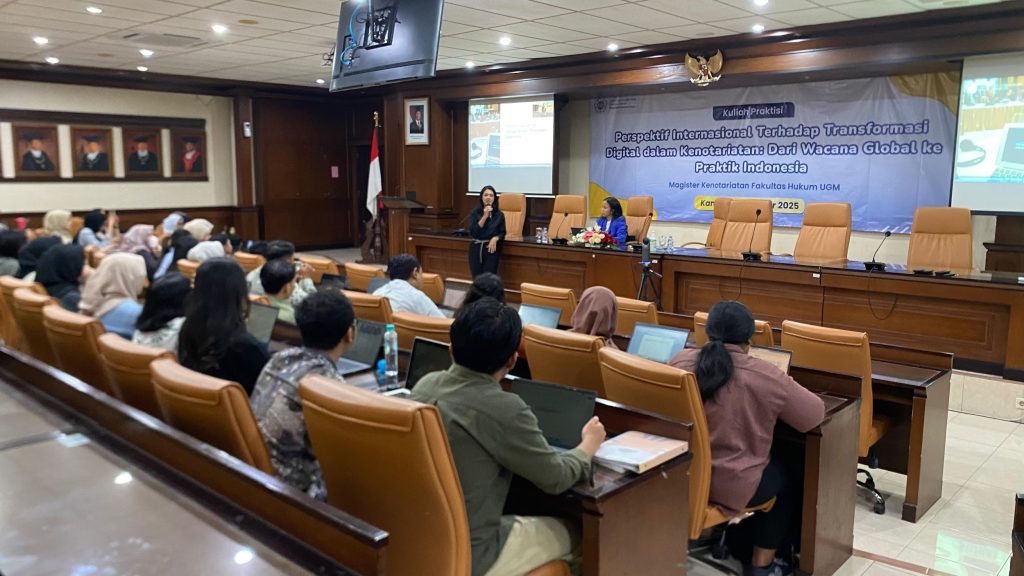
The Master’s Program in Notarial Studies at the UGM Faculty of Law hosted a Practitioner Lecture titled “International Perspectives on Digital Transformation in the Notarial Profession: From Global Discourse to Indonesian Practice” on Thursday (October 23, 2025).
This event featured Prita Miranti Suyudi, S.H., M.Kn., a notary/PPAT who also serves as Vice Chair of the International Cooperation Commission at the International Union of Notaries (UINL) and VAP Asia for CCNI, as the guest speaker, and Alfatika Aunuriella Rini, S.H., M.Kn., Ph.D., as the moderator.
The practitioner lecture aimed to provide insights into the developments and direction of digital transformation in the notarial profession from a global perspective, while also fostering students’ understanding of the dynamics of the notarial profession in the era of legal digitization. Through this event, participants were invited to examine how notarial practices in various countries are adapting to technological advancements.
As one of Indonesia’s notaries active in international forums, Prita Miranti Suyudi shared her experiences regarding Indonesia’s role within the UINL—the umbrella organization for notarial systems under the civil law tradition, which encompasses 93 countries. In her presentation, she highlighted the long journey of digital transformation in the notarial profession, as discussed in various UINL Congresses, which have marked the evolution of technological developments ranging from electronic deeds to Remote Online Notarization (RON).
Furthermore, he explained the progress of notarial digitization in Indonesia, which includes the use of Electronic Signatures (TTE), Electronic Documents (Warkah-El), and Electronic Certificates (Sertipikat-El) within the Ministry of Agrarian Affairs and Spatial Planning/National Land Agency (ATR/BPN) system. He emphasized that digital transformation requires notaries not merely to be followers but also to act as contributors in shaping trustworthy and integrity-driven standards for digital notarial practice.
Amid advancements in technology and artificial intelligence, he asserted that the core values of a notary—as an independent and trustworthy legal expert—remain irreplaceable by algorithms. Technology, he argued, should serve as a tool to strengthen the values of authenticity and legal certainty, not to replace them.
Through this event, students in the Master’s Program in Notarial Studies at the UGM Faculty of Law are expected to broaden their international perspectives and gain an understanding of the challenges facing the notarial profession in the face of global technological change.
As part of the commitment of the Master’s Program in Notarial Law at the UGM Faculty of Law to Sustainable Development Goal (SDG) No. 4: Quality Education, this event reflects the university’s efforts to provide learning experiences that are relevant, inclusive, and responsive to global developments. By featuring experienced practitioners at the international level, this event not only enriches academic knowledge but also strengthens students’ capacity to become competitive and ethical legal professionals in the era of digital transformation.
Author : Program Director of the Master’s Program in Notarial Law, Faculty of Law, UGM.