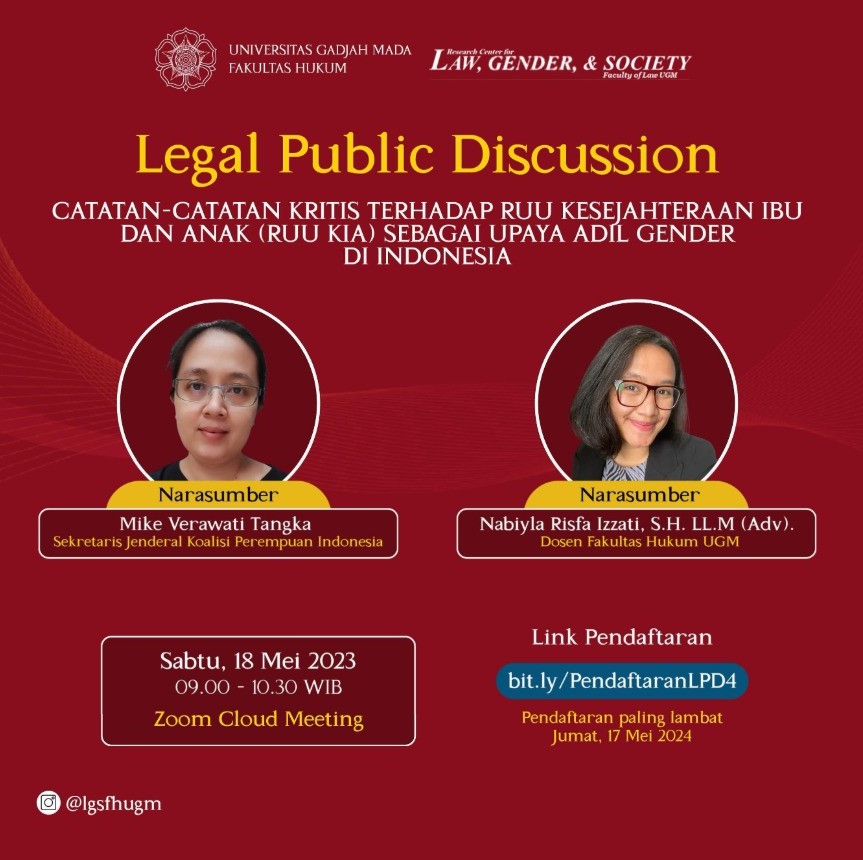
The Research Center for Law, Gender, and Society (LGS), Faculty of Law, Universitas Gadjah Mada, held the Legal Public Discussion (LPD) Series 4 under the theme "Critical Notes on the Mother and Child Welfare Bill (RUU KIA) as an Effort Toward Gender Justice in Indonesia" on Saturday, 18 May 2024, from 09.00 to 10.30 WIB, via Zoom Meeting. The discussion served as a forum to examine the developments, considerations, urgency, and arguments surrounding the RUU KIA, with the aim of strengthening its implementation once it is enacted into law.
The event featured two speakers: Mike Verawati Tangka, Secretary General of the Indonesian Women's Coalition (Koalisi Perempuan Indonesia), and Nabiyla Risfa Izzati, S.H., LL.M. (Adv.), Lecturer at the Faculty of Law, Universitas Gadjah Mada. The discussion was open to students, academics, women's rights activists, and the general public who registered in advance through the official registration link.
Throughout the discussion, the speakers raised several fundamental concerns regarding the RUU KIA. One key critical note was the concern that the bill risks reinforcing gender-based domestic role standardization, as caregiving responsibilities remain predominantly placed on mothers. This framing was seen as potentially reinforcing the notion of "motherism," which runs counter to the spirit of gender equality that should underpin family policy in Indonesia.
The speakers also highlighted the disparity between paternity leave and maternity leave provisions, noting that the current arrangement does not yet fully reflect the principle of shared co-parenting between fathers and mothers. This imbalance risks reinforcing, rather than alleviating, the double burden that women continue to bear across both domestic and public spheres.
Another critical point raised was the limited involvement of civil society organizations and women's rights groups in the drafting process of the RUU KIA, which has resulted in the bill not yet fully reflecting a comprehensive gender justice perspective. The speakers further emphasized the need to strengthen implementation, oversight, and state accountability so that the bill, once passed, can genuinely eliminate discrimination against women rather than institutionalize new gender-biased norms.
Through this discussion, LGS FH UGM hopes to foster critical and constructive dialogue among academics, policymakers, and civil society, while offering substantive input for refining the RUU KIA in line with the principles of gender equality and justice, as mandated by the Constitution and various human rights instruments applicable in Indonesia.
This activity supports the achievement of the following Sustainable Development Goals (SDGs): SDG 3; SDG 5; SDG 8; SDG 10; SDG 16