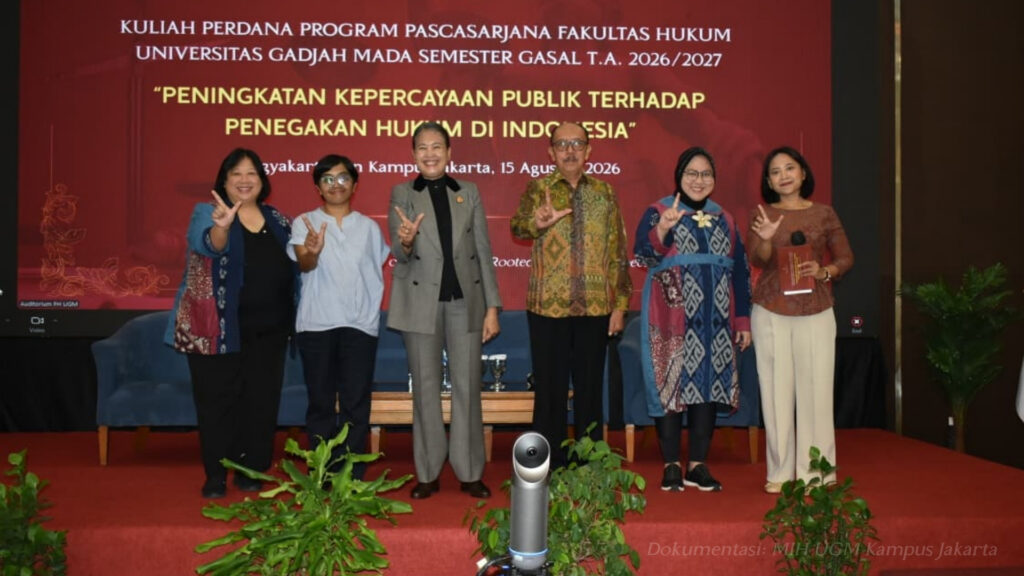
Postgraduate legal education is not solely oriented toward academic achievement, but also toward fostering integrity and strengthening the values of truth, justice, and advocacy for the interests of society. This message was one of the key themes discussed during the Postgraduate Lecture organized by the Faculty of Law, Universitas Gadjah Mada (FH UGM) for seven master’s programs and one doctoral program, including the Master of Laws Program (MIH UGM) at the Jakarta Campus. The event brought together academics, legal practitioners, and leaders of law enforcement institutions.
The event was officially opened by the Dean of FH UGM, who emphasized the importance of students maintaining integrity and public trust in the legal system. Students were also encouraged to manage their time, energy, and intellectual resources effectively throughout their postgraduate studies, while making use of the various research centers available to develop their expertise and make meaningful contributions to society. Dahliana Hasan, S.H., M.Tax., Ph.D. emphasized, “Pursuing postgraduate education is not merely about achieving good grades, but about having integrity, upholding the values of truth and justice, and standing up for those who are vulnerable.”
During the KeUGMan session, Dr. Arie Sujito, S.Sos., M.Si., Vice Rector for Student Affairs of UGM, emphasized the importance of KeUGMan values in responding to technological developments, including AI and ChatGPT. According to him, technological advancement must be accompanied by stronger moral values and integrity. He stated, “KeUGMan values must serve as an anchor that guides our knowledge, values, and commitment when addressing various challenges facing the nation.”
As the opening speaker for the Postgraduate Lecture session, Sri Wiyanti Eddyono, S.H., LL.M.(HR)., Ph.D., who served as moderator, initiated the discussion by highlighting developments in the criminal justice system that increasingly recognize the position of victims through a victim-oriented approach. She also emphasized the importance of integrity among law enforcement officials, transparency in judicial decisions, and effective oversight. These ideas provided an introduction for the speakers to explore broader issues within Indonesia’s criminal justice and law enforcement systems. She noted, “Studying law is not enough if we merely understand legal norms; we must also be able to see the conditions and dynamics occurring within society.”
The first speaker, Brigjen. Pol. (Purn.) Dr. Achmadi, S.H., M.A.P., Chairperson of the Witness and Victim Protection Agency (LPSK), discussed the importance of protecting witnesses, victims, and Justice Collaborators within the criminal justice system. He explained that threats against them do not always take the form of direct intimidation, but may also involve psychological pressure or concealed threats that can affect the safety and mental well-being of victims and witnesses. He emphasized, “Victims experience suffering in many different forms. Therefore, the protection of witnesses and victims requires integrity, empathy, and genuine concern.”
Dr. Nani Indrawati, S.H., M.Hum., Supreme Court Justice of the Civil Chamber of the Supreme Court of the Republic of Indonesia, highlighted the high volume of cases handled by the Supreme Court. She emphasized the importance of preserving the dignity of the judiciary through decisions that uphold justice, legal certainty, and utility, while also strengthening judicial transparency. She stated, “Judges are entrusted with the legitimacy to uphold the dignity of justice, legal certainty, and utility through every decision they render.”
Dr. Martha Parulina Berliana, S.H., M.H., emphasized that the greater the authority vested in law enforcement officials, the greater the responsibility they must bear. She stressed the importance of integrity, due process of law, the principle of legality, and equality before the law in handling cases. She stated, “The greater the authority possessed by law enforcement officials, the greater their accountability.”
Advocate and human rights activist Asfinawati highlighted issues concerning corruption, general criminal offenses, and gross human rights violations. She also emphasized the importance of maintaining the independence of law enforcement institutions and preventing conflicts of interest in the handling of cases. She noted, “When an institution handles a case involving itself, issues of independence and conflicts of interest must receive serious attention.”
Prof. Dr. Marcus Priyo Gunarto, S.H., M.Hum., Professor of Criminal Law at FH UGM, emphasized the importance of maintaining a balance between legal certainty, justice, and utility. According to him, fair treatment strengthens public trust and encourages voluntary compliance with the law. He also reminded law students not to stop at mastering legal theory, but to have the courage to fight for justice. Prof. Marcus encouraged students to “be intellectuals who fight for justice and fighters who think critically.”
The Postgraduate Inaugural Lecture for the MIH UGM Jakarta Campus continued with sessions on information technology, academic information systems, and an introduction to the KMMIH UGM Jakarta Campus. Ahmad Kailani, S.Si., an education staff member, introduced various UGM information technology facilities, including the Single Sign-On (SSO) account used to access SIMASTER, UGM email, Google Education Plus, Microsoft 365, and various other digital services. Students were also introduced to UGM internet services, library resources, journals, theses, and online courses. He explained, “With a UGM account, students can access various university facilities, including both digital services and physical facilities.”
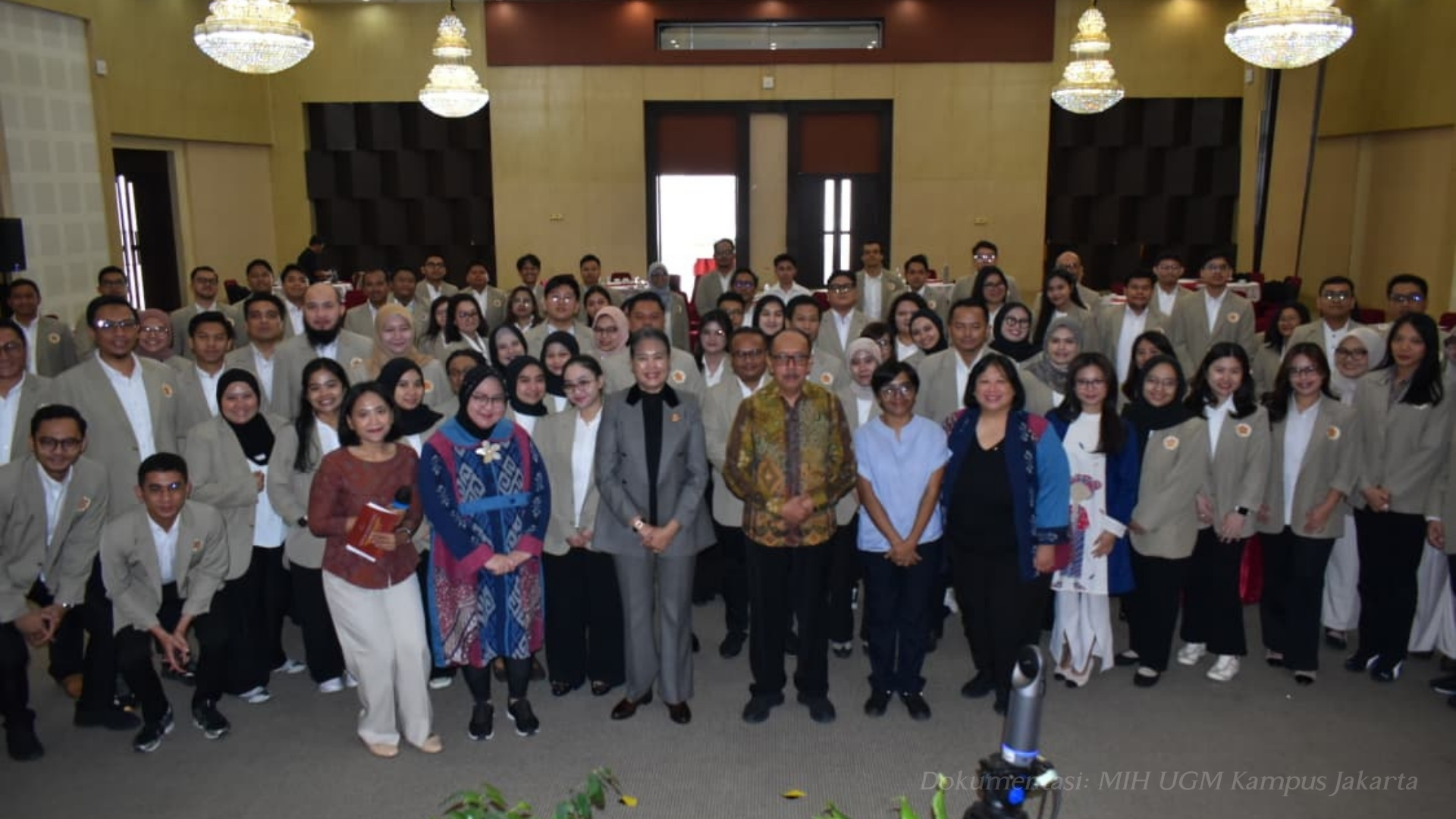
Next, Fa Ijun Sabidin, S.Kom., introduced SIMASTER as UGM’s integrated information system. Students received an overview of NIM, NIU, NIF, attendance, course registration (KRS), access to learning materials and assignments, academic results, and correspondence services at the Faculty of Law through EVIDEN. Students were also reminded to actively monitor their UGM email accounts as an official means of communication throughout their studies. He emphasized, “Understanding the academic system is not merely an administrative matter, but also part of students’ discipline and professionalism.”
Through this Postgraduate Inaugural Lecture, FH UGM hopes to nurture future national leaders and legal professionals with strong integrity who are committed to upholding, enforcing, and safeguarding the law in Indonesia, thereby advancing justice and truth for society as a whole. Ultimately, the event reaffirmed that effective law enforcement requires not only mastery of legal knowledge, but also integrity, justice, transparency, protection of the public, and public trust. Law students have a strategic role in ensuring that the knowledge they acquire contributes to strengthening a legal system that is fair and responsive to the interests of society.
This spirit is also aligned with the Sustainable Development Goals (SDGs), particularly SDG 16: Peace, Justice and Strong Institutions. Values of integrity, access to justice, protection of witnesses and victims, judicial transparency, independence of law enforcement officials, and efforts to build public trust are essential components in establishing legal institutions that are effective, accountable, inclusive, and just.
Author: Ramzy Oansa Ilham