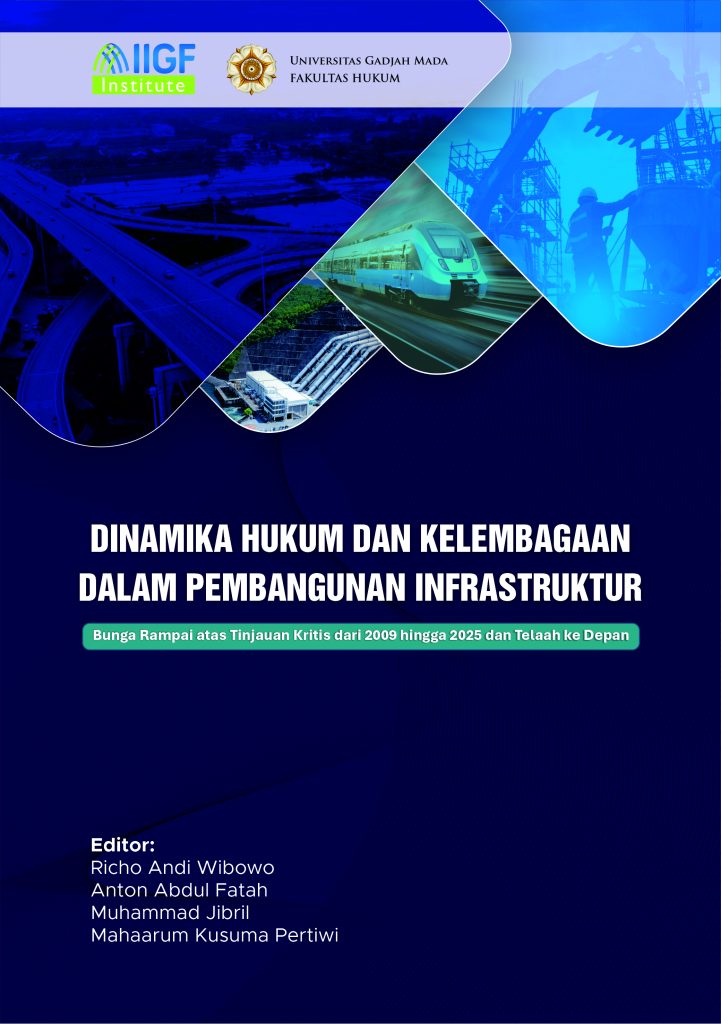
The Faculty of Law at Gadjah Mada University (FH UGM), in collaboration with the IIGF Institute and PT Penjaminan Infrastruktur Indonesia, published the book *Legal and Institutional Dynamics in Infrastructure Development: An Anthology of Critical Reviews from 2009 to 2025 and a Look Ahead* on Tuesday (October 21, 2025). This book emerged from the need to evaluate and provide recommendations regarding the development of infrastructure in Indonesia over the past two decades, from the MP3EI program during the presidency of Susilo Bambang Yudhoyono to the acceleration of national strategic development under President Joko Widodo.
Public infrastructure must be understood not merely as a matter of the success of physical development alone, but as a pillar for implementing equity in the distribution of the “fruits of development,” fostering collaboration among public agencies and with the private sector, and ensuring that no one is left behind in the development process; thus, development must elevate—rather than diminish—the quality of life for the public, including residents affected by projects. Given the increasing complexity of policymaking, the diversity of infrastructure projects, the intricacies of social dynamics on the ground, and limited budget availability, a critical examination of regulations, institutional governance, legal protections for the public, and guarantee schemes has become increasingly important.
This book has three main objectives. First, to evaluate infrastructure development regulations and policies from the perspectives of equity, institutional effectiveness, and financing. Second, to analyze sustainability challenges in infrastructure financing schemes, including social risks and the need for multi-stakeholder synergy. Third, to formulate recommendations based on empirical evaluations to strengthen the formulation of inclusive and equitable public policies.
This book is organized into three main sections: reflections on and reformulation of legal norms, reflections on and reformulation of institutions, and case studies and lessons learned. Contributions from diverse perspectives by 28 authors representing a wide range of stakeholders, including UGM, the IIGF Institute, academics from universities in Java and outside Java, relevant public agencies, and NGOs. The various chapters elaborated by the authors discuss legal policy, government guarantees, the dynamics of inter-institutional coordination, strategies to prevent sectoral egoism and social conflict, strengthening governance, and so on.
The publication of this book also supports the achievement of the Sustainable Development Goals (SDGs). First, through its analysis of inclusive infrastructure development, this book aligns with SDG 9: Industry, Innovation, and Infrastructure, particularly in terms of strengthening sustainable and innovative infrastructure. Second, the discussion on institutional governance and evidence-based policy recommendations supports SDG 16: Peace, Justice, and Strong Institutions, by emphasizing the importance of accountability, transparency, and responsive legal governance. Third, the diversity of the authors and inter-institutional collaboration represent a tangible manifestation of support for SDG 17: Partnerships for the Goals, strengthening academic networks and fostering cross-sectoral collaboration in national development. Furthermore, the discussion on equitable development and the equitable distribution of benefits also reflects a commitment to SDG 10: Reducing Inequalities, particularly in the context of the distribution of development outcomes.
Through the publication of this book, the Faculty of Law at UGM and the IIGF Institute reaffirm their role in enriching the discourse on sustainable development in Indonesia. This work is expected to serve as an important reference for academics, policymakers, industry stakeholders, and civil society organizations in promoting infrastructure development that is not only physically robust but also equitable, inclusive, and human-centered.
The book was curated by four editors: Richo Andi Wibowo (FH UGM), Anton Abdul Fatah (IIGF Institute), Muhammad Jibril (FH UGM), and Mahaarum Kusuma Pertiwi (FH UGM). It is worth noting that this book was intentionally designed for non-commercial purposes. Readers can download it for free, either the entire book at once or specific chapters of their choice. There are two download links available, one from IIGF and one from UGM, as follows: (i) IIGF link; (ii) UGM repository link