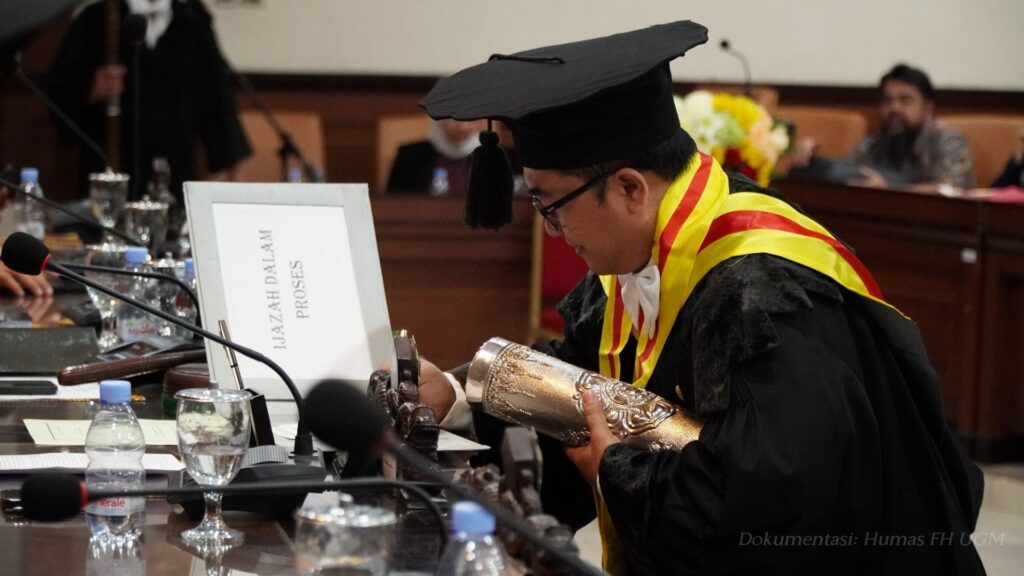
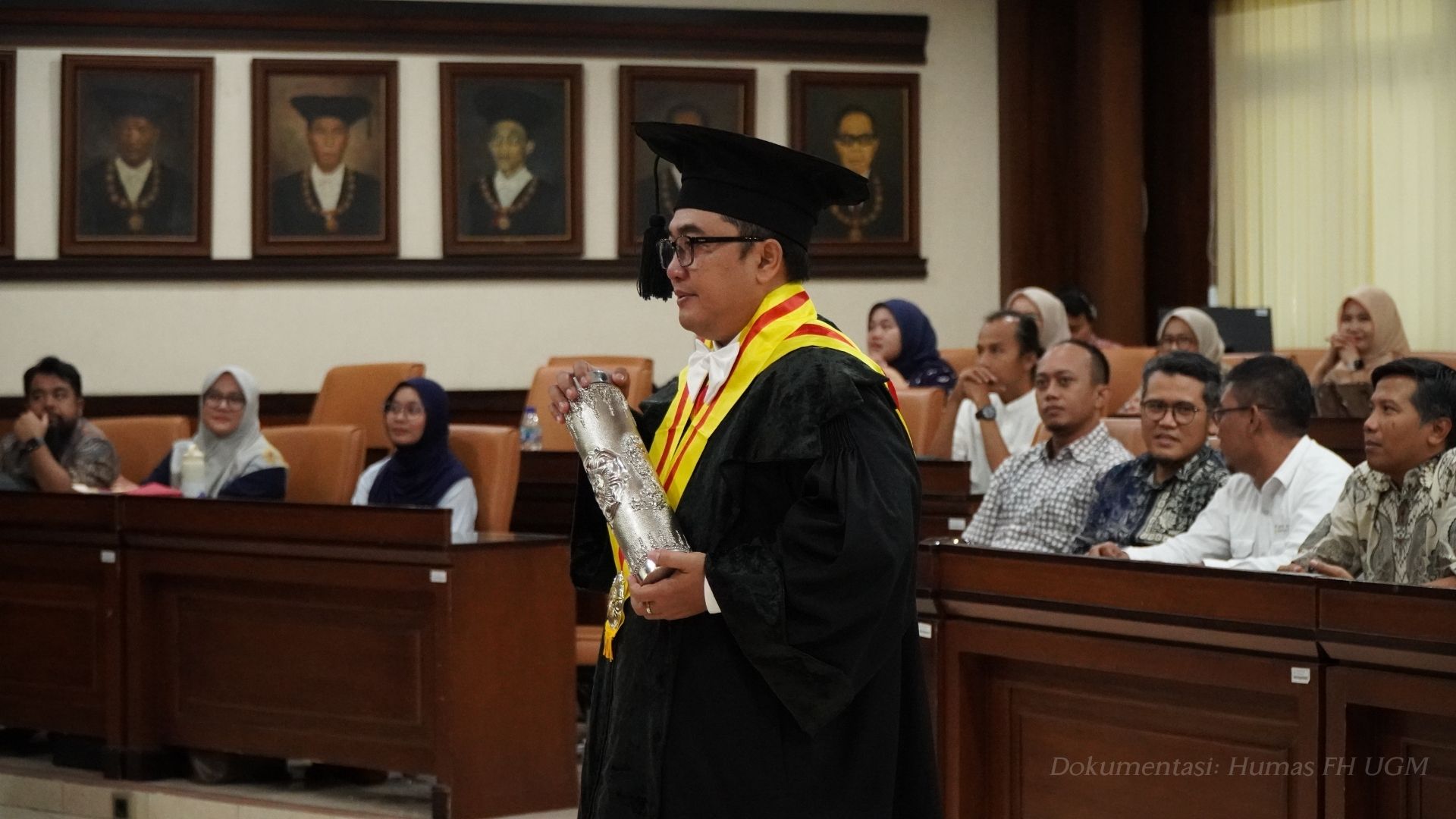
Advances in information technology have fundamentally transformed the landscape of tax administration in Indonesia. Digital services such as e-Faktur, e-Filing, and the Directorate General of Taxes' Coretax system have become the primary platforms through which taxpayers fulfill their obligations. At the same time, the digitalization of transactions has opened up new avenues for criminal conduct that demand greater readiness within the procedural law of the courts. Responding to the challenges of handling digital evidence in the courtroom, Erwan Budi Prasetyo, S.H., M.H. successfully defended his dissertation at the Open Doctoral Defense of the Doctoral Program in Legal Studies at the UGM Faculty of Law (PDIH FH UGM) on Friday, August 28, 2026, in Room III.1.1 of Building 3, First Floor, FH UGM.
Through his dissertation titled "The Application of the Doctrine of Admissibility of Evidence to Electronic Evidence in the Law of Proof of Tax Crimes," Erwan highlighted the still-fragile state of digital evidence governance. Based on an analysis of court decisions, electronic evidence is frequently treated as little more than a summary of physical data. Such practice carries the risk of generating disparities in judicial decision-making, and fails to fully verify the authenticity and integrity of the data which may ultimately harm those seeking justice through the adverse effect of erroneous prejudice (prejudicial effect).
Erwan further proposed the concept of an Evidence Ecosystem (EB Formula). This concept integrates three key pillars: the quality of electronic data information, the traceability of the computing system infrastructure, and regulatory intervention (legal policy). The proposal is further enriched by the introduction of a balancing test through the economic analysis of law approach. Through this instrument, judges are provided with a rational framework for weighing the probative value of digital data against the burden of trial costs, the lawfulness of its acquisition, the benefit of disclosing the material truth, and the aspect of protecting citizens' personal data.
The open doctoral defense was presided over by Dean of FH UGM, Dahliana Hasan, S.H., M.Tax., Ph.D., with Prof. Adrianto Dwi Nugroho, S.H., Adv.LL.M., LL.D. serving as Promotor and Dr. Dra. Dani Krisnawati, S.H., M.Hum. as Co-Promotor. The examining panel comprised Prof. Dr. Marcus Priyo Gunarto, S.H., M.Hum., Dr. Supriyadi, S.H., M.Hum., Dr. Arvie Johan, S.H., M.Hum., and Dr. Sigit Priyanta, S.Si., M.Kom. This achievement confirms Dr. Erwan Budi Prasetyo, S.H., M.H. as the 284th doctoral graduate of the UGM Faculty of Law and the 7,404th doctoral graduate of Universitas Gadjah Mada.
This dissertation has direct relevance to the achievement of the UN Sustainable Development Goals (SDGs) particularly SDG 16 (Peace, Justice, and Strong Institutions) through the modernization of the fiscal criminal justice process to be clean, transparent, and protective of defendants' rights against legally tainted evidence (tainted evidence). The proposal also supports SDG 8 (Decent Work and Economic Growth) and SDG 17 (Partnerships for the Goals) by creating legal certainty for the business climate, securing state tax revenue from leakage, and strengthening strategic collaboration among law enforcement officials, tax authorities, and digital forensic experts in Indonesia.
Author : Wisnu Arya Audanta (Part-Time Staff, Doctoral Program in Law)