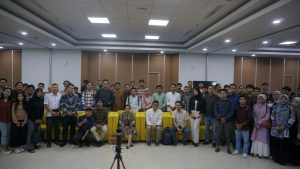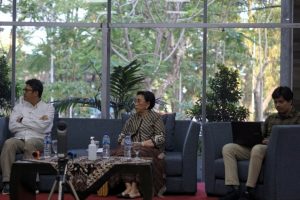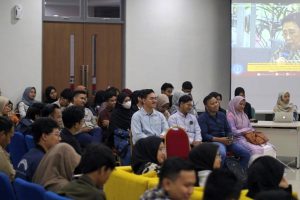
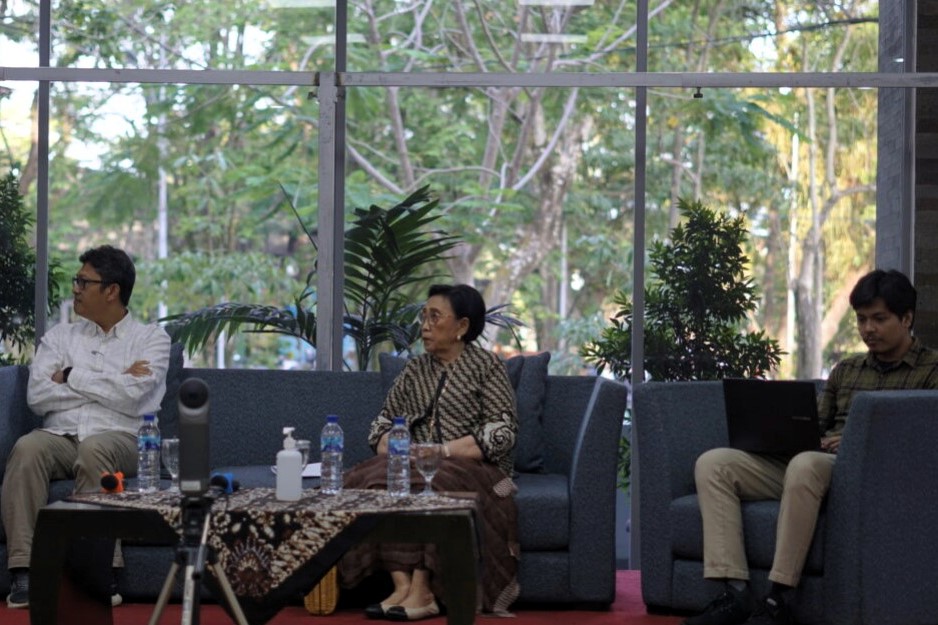
The Center for the Study of Democracy, the Constitution, and Human Rights (PANDEKHA); the Center for the Study of Law and Social Justice (LSJ) at the Faculty of Law, Gadjah Mada University, Yogyakarta, in collaboration with the National Commission on Human Rights (KOMNAS HAM) of the Republic of Indonesia and the Riau Islands Student Forum to hold a discussion addressing critical issues with national implications, focusing on the theme “The Right to Development: Reflections on the Rempang Agrarian Conflict and National Strategic Projects (PSN).” The discussion on the Right to Development is highly relevant to the Sustainable Development Goals (SDGs), to which the Indonesian government has already expressed its commitment to supporting their achievement. The topic of the Right to Development aligns with SDGs 1, 3, 7, 10, 11, 15, and 16.
Given that human rights issues have posed increasingly significant challenges in recent years—one of which relates to the right to development, as reflected in the agrarian conflict in Rempang—if there is no change in the current development strategy, the Rempang case may not be the last amid the implementation of the National Strategic Projects (PSN). Through academic discussions such as this, we can consider and propose alternative solutions for the future to address agrarian conflicts and realize citizens’ right to development. This introduction was delivered by Dr. Yance Arizona, S.H., M.H., M.A., in his opening remarks as Chair of Pandekha.
Rakhmadia Siraj, Chair of the Riau Islands Student Forum, delivered an opening statement during the discussion, noting that the land conflict in Rempang began in the 1980s with an agreement between President Suharto regarding management rights, which were subsequently transferred to BP Batam. Initially, 16 traditional villages were left untouched by BP Batam authorities, but in 2002, BP Batam began securing rights-of-use agreements for the purpose of industrial development. The implication was an overlap between customary lands held by the indigenous community (Rempang) and lands inherited from their ancestors. In 2023, Minister Bahlil signed an agreement regarding a Strategic National Project (PSN) investment; however, the community was not in favor of the relocation, though they did not reject the investment project itself. The rejection of the relocation was justified on the grounds that: 1) The local residents’ livelihood is fishing, and the relocation site is in the middle of an urban area, making access to the sea very difficult; 2) There are cemeteries and ancestral lands that have existed for a long time; 3) There are differences in understanding and perspectives between the indigenous Rempang community and the migrant community regarding the relocation. The current situation in Rempang is that the community remains on high alert under tight security by the police and the Indonesian National Armed Forces (TNI), causing anxiety and discomfort among the residents.
Prof. Dr. Maria S.W. Sumardjono, S.H., M.C.L., M.P.A., a Professor of Agrarian Law at the Faculty of Law, UGM, further explained that the objectives of PSN 2 are: 1) Economic growth; 2) Equitable development for the people’s welfare, while the right to development—as one of the human rights—includes at least three aspects: the right to participate in, contribute to, and benefit from economic, social, cultural, and political development. The Rempang case clearly demonstrates a conflict in relations resulting from one-way communication without community involvement regarding project plans and relocation. He questioned where the balance of fairness lies. When rights are not granted but obligations must be fulfilled—especially since land is a fundamental right guaranteed by the constitution—to what extent can disparities in access be justified? Only to the extent that they benefit the most disadvantaged members of society. The focus of social justice is the fate of the less fortunate members of society. Empirically, according to information from BP Batam, the entire Rempang Island is designated as a conservation forest area, while in the Riau Islands Regional Spatial Plan (RTRW), Rempang Island is classified as a protected forest. So how does this relate to the National Strategic Project (PSN)? Article 24 of Government Regulation No. 23 of 2021 on Forestry Management states that protected and conservation forests may be released for National Strategic Projects. What about the residents of Rempang, whose area is claimed to be a forest zone? There is a 2004 decree by the mayor of Batam stating that the old village should not be designated as an HPL management area under the Batam Authority (now BP Batam); however, since there was no follow-up, no certificates were issued. Meanwhile, in 2019, Minister of Agrarian Affairs and Spatial Planning/Head of the National Land Agency (BPN) Sofyan Djalil distributed 1,406 certificates across three locations in Batam City’s old villages and pledged to complete the certification process for 34 other old villages in Batam. Indirectly, this recognition of the land rights of residents in Batam Island’s old villages also applies to residents of old villages in other locations. Regarding relocation, resettlement, or involuntary resettlement: Voluntary (based on a personal desire to move) versus involuntary (due to coercion or compulsion). The prerequisites for involuntary resettlement include: 1). Initial assessment of social conditions; 2). A detailed relocation plan and its timeline; 3). Restoration of residents’ socioeconomic conditions, employment opportunities, measures to address emerging issues, monitoring, and evaluation, as the standard should be Replacement Value. In other words, relocation cannot be determined unilaterally and must involve the community, especially those affected. Proper resettlement should provide individuals with the opportunity to visit and assess the location to which they will be moved, so that they have options to consider. A non-participatory relocation offer essentially leaves significant problems unresolved because it fails to account for residents’ psychological conditions, such as: 1) Fears of losing their history or identity; 2) Being uprooted from existing social networks; 3) Uncertainty about starting a new life in a new place; and 4) The potential for horizontal conflicts among nearby residents. Relocation without participation will be difficult for affected residents to accept. Offering relocation options and facilities while determining recipient priorities—without giving the community time to reflect and make choices or decisions—gives the impression that relocation is the only way out. Reactive decisions lead to outcomes like this, and the mistakes made must also be corrected reactively.
Saurlin P. Siagian, S.Sos., M.A., as a Commissioner of the Indonesian National Human Rights Commission (Komnas HAM), provided a response regarding the investigation into agrarian conflicts, particularly the Rempang incident. In 2023, Komnas HAM received an additional 692 significant complaints regarding agrarian conflicts. Cumulatively, from January 2021 through August 31, 2023, the total number of agrarian conflict complaints reached 1,532 cases. Currently, the Agrarian Team is conducting a comprehensive study of agrarian conflicts, which is expected to produce a human rights-based roadmap for resolving agrarian conflicts. In developing this roadmap and recommendations, the Agrarian Team is coordinating and collaborating with various ministries, agencies, local governments, and civil society organizations in Indonesia. Furthermore, Komnas HAM assesses that the reported agrarian conflicts are linked to government policies and decisions—both at the national and sectoral levels, including at the local level—that have failed to deliver justice to the public. Complaints regarding agrarian conflicts are piling up at the National Commission on Human Rights (Komnas HAM), as existing resolutions are inadequate and do not involve the inter-ministerial coordination required to resolve the existing issues. Among the four sectors with the highest number of agrarian conflict complaints—namely land, plantations, infrastructure, and housing—80 percent involve land disputes. Cases submitted to Komnas HAM are closely interlinked across sectors; for example, land disputes are often tied to plantation and infrastructure issues. Regarding the Rempang case, several findings by Komnas HAM led to the following stances, positions, and recommendations: 1). Requesting the Government to review the development of the Rempang Island Eco City Area as a Strategic National Project (PSN) based on Ministerial Regulation No. 7 of 2023; Requesting that the Ministry of Agrarian Affairs and Spatial Planning (ATR) and the National Land Agency (BPN) refrain from issuing Land Use Permits (APL) on Rempang Island, given the potential for human rights violations; Relocation must be carried out voluntarily, without coercion, and adequate housing must be provided in accordance with residents’ needs; The government must engage in sufficient and meaningful dialogue and public outreach regarding these development and relocation plans; the government must respect the wishes of the affected communities not to relocate, thereby eliminating the need to relocate residents; and must not resort to violence or involve law enforcement in the relocation process or matters related to the PSN on Rempang Island. The National Commission on Human Rights also hopes that the government’s commitment to improving the implementation of the Rempang Eco City Project will be reflected in transparent policies and that these policies will be developed in consultation with the affected communities there.
Herlambang P. Wiratraman, S.H., M.A., Ph.D., as Chair of the LSJ at the Faculty of Law, UGM, stated that there are several fundamental issues that are not being treated as problems, such as: 1) The Rempang Eco City project was elevated in status after receiving investment, even though it had not previously been designated as a National Strategic Project (PSN) as of August 28, 2023; 2) The implication is forced eviction, which is in fact contrary to the Constitution. The right to development (RTD) addresses not only individual interests but also the collective rights of communities. Our legal perspective is dominated by the state, even though law in a local context exists within a pluralistic society; 3) The politics of soft narrative. The concepts and background of the Right to Development include: 1) collective issues that must be recognized within human rights; 2) far too many cases in which people’s rights have been disregarded due to colonialism, imperialism, and massive projects that displace them; 3) far too many human rights violations of an excessive nature. I agree that “there is a close link between the Job Creation Law and the massive National Strategic Projects (PSN) that violate the fundamental principles of the Right to Development.” Whose interests are prioritized when national strategic projects are planned? According to the declaration, the Right to Development is: 1) Society, as the primary beneficiary of development; 2) Consequently, the state bears the primary responsibility for creating conditions that support the development of society and individuals; 3) The affirmation that the right to development is an inalienable human right that must not be violated, including the right to adequate housing and the right to work. The principles that need to be considered when the Right to Development is viewed as a key concept and approach are: 1) a Human Rights-Based Approach; 2) national and international dimensions; 3) People-Centered Development; 4) Participation. In this regard, the state’s obligations are essentially: 1) The state must formulate national development policies aimed at improving well-being through active, free, and fair participation, as well as the equitable distribution of the benefits generated; and 2) The state must take decisive action to eliminate human rights violations and recognize the fundamental right of communities to determine their own destiny.
“As long as development fails to uphold the principle of human dignity—a fundamental human right—it is not development, but rather colonization, marginalization, and exploitation”—Herlambang P. Wiratraman. [Yogyakarta, September 27, 2023].
(Author: Tria Noviantika – Wednesday, 27 September 2023)
Dokumentasi Kegiatan