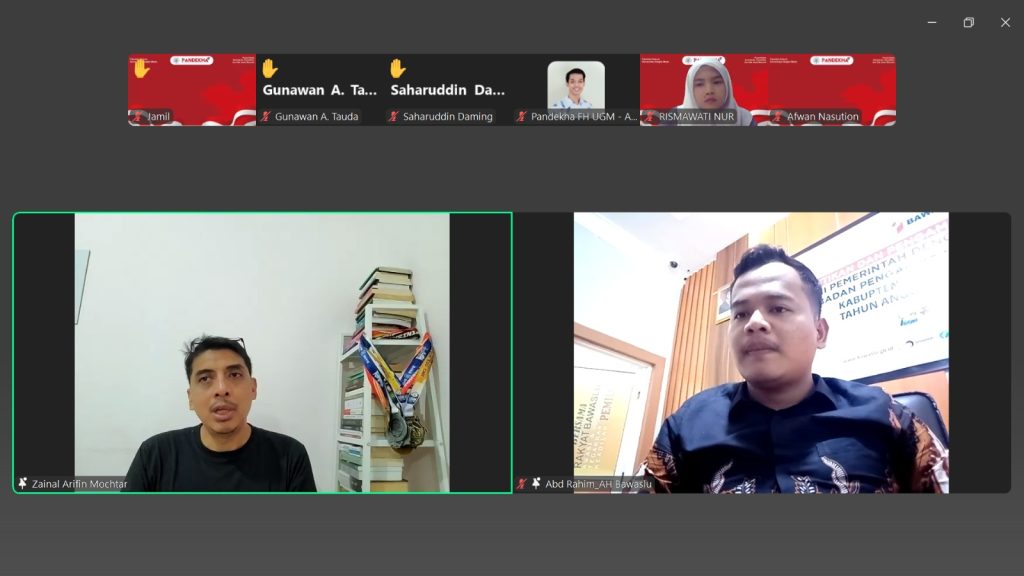
The Center for the Study of Democracy, the Constitution, and Human Rights at the Faculty of Law, Gadjah Mada University, in collaboration with the Department of Constitutional Law, hosted a public discussion titled “Separating National and Regional Elections: Strengthening Democracy or a Threat to People’s Sovereignty?”. This online event drew significant public enthusiasm, with over 300 participants from diverse backgrounds, including academics, students, and election observers.
This discussion was held as an academic response to the issuance of Constitutional Court Decision No. 135/PUU-XXII/2024, which separates the schedules for national and regional elections. The panelists for this forum included Dr. Zainal Arifin Mochtar, S.H., LL.M., Chair of the Department of Constitutional Law at the Faculty of Law, UGM; Prof. Dr. Muchamad Ali Syafa’at, S.H., M.H., from the Faculty of Law at Brawijaya University; and Dr. Hurriyah, S.Sos., a researcher at the Center for Political Studies at the University of Indonesia. The discussion was moderated by Rismawati Nur.
All three speakers generally expressed their support for the policy direction of separating elections. According to them, separating the schedules for national and local elections can bring a number of strategic benefits to Indonesian democracy. One of these is providing more space for local issues to emerge and become a primary focus in political contests. Additionally, the separation is seen as making it easier for voters to identify the candidates running at each level, thereby enhancing the quality of public political participation.
On the other hand, this policy is also seen as an opportunity to strengthen political parties, both at the national and regional levels. With separate election schedules, political parties have the opportunity to consolidate further and develop a more structured cadre system that is better tailored to local needs.
In the context of sustainable development, the separation of elections is also consistent with the commitment to the Sustainable Development Goals (SDGs), particularly Goal 16: Peace, Justice, and Strong Institutions. The restructuring of the election schedule is expected to promote a more democratic, representative, and equitable leadership succession process, both in the legislative and executive branches.
In addition, this public discussion is part of the political education and constitutional literacy initiatives organized by higher education institutions. This event provides a learning opportunity for the public, including students and academics, to understand changes in election policies and their impact on democracy. This is, of course, in line with Goal 4: Quality Education.
This event serves as an important forum for reflection on the future direction of Indonesia’s electoral system reform, and demonstrates the academic community’s tangible contribution to upholding the integrity of constitutional democracy in Indonesia.
Writer: Mochamad Adli Wafi