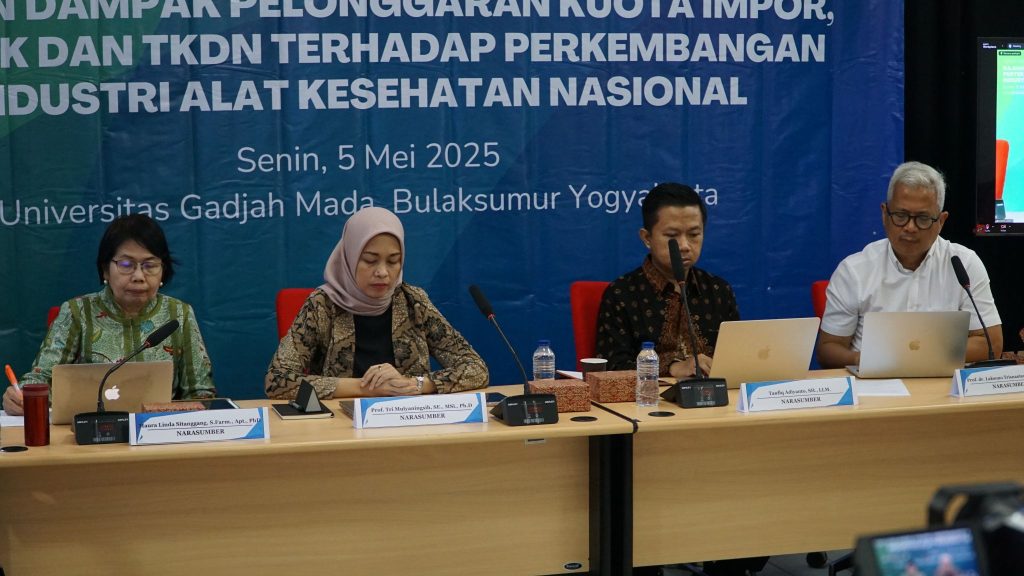
On Monday (May 5, 2025), Taufiq Adiyanto, S.H., LL.M., a lecturer from the Department of Tax Law, Faculty of Law, Universitas Gadjah Mada, served as a speaker in a Focus Group Discussion (FGD) entitled "The Impact of Import Quota Relaxation, Elimination of Technical Considerations (Pertek), and TKDN Policy on the Development of the National Medical Device Industry." The event was organized by the Center for Health Policy and Management (PKMK) FK-KMK UGM in collaboration with ASPAKI and HIPELKI.
The discussion was held in response to the United States' reciprocal tariff policy, which has the potential to impact global trade and the domestic medical device industry. The main focus of the meeting was to examine the impact of changes in import policy and technical regulations on the sustainability and competitiveness of national medical device manufacturers.
In his presentation, Taufiq Adiyanto emphasized the important role of legal and economic education in analyzing the complexities of public policy in the health sector. He stated that education plays a strategic role in fostering in-depth understanding among stakeholders, thereby strengthening data-based decision-making and the values of justice. This aligns with SDG 4 (Quality Education) and SDG 16 (Strong Institutions).
Adiyanto also highlighted the importance of an adaptive legal framework to support industry growth, while maintaining safety and quality standards for medical devices. He stated that policy relaxation must be balanced with effective oversight to avoid compromising public safety. This approach supports SDG 3 (Health and Well-Being) by promoting safe and sustainable healthcare services.
The shift in the TKDN policy from a mandatory to an incentive approach was also discussed as an opportunity to encourage domestic innovation. In this context, vocational training and education for local industry players are crucial for increasing national competitiveness and encouraging inclusive industrial sector growth, in line with SDG 8 (Decent Work and Economic Growth).
This FGD serves as an important forum bringing together academics, industry players, and policymakers to develop strategies responsive to global dynamics. Continuous dialogue and cross-sector collaboration are seen as key to creating a sustainable and competitive medical device industry ecosystem.
Taufiq concluded the discussion by reaffirming that education is not only a tool for transferring knowledge, but also a foundation for creating fair and visionary policies to support the transformation of the national medical device industry.