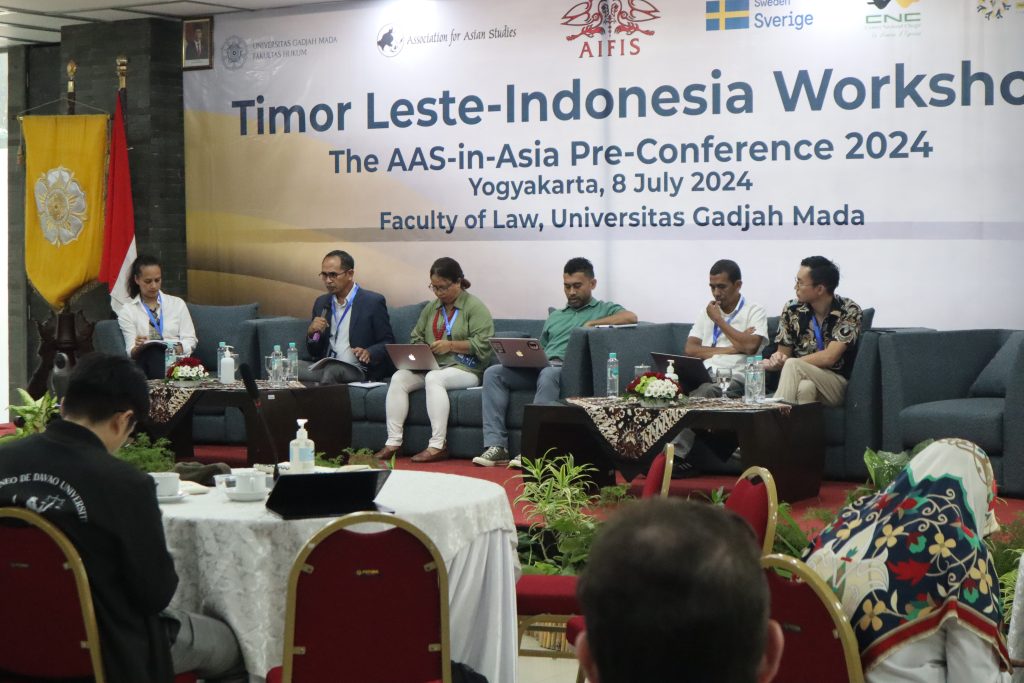
The first panel of the Timor-Leste–Indonesia Workshop at AAS-in-Asia 2024, titled "Remembering RENETIL and Timorese Students," brought together scholars for a substantive discussion on the history and significance of the Timorese student movement, RENETIL (Resistência Nacional dos Estudantes de Timor-Leste), and its role in the country's independence struggle. The workshop was held on Monday, July 8, 2024, at the Auditorium of the UGM Faculty of Law. The event was a collaborative effort between the Swedish International Development Cooperation Agency (SIDA), Centro Nacional Chega! (CNC) Timor-Leste, the UGM Faculty of Law, and UGM, and formed part of the AAS-in-Asia Conference 2024, themed "Global Asias: Latent Histories, Manifest Impacts."
Panel discussion was moderated by Krishna Uk of the Association for Asian Studies. Speakers included Joaquim da Fonseca, Secretary-General of RENETIL; Nuno Rodrigues Tchailoro and Rogerio Savio, independent researchers from Timor-Leste; Takihiro Kamisuna, a doctoral candidate from the University of Cambridge; and Laurentina (Mica) Barreto Soares from the Universidade Nacional Timor Lorosa'e.
The panel offered rich historical insight into the strategies and contributions of RENETIL — founded in 1988 — which emerged from the collective struggle of Timorese students facing isolation and suppression under Indonesian rule. Among its key achievements, RENETIL forged strategic alliances with the Indonesian Democracy Movement (IDM), a partnership that contributed to the fall of the Suharto regime.
Discussions also explored the social and political dynamics shaping relations between Indonesia and Timor-Leste, including how student movements from both countries supported each other in resisting authoritarianism. Notable attention was given to the role of women within RENETIL, often overlooked in mainstream historical narratives, who played a crucial role in sustaining the independence struggle through logistical and political support.
The panel ultimately affirmed the importance of cross-border solidarity in confronting oppression, and the need to acknowledge women's contributions to independence movements. It also highlighted how RENETIL's legacy continues to carry relevance within the social and political landscape of Timor-Leste and its relationship with Indonesia today.