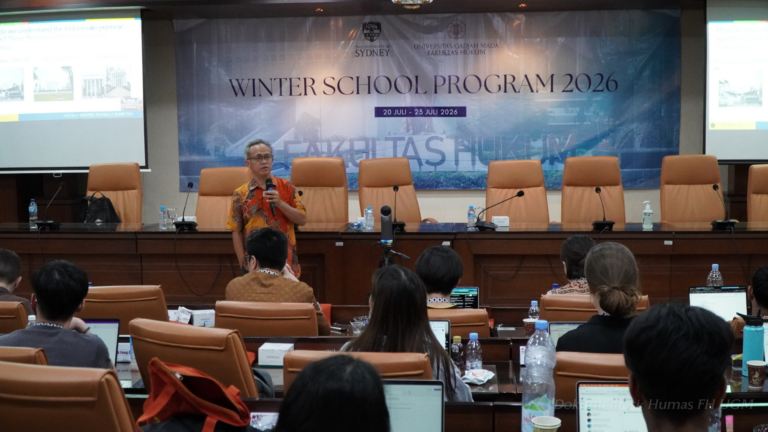

On Saturday, February 21, 2026, a national seminar was held under the title “Weighing the Application of Deferred Prosecution Agreements in Handling Corporate Corruption: An Effective Solution for State Loss Recovery or a Form of Erosion of Criminal Accountability?” The seminar was organized by the Master of Laws Program (MIH) Jakarta Campus and held on the 9th Floor of Tower B, UGM Jakarta Building. The forum brought together representatives of government, the judiciary, academia, and practitioners to examine in depth the direction of national criminal law reform — particularly in the aftermath of the regulation of Deferred Prosecution Agreements (DPA) under the 2025 Code of Criminal Procedure (KUHAP).
The seminar was opened by Prof. Dr. Heribertus Jaka Triyana, S.H., LL.M., M.A. Vice Dean for Research, Community Service, and Information Systems at the UGM Faculty of Law. In his remarks, he affirmed that the reform of the National Penal Code and the new Code of Criminal Procedure marks a profound shift in Indonesia\'s criminal law system. The paradigm — once oriented primarily toward retribution — is now moving toward a more rehabilitative and restorative approach. The recognition of corporations as subjects of criminal law and the application of the double track system signals that sentencing is no longer solely about punishment, but also about recovery and improved governance.
The keynote address was delivered by Prof. Dr. Asep N. Mulyana, S.H., M.Hum. Acting Deputy Attorney General and Head of the General Crimes Division. He explained that the 2025 Code of Criminal Procedure introduces a number of important innovations, including the DPA as a mechanism for deferring prosecution against corporations before a case is referred to court. He described the DPA as a hybrid instrument — situated within the criminal regime yet employing a negotiated approach under strict judicial supervision. He emphasized that the modern approach to law enforcement goes beyond merely following the suspect— it also means “following the money" and "following the asset". Law enforcement, in this framework, does not stop at criminal conviction but extends to the recovery of state losses and systemic reform.
The philosophical direction of national sentencing policy was addressed by Prof. Dr. Edward Omar Sharif Hiariej, S.H., M.Hum., Deputy Minister of Law of the Republic of Indonesia. He affirmed that Indonesia\'s sentencing system is now moving toward corrective, restorative, and rehabilitative justice. In the corporate context, imprisonment is not the primary instrument. The DPA, in his view, can serve as a means of ensuring state loss recovery while maintaining economic stability and business continuity — provided it is implemented transparently and accountably.
From an academic perspective, Dr. Febby Mutiara Nelson, S.H., M.H., surveyed DPA practice across various jurisdictions. She drew on corporate case settlements in the United Kingdom and the United States — including the cases of Rolls-Royce Holdings plc and The Boeing Company — as examples of how DPAs have been able to drive the payment of substantial fines while simultaneously driving reforms to internal compliance systems. She underscored that institutional design is critical to the success of a DPA — particularly regarding judicial oversight and the transparency of the criminal justice process.
Meanwhile, Dr. Albertina Ho, S.H., M.H. President of the East Kalimantan High Court, highlighted the central role of the judge in the DPA mechanism. She stressed that judicial approval of a DPA is not a mere administrative formality. Judges are required to substantively assess the compliance of the agreement's terms with the applicable law, the proportionality of the obligations imposed, its impact on victims and society, and the corporation's capacity to fulfill its commitments. If obligations are met, the case may be discontinued; conversely, a breach of the agreement reopens the door to prosecution.
From a practice standpoint, Eri Hertiawan, S.H., LL.M., MCIArb., noted that global experience has demonstrated the DPA's effectiveness in recovering state losses and avoiding systemic impacts on the economy. He cautioned, however, that DPA application must be selective and based on clear parameters to avoid creating the perception of impunity for large corporations.
Further perspectives were offered by Dr. Didik Sasono Setyadi, S.H., M.H. Arbitrator of the Indonesian Energy Dispute Arbitration Board. He opened by discussing the concept of white-collar crime as introduced by Edwin Sutherland — referring to crimes committed by individuals or corporations in the exercise of their professional positions or activities. Corporate crime, he argued, has systemic and far-reaching consequences, ranging from state financial losses to threats to public welfare. Dr. Didik affirmed that the new Penal Code provides a strong normative foundation by recognizing corporations as subjects of criminal law. Criminal liability can be attributed not only to formal executives, but also to those who give orders, those who exercise control, and even to beneficial owners. He elaborated on various theories of corporate criminal liability — including the identification theory, vicarious liability, and strict liability — all of which are relevant in establishing the element of fault.
The discussion, moderated by Dr. Muhammad Fatahillah Akbar, S.H., LL.M., was dynamic and critically engaged. The speakers agreed that the DPA is not a form of corporate amnesty — it is a criminal policy instrument that must be positioned carefully within Indonesia\'s criminal justice system. Its success is highly contingent on the integrity of law enforcement officials, effective judicial oversight, and a genuine commitment to making state loss recovery and governance reform the central priorities.
The seminar is also aligned with the Sustainable Development Goals (SDGs)— in particular SDG 16 (Peace, Justice and Strong Institutions). The discourse surrounding DPA and criminal justice system reform contributes to building transparent, accountable, and effective legal institutions. The discussion of corporate governance and state loss recovery also intersects withSDG 8 (Decent Work and Economic Growth) and SDG 17 (Partnerships for the Goals) in the pursuit of sustainable development.
The seminar was attended not only by UGM MIH Jakarta Campus students from the Business Law, Litigation Law, and Immigration Law concentrations, but also by students from universities across Indonesia who joined online. Government institutional representatives and law enforcement officials — including a delegation from the Supreme Court of the Republic of Indonesia — also participated, enriching the discussion with practical and institutional perspectives. This cross-institutional participation demonstrates that the issues of DPA and corporate criminal liability are not merely academic concerns — they are a shared agenda in strengthening the national legal system. Through this forum, the UGM MIH Jakarta Campus reaffirms its commitment to serving as a space for critical reflection and genuine contribution to legal reform that supports transparent, just, and sustainable governance.
Author: Ramzy Oansa Ilham (Part-Timer, MIH Jakarta Campus