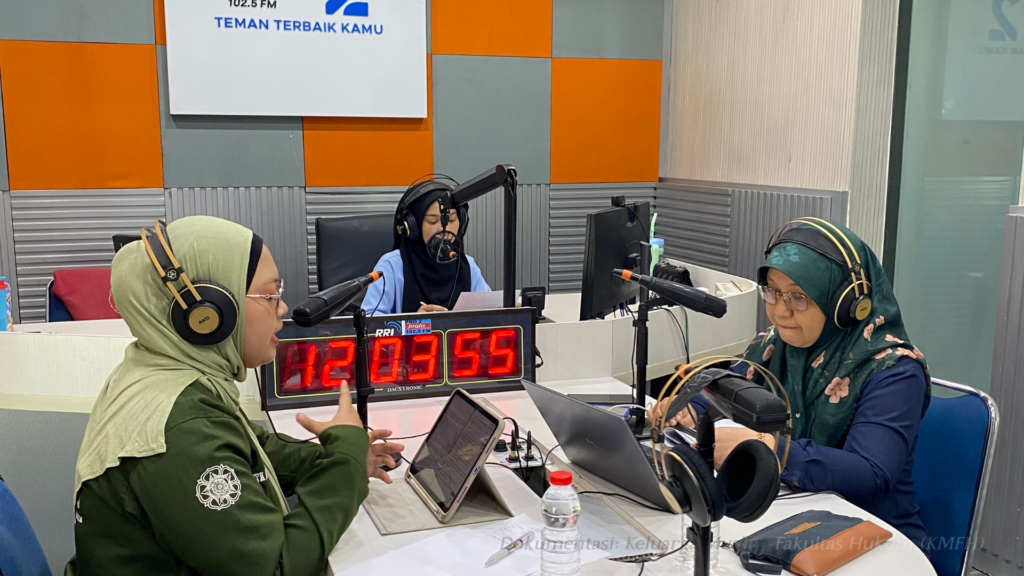
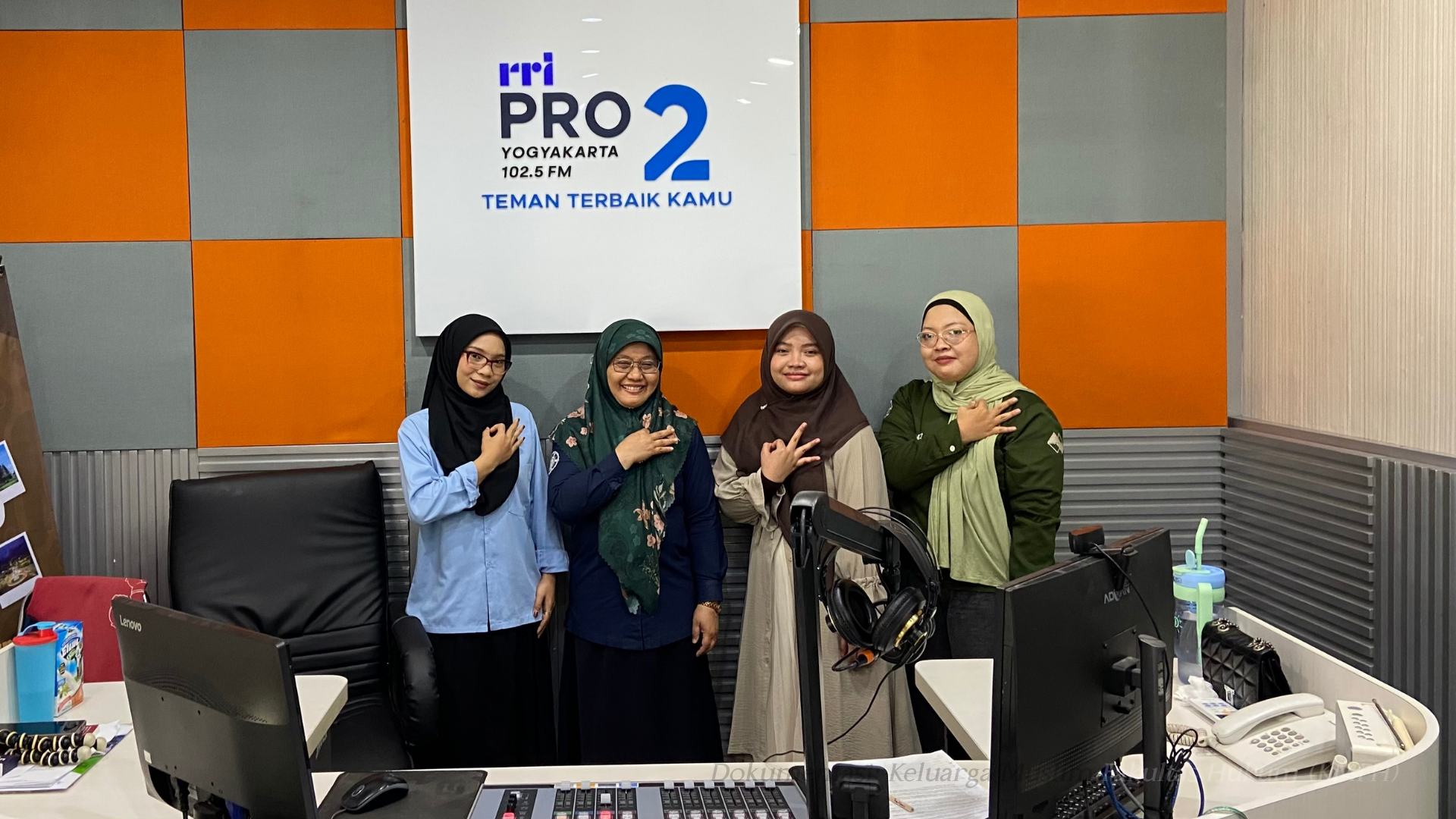
The Muslim Family of the Faculty of Law, Universitas Gadjah Mada (KMFH UGM), once again delivered a legal awareness session for the public through the ‘Santai Siang’ programme on Radio Republik Indonesia (RRI) Pro 2 Yogyakarta, on Wednesday (2/9/2026). Under the theme “Inheritance Is Not a Matter for Later: The Importance of Promptly Settling Inheritance and the Procedures for its Administration from an Islamic Law Perspective”, the event discussed the importance of understanding rights and obligations in the distribution of inheritance whilst encouraging the public not to delay the settlement of an estate.
The event formed part of a community service grant from the UGM Faculty of Law, initiated by Okta Amaliya Fitriana and Hadza Unzila Ilaina, UGM Faculty of Law students from the 2024 intake. This legal awareness session featured Prof. Dr. Hartini, S.H., M.Si., Professor of Islamic Law at the UGM Faculty of Law, as the guest speaker, who provided a comprehensive explanation regarding the importance of expediting the distribution of inheritance from an Islamic legal perspective.
Under Islamic law, the process of distributing an estate involves certain stages that must be observed before the assets are distributed to the heirs. Obligations relating to the deceased, including funeral arrangements, settlement of debts, and execution of wills, must first be fulfilled. Only after these obligations have been settled can the remaining assets be determined as inheritance and distributed to those legally entitled to receive it. Furthermore, when determining heirs, family ties do not automatically entitle a person to receive an inheritance, as there are certain conditions that may prevent someone from inheriting.
Delaying the distribution of inheritance without clear justification may give rise to further complications. In addition to delaying the resolution of each heir’s rights, such a delay may open the door to conflict amongst family members. The situation can become even more complicated if one of the heirs dies before the distribution process is completed. In such circumstances, successive inheritance (kewarisan bertingkat) may occur, meaning that assets which were originally intended to be transferred to a single heir must go through a subsequent inheritance process. This can make the administrative process and transfer of rights more complex, particularly when the inherited property consists of land or other real estate.
However, prompt settlement of an estate must still take into account the specific circumstances of each family. Distribution may not be possible if disputes remain, unresolved legal relationships with third parties persist, or the deceased's obligations remain unsettled. Thus, ‘promptly’ does not always mean carried out at the same time for every family, but rather adapted to the conditions and settlement requirements of each case.
Another issue highlighted during the discussion was the cultural reluctance, or sungkan, that makes some people feel uncomfortable discussing an estate immediately after a family member’s death. Amid the perception that discussing property shortly after someone's death may be considered insensitive or even greedy, the public needs to understand that settling inheritance matters can instead be viewed as part of the family's responsibility. Discussions can be initiated gradually, for example by first identifying the deceased's outstanding obligations, so that family conversations do not immediately focus on the distribution of assets.
The program also discussed the possibility of resolving inheritance matters through tasaluh, or reconciliation. Heirs may reach an agreement concerning the distribution of the estate after first determining the share to which each heir would be entitled under Islamic inheritance law. Such an agreement must be reached through mutual consent among all relevant parties and through deliberation. Consequently, an understanding of each heir’s rights is essential before any distribution agreement is drawn up.
The question-and-answer session with listeners also highlighted a number of current issues relating to the distribution of an estate. One of these concerned parents’ assets being used to settle a child’s debts, including those arising from online gambling. In addressing this issue, the guest speaker explained that the status of the assets must first be considered. If the parents are still alive, these assets are, in principle, not yet subject to inheritance. The use of these assets must then be assessed in terms of their legal framework, including the possibility of them being treated as a gift to the child who has already benefited from the assets should inheritance take place at a later date.
Another question concerned an heir who dies before their parents’ estate is distributed. The discussion introduced the distinction between successive inheritance and the concept of a substitute heir (ahli waris pengganti). Based on the explanation provided during the broadcast, when an heir is still alive at the time of the testator’s death but subsequently dies before the estate is distributed, their rights essentially remain intact, and the inheritance process may continue through successive inheritance. Meanwhile, the concept of a substitute heir is governed by specific provisions in the Compilation of Islamic Law and the development of its application.
The legal briefing also addressed situations where the whereabouts of one of the heirs are unknown. In Islamic law in Indonesia, there is the concept of ‘mafqud’, which refers to a person who has gone missing and whose whereabouts are unknown. In such circumstances, the opening and distribution of the estate may proceed once a court ruling has been issued regarding the ‘mafqud’ status. However, the share to which the person whose whereabouts are unknown is entitled must still be set aside as a precaution in case the person returns, or another party with a claim to that share comes forward.
This legal awareness programme is also linked to the achievement of the Sustainable Development Goals (SDGs), particularly SDG 16 on peace, justice and strong institutions. Education on rights and obligations regarding the distribution of inheritance can help the community understand the appropriate mechanisms for resolving legal issues and encourage the settlement of disputes through consultation and reconciliation. Improving public understanding of rights, obligations, and procedures relating to inheritance is expected to help encourage the proper resolution of legal matters and reduce the potential for conflict within families.
Through this legal awareness programme, KMFH UGM aims to provide legal education that is closely aligned with the issues faced by the community in their daily lives. The distribution of an estate is not only about who receives the assets, but also concerns the settlement of the deceased’s obligations, the certainty of the heirs’ rights, and the continuity of family relationships. Therefore, the settlement of an estate must be carried out with an understanding of legal provisions, taking into account the circumstances of each family, and prioritising consultation and reconciliation so that the inherited assets do not become a source of conflict within the family.
Author: Okta Amaliya Fitriana Hadza Unzila Ilaina (Keluarga Muslim Fakultas Hukum)