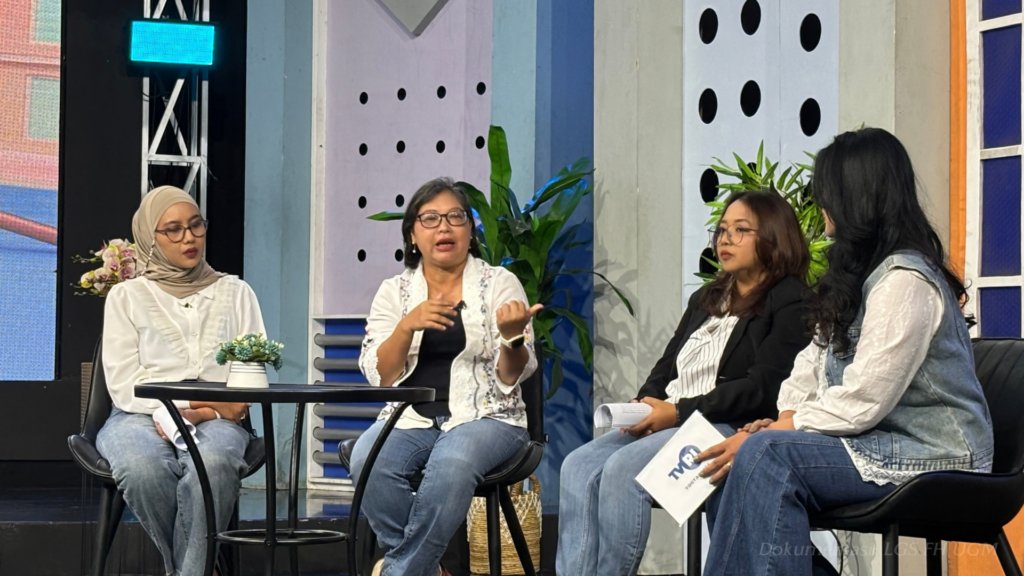
Through the Lecturer Legal Outreach Grant Program (Hibah Penyuluhan Hukum Dosen/HPHD) 2026, UGM Faculty of Law Lecturer Sri Wiyanti Eddyono, S.H., LL.M.(HR), Ph.D., in collaboration with the Centre for Law, Gender, and Society (LGS) at FH UGM, conducted an interactive Pro Justicia talkshow themed "Human Trafficking Disguised as Campus Programs: The Exploitation of Students in Higher Education", on Tuesday, September 8, 2026, at Studio 1, TVRI Yogyakarta. The talkshow featured Sri Wiyanti Eddyono (FH UGM Lecturer and Chair of the LGS Research Centre), Annisa Ayuningtyas, S.H., LL.M. (LGS Research Centre Researcher), and Hanindha Kristy (Director of Beranda Migran). The broadcast was also attended by students and members of the general public present in the studio.
The discussion departed from the Ferien Job case. An internship program in Germany alleged to have ensnared approximately 1,047 students from 33 universities across Indonesia. Students were promised high wages and credit hour conversion (SKS), but were instead put to work in manual labor such as packing goods in a fruit factory and in package logistics, work entirely unrelated to their fields of study.
Sri Wiyanti explained that internship programs are fundamentally legitimate academic activities. The problem arises when the internship mechanism is abused, from the recruitment, departure, and placement stages, through manipulative means and with the goal of exploitation. "This is clearly exploitation; what was promised and what was delivered are entirely different," she stated. She also observed that the pressure of accreditation targets has driven some institutions to prioritize material benefits, such as commissions for sending students abroad, over the protection of their students.
Hanindha Kristy revealed that agents from Germany came directly to campuses with the backing of Memoranda of Understanding and the knowledge of university leadership. The wages received by students were frequently deducted for expensive agent-designated accommodation, transport, and the repayment of advance fund debts. Annisa Ayuningtyas, meanwhile, presented findings from interviews with victims from four universities. Victims were typically young adults from middle-to-lower income families. A contract in Bahasa Indonesia served only as a formality for obtaining the Letter of Acceptance the actual contract was presented to students in German upon their arrival, without any space for negotiation. Not a few students sustained occupational injuries but chose to remain silent due to financial constraints and fear of reporting.
As a way forward, the resource persons highlighted Ministerial Regulation No. 63 of 2024 on Apprenticeship (Permendikbudristek 63/2024), which positions higher education institutions as the primary actors, with obligations to verify partners, ensure complete documentation, and conduct regular monitoring. Administrative violations may be reported to the ministry, while criminal violations must be pursued through the police under public oversight. Sri Wiyanti added that contracts not available in Bahasa Indonesia do not carry valid legal force and may be voided. Students were urged to verify every internship offer and to seek assistance immediately upon identifying any irregularities.
The session delivered concrete benefits: improved legal literacy among students prior to joining internship programs, encouragement for universities to improve the governance of internship cooperation, and an advocacy space for victims to find the courage to come forward. The issues raised are relevant to SDG 4 (Quality Education), SDG 5 (Gender Equality), SDG 8 (Decent Work and Economic Growth), SDG 10 (Reduced Inequalities), SDG 16 (Peace, Justice, and Strong Institutions), and SDG 17 (Partnerships for the Goals), given that resolving the issue requires collaboration among universities, the ministry, law enforcement agencies, and civil society organizations.
Author: Zamrotul Miftakhus Laili