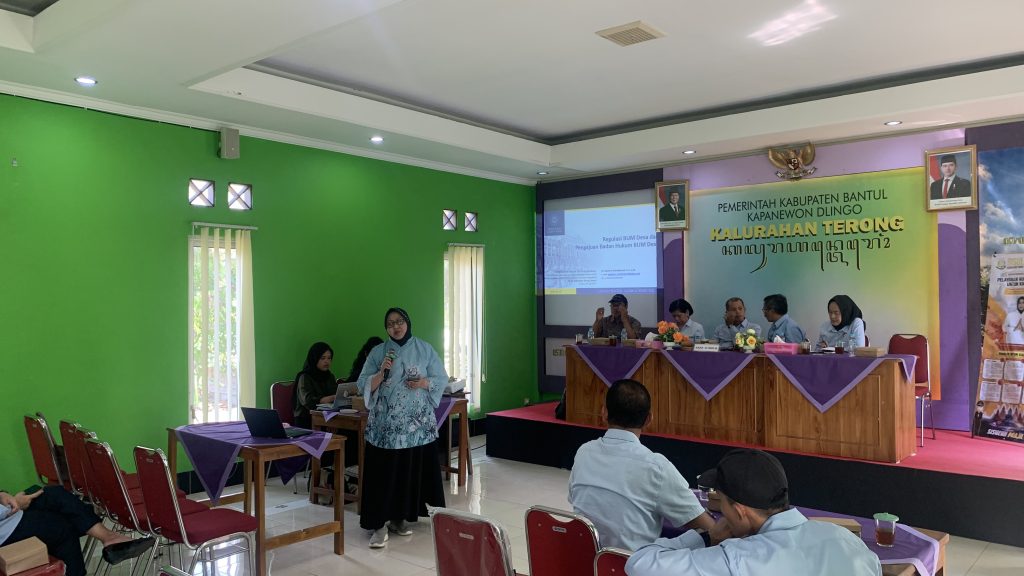
On Tuesday (June 3, 2025), the Faculty of Law at Gadjah Mada University (UGM), through its Legal Aid Consultation Center (PKBH), in collaboration with the Yogyakarta Special Region High Prosecutor’s Office, held a legal outreach event titled “Suluh Praja” at the Terong Village Office in Dlingo Subdistrict, Bantul Regency, Yogyakarta Special Region. This event aimed to improve legal literacy among the community and village officials, particularly regarding legal issues frequently encountered at the village level. The theme for this edition was “Village-Owned Enterprises and Land Rights Disputes,” with a focus on providing an understanding of the legal aspects of establishing BUMDes as well as the handling of agrarian conflicts that often arise in rural areas.
The event began at 9:30 a.m. with opening remarks by Sugiyono, a representative of the Terong Village Head, followed by the singing of the national anthem, “Indonesia Raya.” The first presentation was delivered by a team from the Yogyakarta Special Region High Prosecutor’s Office, which explained the role of the prosecutor’s office in the fields of civil law and public administration. Next, Dr. Agustina Merdekawati, S.H., LL.M., from the Faculty of Law at UGM presented material on the licensing and legality of establishing BUMDes. The presentation was followed by Prof. Dr. Tata Wijayanta, S.H., M.Hum., who discussed in depth the dynamics and resolution of land rights disputes occurring in the village.
All speakers actively participated in an interactive discussion with village officials. The discussion was dynamic, with participants asking many questions about the implementation of BUMDes regulations and the resolution of land conflicts. The speakers provided clear, practical, and solution-oriented explanations to address the issues faced by the community.
This initiative contributes to the achievement of several goals within the Sustainable Development Goals (SDGs), including: Goal 8 on decent work and economic growth through the strengthening of village-owned enterprises (BUMDes); Goal 10, which promotes the reduction of social inequality through the protection of land ownership rights; Goal 11 to create inclusive and sustainable settlements; and Goals 16 and 17 that support fair, resilient, and collaborative institutions in village development.
Author: Ruth Jessieca Margareth Togar (PKBH)