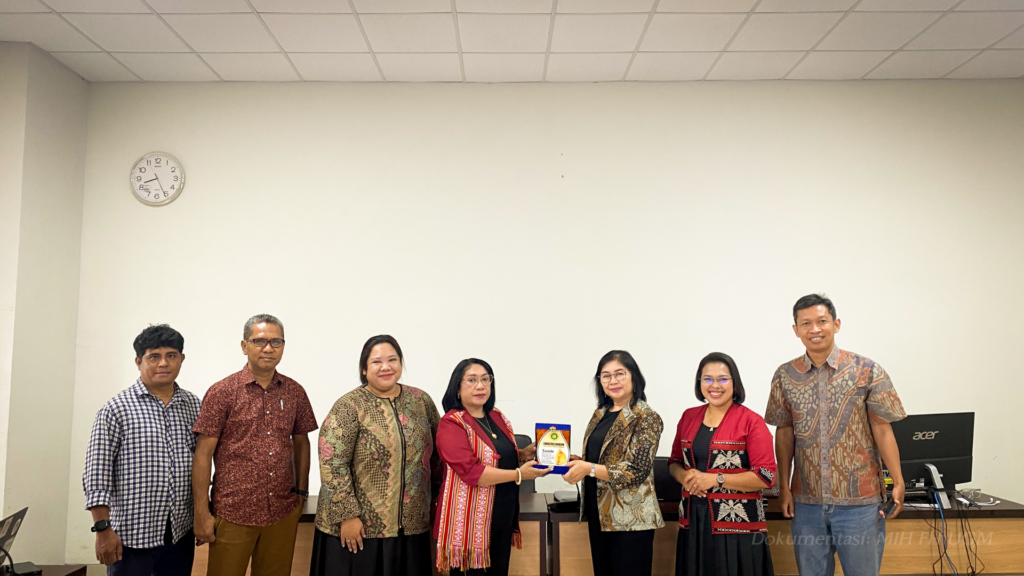
The Master of Laws Program (Magister Ilmu Hukum/MIH) at the Faculty of Law, Universitas Gadjah Mada (FH UGM), received a benchmarking visit from the Faculty of Law, Universitas Nusa Cendana, on Tuesday, October 27, 2026, as part of its work to draft a curriculum based on Outcome-Based Education (OBE).
The in-person meeting began at 8:00 a.m. WIB. It was led by the Chair of the MIH Program at FH UGM and held as a way of exchanging information and experience on developing and implementing an OBE-based curriculum in higher education, particularly in drafting learning outcomes and academic evaluation.
The meeting opened with a presentation from MIH FH UGM on how it applies an OBE-based curriculum. It was explained that the MIH curriculum consists of compulsory courses and compulsory cluster courses developed on the basis of needs in the field. The new curriculum, which took effect in August 2026, saw its credit hour (SKS) load adjusted from 40 SKS to 50 SKS and then adjusted again to 45 SKS. MIH also focuses more on the development of theoretical scholarship, while legal education oriented toward practical aspects is available in other study programs, such as the Master of Notarial Law (Magister Kenotariatan/MKn).
In practice, OBE has been applied across the board in MIH's learning process. This is reflected in the Semester Learning Program and Activity Plan (RPKPS), which directs students to take part in discussions, presentations, and case analyses in line with each course topic. Each course is also mapped so that it contributes to meeting the Graduate Learning Outcomes (Capaian Pembelajaran Lulusan/CPL), which are in turn broken down into Course Learning Outcomes (Capaian Pembelajaran Mata Kuliah/CPMK). It was also explained that an e-exam system is being developed to make grading easier for lecturers, and that case studies are used as part of learning evaluation.
The discussion then covered the management of study programs and alumni tracing. It was explained that study programs at FH UGM are directly accountable to the Dean, while departments focus on developing fields of scholarship. Academic management is also supported by education staff and by students working as part-timers. In carrying out its tracer study, MIH has faced the problem of low response rates from alumni and graduate users. To address this, the program draws on its alumni network and works with the Law Career Development Center (LCDC) to obtain and follow up on graduate tracing data.
After the MIH FH UGM presentation, the meeting continued with a discussion and responses from representatives of the Faculty of Law, Universitas Nusa Cendana. They said that Universitas Nusa Cendana still uses its old curriculum, while the demand to apply OBE makes a curriculum update necessary. Universitas Nusa Cendana also has several areas of concentration, including Constitutional Law, Criminal Justice Law, and Business Law.
In the session, the Universitas Nusa Cendana representatives raised a number of questions about curriculum drafting, in particular about explicitly including the Sustainable Development Goals (SDGs) in the RPKPS and about the choice between adding more courses and increasing the SKS weight of existing courses. The strategy for carrying out a tracer study was also discussed, including which media are effective for getting responses from alumni and graduate users. This was a concern because academic administration at Universitas Nusa Cendana is currently supported by only one academic staff member.
In response, it was explained that alumni tracing can use the LCDC as the unit that focuses on career development. The data the LCDC obtains can be passed on to the study program for follow-up. A study program can also contact graduates' supervisors or employers through the alumni network to obtain the data it needs.
The discussion then continued with responses from the JAMIA Unit on learning evaluation and the management of team teaching. It was explained that evaluation can be carried out on several assessment bases depending on the characteristics of a course, with case-based assessment being one of the more widely applied methods. Alumni tracing is also one of the instruments for measuring the quality of how education is delivered. In managing team teaching, each lecturer needs to have a clear RPKPS from the outset so that the division of tasks, learning materials, and evaluation mechanisms can run in a coordinated way.
Through this benchmarking visit, the Faculty of Law, Universitas Nusa Cendana gained a range of information and experience on applying an OBE-based curriculum at MIH FH UGM. The discussions on drafting CPL and CPMK, RPKPS, learning evaluation, human resource management, and alumni tracing are expected to serve as input for the evaluation and renewal of the curriculum at Universitas Nusa Cendana.
The activity also served as a vehicle for exchanging knowledge and experience among law faculties in support of developing higher education that is oriented toward learning outcomes and better quality in how education is delivered.
Author: Master of Laws Program, Faculty of Law, Universitas Gadjah Mada