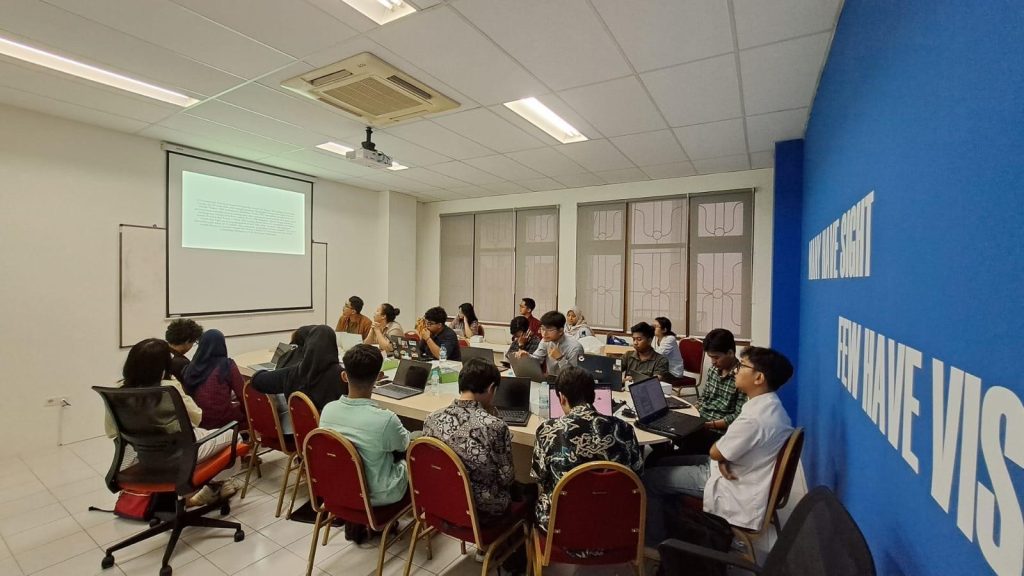
To enrich academic understanding and discussion on customary law issues, the Djojodigoeno Center for Customary Law Studies (PUSKAHA) hosted a Research Findings Discussion on the theme “Legal Policy and Customary Law Communities.” The discussion took place on Thursday (November 16, 2023) in the Meeting Room of the UGM Faculty of Law Research Center. This discussion not only supports Goal 4 (Quality Education) but also Goals 16 (Promoting Justice, Peace, and an Inclusive Society) and 15 (Life on Land) of the Sustainable Development Goals (SDGs).
This event featured two discussion topics presented by two student volunteers from PUSKAHA Djojodigoeno at the Faculty of Law, UGM.
First, Made Ananda Putri, a master’s student in Law at the Faculty of Law, UGM. The topic discussed was “The Future of Traditional Villages in Bali Province: The Role of Law and Politics in Preserving Local Cultural Heritage.” This presentation explored how law and politics influence the formalization and autonomy of traditional villages in Bali, highlighting regulatory changes over time and their implications for local culture.
Second, I Nyoman Setitidana Indra Waspada, a student in the Master of Laws (LLM) Program at the Faculty of Law, UGM. The topic addressed was “Understanding the Legal Politics of Drafting the Indigenous Peoples Bill: A Case Study on the Title and Definition of Indigenous Peoples.” This presentation highlighted the process of drafting the Indigenous Peoples Bill, including how differing definitions from various stakeholders influence legislation and legal politics.
This discussion, attended by undergraduate and graduate students, served not only as a forum for exchanging information. It also opened up new perspectives and provided a deeper understanding of the challenges and opportunities in policy-making related to indigenous communities. One of the main highlights of the discussion was the importance of the definition of indigenous communities in the bill and how the state must grant indigenous communities the right to self-definition. The views of Sartika Intaning Pradhani, a lecturer in customary law, regarding the limitations imposed by definitions became a key focus of the discussion.
The discussion organized by PUSKAHA Djojodigoeno highlighted the importance of ongoing and collaborative dialogue among academics and researchers in understanding and addressing issues related to customary law. Although it did not directly involve policymakers or representatives of indigenous communities as a whole, this forum served as an important platform for voicing and clarifying the issues faced by customary law communities. Discussions such as this can also generate recommendations that policymakers can utilize.
The differing viewpoints that emerged during the discussion reflect the diversity of perspectives within the study of customary law. These differences were navigated through ethical and constructive discourse, fostering a healthy and productive discussion environment. This demonstrates that differing viewpoints are not obstacles, but rather assets in creating more inclusive and effective policies.
Through this discussion, PUSKAHA Djojodigoeno demonstrated its commitment to continuing to support research that contributes to the development of more effective and equitable policies for indigenous communities in Indonesia. Through its research and discussions, PUSKAHA hopes to provide valuable insights that can help shape policies that are more responsive to the needs and rights of indigenous communities.
Author : Pusat Kajian Hukum Adat (PUSKAHA) Djojodigoeno