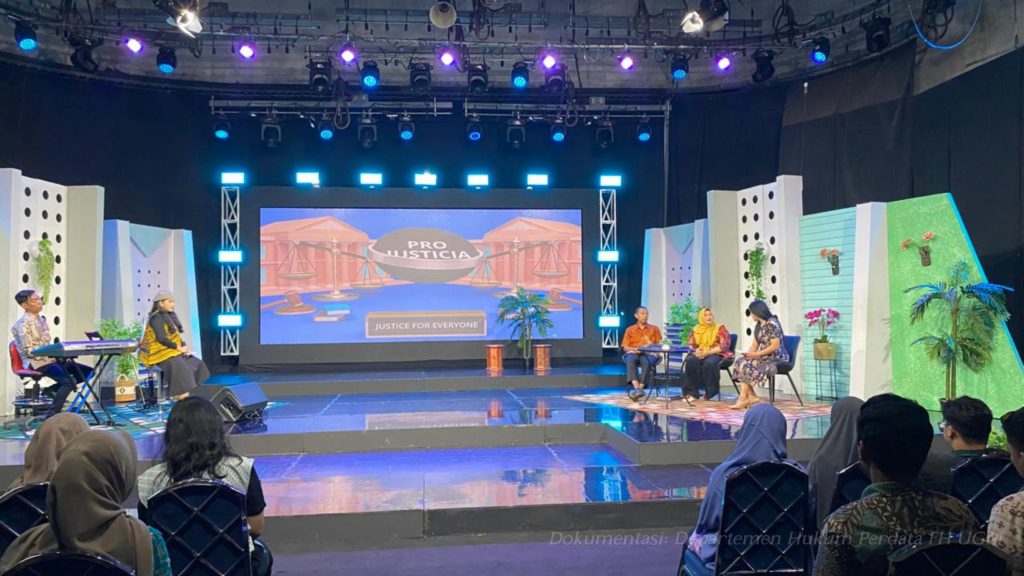
The Center for Legal Consultation and Assistance (Pusat Konsultasi dan Bantuan Hukum/PKBH) of the Faculty of Law, Universitas Gadjah Mada (UGM), once again organized the Pro Justicia Program in collaboration with TVRI Yogyakarta as part of its community service initiative to improve public legal literacy. On this occasion, the program carried the theme “The Right to Legal Aid for Persons with Disabilities in the Special Region of Yogyakarta” and was broadcast live from the TVRI studio on Tuesday (28 April 2026) at 3:00 PM WIB.
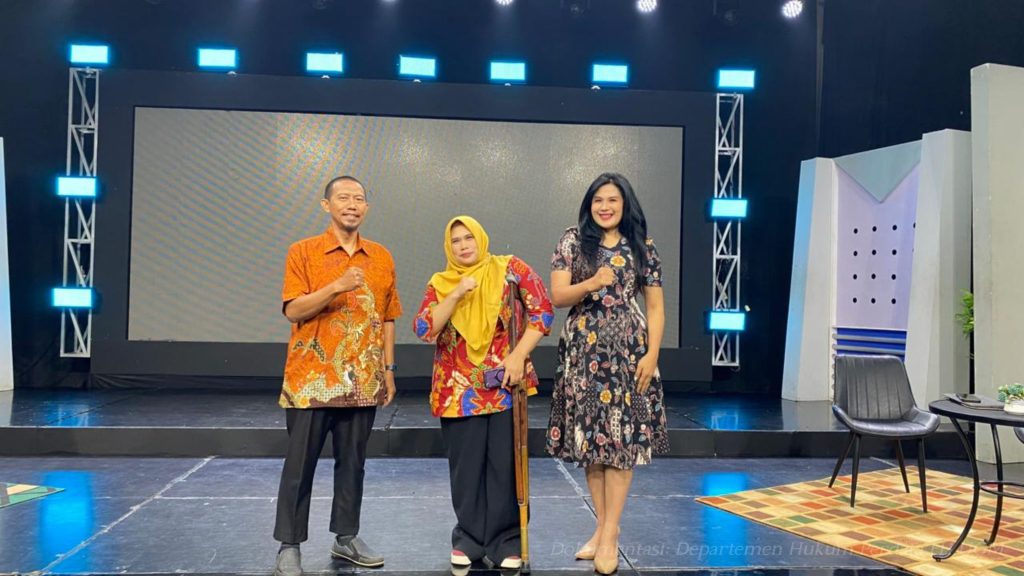
The program featured two speakers with academic expertise and practical experience in legal advocacy: Hasrul Halili, S.H., M.A., a lecturer at the Faculty of Law UGM, and Nurul Saadah Andriani, S.H., M.H., Director of the Center for Advocacy of Women, Persons with Disabilities, and Children (SAPDA). Through the discussion, both speakers comprehensively examined the right to legal aid for persons with disabilities from both normative and practical perspectives.
In general, the activity served as part of a legal education program aimed at bridging the gap between existing legal regulations and public understanding. During the discussion, the speakers explained that Indonesia already possesses a relatively progressive legal framework guaranteeing the rights of persons with disabilities, including the right to obtain free legal aid. Nevertheless, the implementation of these regulations continues to face significant challenges.
The speakers highlighted that persons with disabilities still encounter various barriers in accessing justice. These challenges include limited access to information, the lack of disability-friendly facilities, and insufficient understanding among law enforcement officials regarding the specific needs of persons with disabilities. In practice, such conditions often make it difficult for persons with disabilities to report cases, participate in legal proceedings, or obtain adequate legal assistance.
Furthermore, advocacy experiences shared by SAPDA revealed that many cases involving persons with disabilities, particularly women with disabilities, never reach formal legal processes. Social stigma, fear, and communication barriers remain the primary reasons why many victims choose not to pursue legal action. This demonstrates that obstacles to justice are not merely structural but are also deeply connected to social and cultural factors that continue to hinder the fulfillment of the rights of vulnerable groups.
From a broader perspective, the program is expected to contribute significantly to increasing public understanding of legal aid rights, especially for persons with disabilities. Through widely accessible legal education broadcasts, the public gains not only information about the availability of legal aid services but also a stronger understanding that access to justice is an inherent right of every individual without exception. In addition, the activity encourages persons with disabilities and their families to seek legal services when facing legal problems.
This initiative is also closely aligned with the Sustainable Development Goals (SDGs). First, it contributes to SDG 16: Peace, Justice, and Strong Institutions, particularly by promoting inclusive access to justice and strengthening legal institutions that are responsive to vulnerable groups. Second, it supports SDG 10: Reduced Inequalities by encouraging equal access to legal services for persons with disabilities. Furthermore, the protection of vulnerable groups, especially women with disabilities, is also connected to SDG 5: Gender Equality.
Through the implementation of the Pro Justicia Program, PKBH FH UGM seeks not only to provide an informative discussion platform but also to encourage broader transformation within the legal system and society. This activity forms part of ongoing efforts to build collective awareness that access to justice must be inclusive and accessible to all members of society, including persons with disabilities.
Moving forward, it is hoped that similar initiatives can continue sustainably with the involvement of various stakeholders, including government institutions, law enforcement agencies, and civil society organizations. Such collaboration is essential to ensuring that the principle of equality before the law is not merely normative, but genuinely realized in practice. In this way, a legal system that is fair, inclusive, and oriented toward the protection of human rights can become an increasingly tangible reality.
Author: Tribuna Haiqal Rio Wijaya