
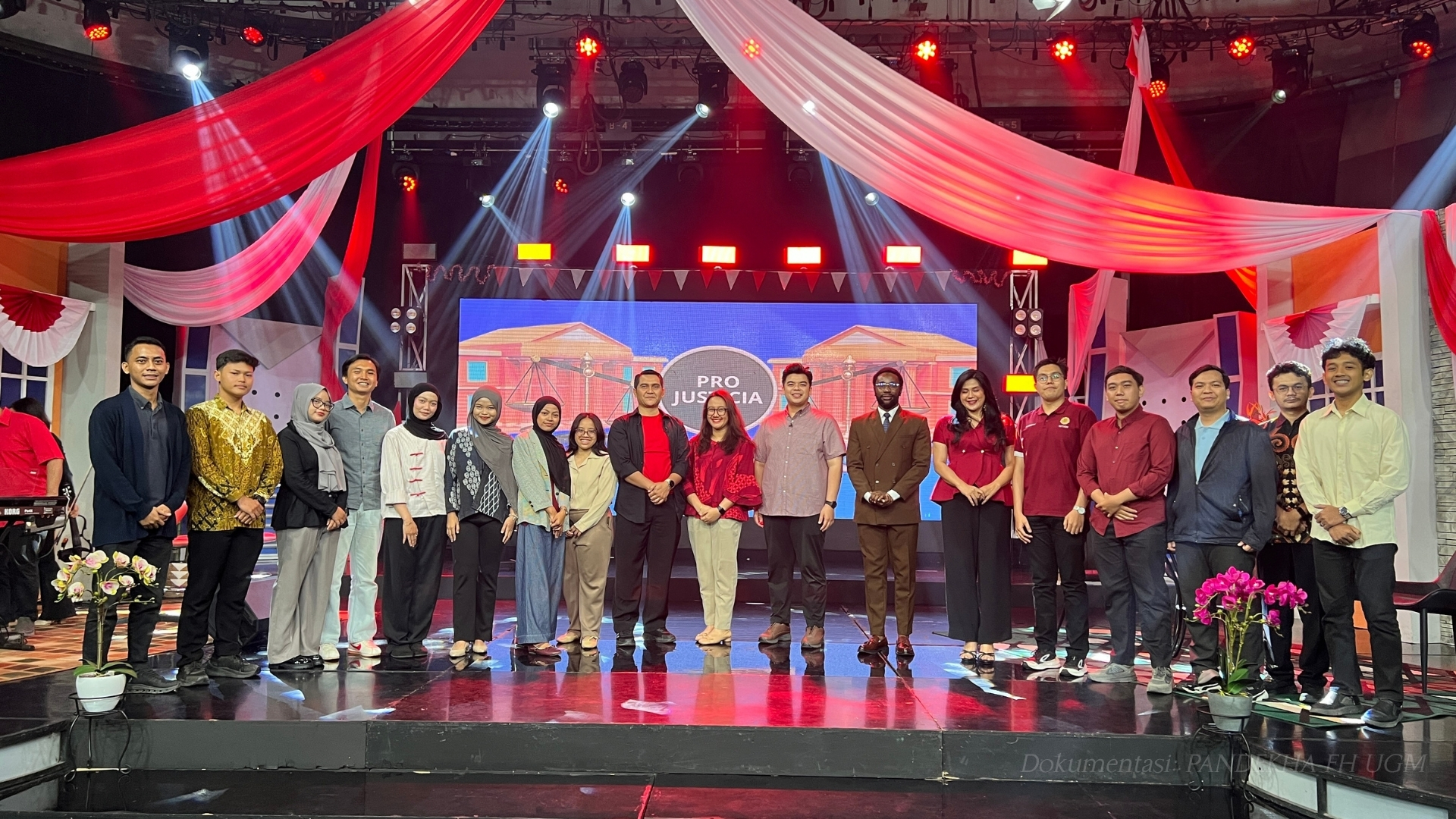
The Centre for Democracy, Constitutional Law, and Human Rights (PANDEKHA) at the Faculty of Law, Universitas Gadjah Mada, held a legal outreach session titled "Business and Human Rights Literacy for Responsible Business", broadcast through the Pro Justicia program on TVRI Yogyakarta on Monday, August 10, 2026. The session formed part of the faculty's community service effort to strengthen public understanding of the relationship between business activities, the protection of human rights (HAM), and business sustainability.
The session featured Sahid Hadi, a researcher at the Centre for Human Rights Studies, Universitas Islam Indonesia (PUSHAM UII); Yance Arizona, S.H., M.H., M.A., a Constitutional Law Lecturer at FH UGM; and Nabiyla Risfa Izzati, S.H., LL.M. (Adv.), Ph.D., a Labour Law Lecturer at FH UGM. The session discussed the importance of business and human rights principles in modern business practice specifically, the need for economic growth and business activities to proceed alongside respect for the rights of workers, local communities, and the environment.
Business activities make an important contribution to job creation, income generation, and economic development. However, business operations can also give rise to risks to human rights when economic orientation is not accompanied by responsible governance. The session therefore introduced the framework of the United Nations Guiding Principles on Business and Human Rights (UNGPs), which rests on three core pillars: the state duty to protect human rights, the corporate responsibility to respect human rights, and access to remedy for those affected by business-related harm.
The discussion also addressed Human Rights Due Diligence the process by which companies identify, prevent, and mitigate the potential adverse impacts of their business activities on human rights. In this context, respect for human rights goes beyond formal regulatory compliance; it must be integrated into corporate decision-making and risk management processes.
One of the session's key messages was delivered by Nabiyla Risfa Izzati, who emphasized that the application of Business and Human Rights principles should not be seen as an additional burden on business operators. Instead, respect for human rights must be positioned as part of business sustainability. When a company ensures the fulfillment of workers' rights, identifies social risks from the outset, and manages the impacts of its activities responsibly, it is not only fulfilling its obligations it is building trust and strengthening long-term business viability.
In the discussion, Yance Arizona and Sahid Hadi also highlighted the importance of harmonized and non-overlapping regulation. Both emphasized that the challenge lies not only in the quantity of rules governing business activity, but also in the extent to which the public understands the purpose and direction of those regulations. In practice, communities are often unaware of the intent behind a particular policy because they have not been adequately involved in the drafting process. For this reason, public participation is essential so that employment regulations can genuinely address the needs and problems faced by the community.
Through this legal outreach session, it is hoped that the public will develop stronger legal literacy enabling them to recognize their rights, understand the responsibilities of business actors, and know the importance of redress mechanisms when harm arises from business activities. At the same time, business operators are hoped to view the application of Business and Human Rights principles as an investment in governance, reputation, resilience, and company sustainability. Business and Human Rights principles thus seek to achieve a balance between worker welfare and business economic interests.
The session supports the achievement of the UN Sustainable Development Goals (SDGs) particularly SDG 16 (Peace, Justice, and Strong Institutions) through the improvement of legal literacy, respect for human rights, and access to justice; and SDG 17 (Partnerships for the Goals) through the collaboration among universities, academics, media, and the public. Through public education on Business and Human Rights, PANDEKHA FH UGM hopes to contribute to the development of business practices that are increasingly accountable, inclusive, responsible, and sustainable.
Author : Mayang Anggi Pradita (Junior Researcher PANDEKHA FH UGM)