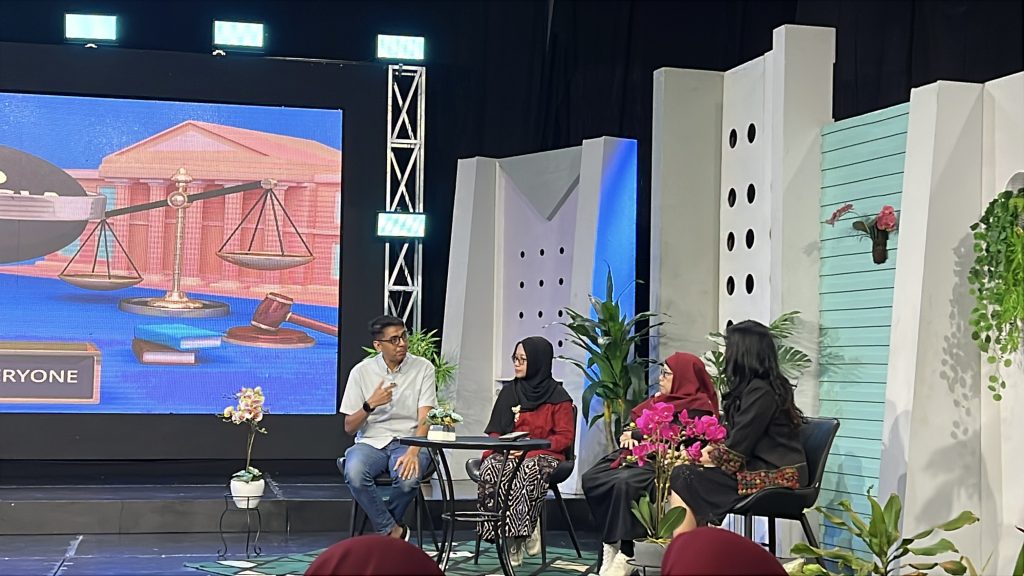
The Center for the Study of Democracy, the Constitution, and Human Rights at the Faculty of Law, Gadjah Mada University (PANDEKHA) held a legal education broadcast titled “Law Is Not an Ivory Tower: Why Public Participation Matters” through the Legal Outreach Grant program organized by the Center for Legal Consultation and Assistance at the Faculty of Law, Gadjah Mada University (PKBH FH UGM) in collaboration with TVRI Yogyakarta. The program was broadcast live on Wednesday (October 1, 2025), at 11:00 a.m. WIB on TVRI Yogyakarta, and discussed the importance of public participation in the legislative process in Indonesia.
This legal outreach session was attended by a number of participants who watched the live broadcast, including students, volunteers, and researchers from PANDEKHA, as well as representatives from civil society organizations active in public policy advocacy. The event also featured three main speakers: Prof. Dr. Ni’matul Huda, S.H., M.Hum. (Constitutional Law Expert, UII Faculty of Law), Wasingatu Zakiyah, S.H., M.A. (Director of the CAKSANA Institute, Public Participation Activist), and Dr. Zainal Arifin Mochtar, S.H., LL.M. (Lecturer at the UGM Faculty of Law, PANDEKHA Researcher). Each speaker discussed various perspectives regarding the urgency of public involvement in the formulation of policies and regulations in Indonesia.
Prof. Ni’matul Huda began the session by discussing the legal framework underpinning public participation in the drafting of legislation. She emphasized the importance of involving the public at every stage of policy-making—from drafting to implementation—including the phenomenon of numerous cases seeking judicial review of laws before the Constitutional Court due to this lack of public participation, so that future policies truly reflect the needs and aspirations of the people. According to her, transparent and accountable public participation is crucial for realizing a more democratic and just legal system.
Wasingatu Zakiyah then went on to discuss the phenomenon of minimal public participation in the lawmaking process in Indonesia. She provided examples of several specific cases where the public was not sufficiently involved in the drafting process, leading to a lack of trust in the resulting policies. Wasingatu emphasized that “meaningful participation” must involve the public substantively in determining the policies to be implemented.

Zainal Arifin Mochtar added a reminder not to misinterpret the situation. The House of Representatives (DPR) serves only as a representation of the people; this does not mean that public participation is no longer needed in the legislative process. On the contrary, the public must be involved and consulted regarding proposed bills—such as the extent of their benefits, whether the public needs them, their positive and negative impacts, and other related issues. All of these matters must involve the public, who will be the ones subject to these regulations. According to Zainal Arifin Mochtar, the DPR’s role should be to serve as a conduit for the people’s voice, not a substitute for it. Consequently, if these standards are absent, there will inevitably continue to be numerous regulations rushed through solely due to time constraints (Midnight Regulations)—which waste public funds—or regulations enacted secretly by and for the benefit of a select group of people (Cinderella Actions), which can only harm the public and potentially perpetuate oligarchy.
This legal outreach program also highlights the importance of public participation in shaping policy direction, as well as how the role of the House of Representatives (DPR) as the people’s representative must be balanced by active public engagement. The public must be given the opportunity to voice their opinions regarding the bills under discussion, to ensure that the resulting policies are inclusive and beneficial to all segments of society.
This outreach program is also highly relevant to the Sustainable Development Goals (SDGs), particularly SDG 16: “Peace, Justice, and Strong Institutions,” which emphasizes the importance of public participation in decision-making and the creation of a fair and transparent legal system. Furthermore, SDG 4: “Quality Education” is closely linked, given that quality legal education is key to creating a more informed and empowered public in the legislative process. Based on SDG 10: “Reduced Inequalities” and SDG 17: “Partnerships for the Goals,” this event also reinforces the importance of inclusivity and collaboration in policy-making.
It is hoped that this educational broadcast will raise public awareness of the importance of their right to participate in policymaking and encourage the creation of a more transparent, inclusive, and democratic legislative system in Indonesia.
Writer: Poppy Hairunnisa (PANDEKHA)