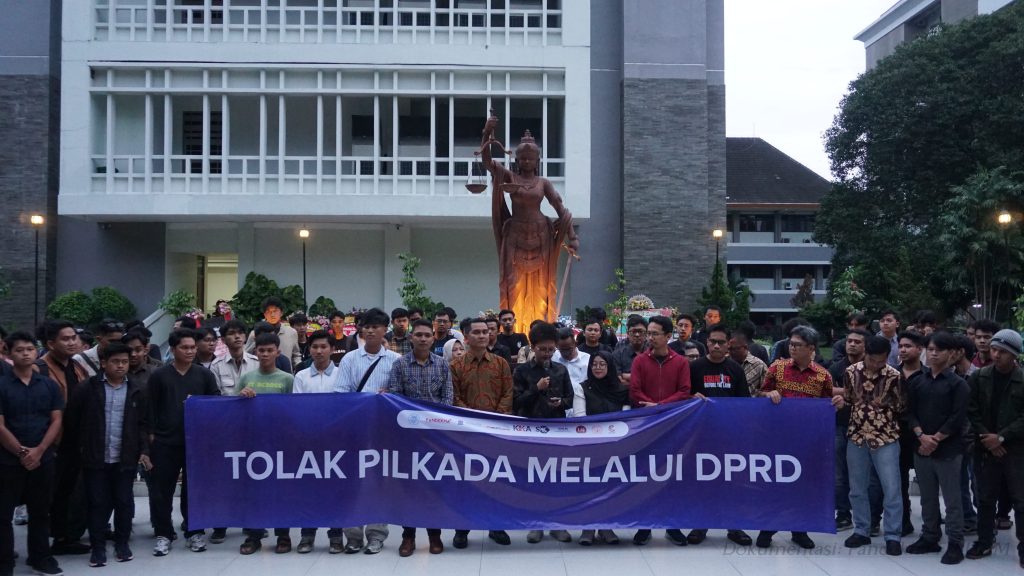
The Faculty of Law of Universitas Gadjah Mada (FH UGM), represented by the Center for Democracy, Constitution, and Human Rights Studies (PANDEKHA), the Center for Anti-Corruption Studies (PUKAT), the Center for Law and Social Justice Studies (LSJ), the Constitutional Law Society (CLS), and DEMA Justicia, together with academics, practitioners, and activists from various institutions and communities, organized a Democracy Forum and Public Statement at Justicia Park, FH UGM. Held on Thursday (15/1/2026), the event was attended by students, democracy activists, civil society advocates, and legal observers. The forum was convened in response to proposals advocating for the election of regional heads (Pilkada) through the Regional Legislative Councils (DPRD), a proposal that has gained support from President Prabowo Subianto.
The Democracy Forum commenced with opening remarks and an address delivered by Satrio Yudhoyono on behalf of CLS FH UGM, followed by the singing of Darah Juang. The event continued with speeches from a number of prominent figures, including Prof. Zainal Arifin Mochtar, Titi Anggraini, Herlambang P. Wiratraman, Khoirunnisa Agustyati, Iwan Satriawan, Prof. Susi Dwi Harijanti, Bivitri Susanti, Prof. Denny Indrayana, and Yance Arizona, as well as a poetry reading by Herdiansyah Hamzah.
In their remarks, the speakers emphasized that the direct election of public officials, including regional heads, is the result of Indonesia’s long democratic journey. Prof. Zainal Arifin Mochtar argued that electing regional heads through DPRD would be even more problematic than direct elections, as it would effectively eliminate public oversight of the selection process. Echoing this concern, Prof. Susi Dwi Harijanti stated that transferring the authority to elect regional heads to DPRD would represent a democratic setback, shifting the process of filling public offices from a democratic mechanism toward a more autocratic one.
Yance Arizona noted that, in practice, regional head elections conducted through DPRD are often not genuinely decided collectively by council members but are instead determined by a small number of political party elites. Meanwhile, Titi Anggraini warned that abolishing direct regional elections could become a gateway to eliminating other forms of direct elections, including presidential elections, thereby posing a broader threat to the principle of popular sovereignty.
From a human rights and inclusivity perspective, Bivitri Susanti highlighted that regional head elections through DPRD could diminish the representation of vulnerable groups, including women, persons with disabilities, Indigenous Peoples, and other minority communities. Iwan Satriawan added that opposition to DPRD-based regional elections forms part of a collective effort to prevent the emergence of an absolute concentration of power. Similar concerns were raised by Feri Amsari, who argued that the proposal reflects a systematic attempt by those in power to reinforce authoritarian tendencies.
Khoirunnisa Agustyati also addressed the frequently cited argument that regional elections are excessively costly, emphasizing that such concerns should be addressed through improvements in electoral governance rather than by abolishing democratic mechanisms altogether. Prof. Denny Indrayana further noted that the Constitutional Court has consistently interpreted the constitutional phrase “elected democratically” as referring to elections conducted in accordance with democratic electoral principles, rather than elections conducted through DPRD.
Concluding the series of speeches, Herdiansyah Hamzah delivered a powerful critique through poetry and commentary, condemning political elites whom he perceived as indifferent to the hardships faced by ordinary citizens while simultaneously promoting agendas that could undermine democracy amid ongoing social and economic challenges across the country. The speakers collectively agreed that the proposal to conduct regional head elections through DPRD contradicts Article 1 paragraph (2) of the 1945 Constitution of the Republic of Indonesia, which affirms that sovereignty resides in the people. Direct regional elections were described as an essential instrument for safeguarding public participation, strengthening governmental accountability, and ensuring that development remains responsive to local needs. The proposal was also viewed as inconsistent with the spirit of the 1998 Reformasi movement and as a potential catalyst for the re-centralization of power and the weakening of Indonesia’s constitutional system.
As a country committed to achieving the Sustainable Development Goals (SDGs), particularly SDG 16, which promotes responsive, inclusive, participatory, and representative decision-making, Indonesia should continue to uphold direct regional elections as the primary democratic mechanism at the local level. The Democracy Forum concluded with the reading of a public statement delivered by Richo Andi Wibowo, Idul Rishan, and Dhia Al-Uyun.
Author : Laila Alfina Mayasari Rizqi (PANDEKHA)