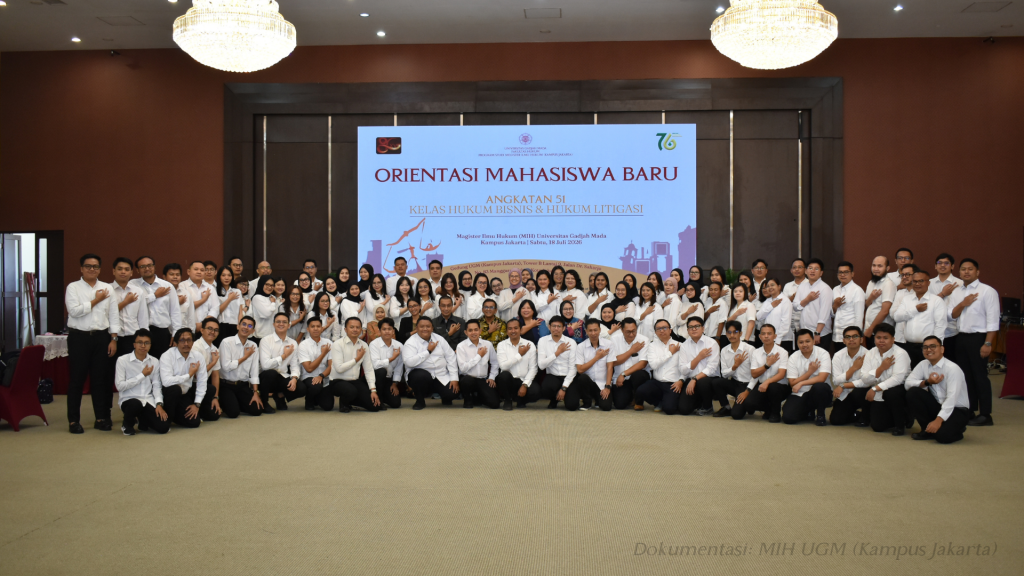
On Saturday, July 18, 2026, the Master of Laws Program (MIH) at UGM's Jakarta Campus held the New Student Orientation for its 51st Cohort, for students enrolling in the Business Law and Litigation Law concentrations. The event served as the opening gateway for new students into the academic environment, while also introducing them to the scholarly culture that defines the Faculty of Law at Universitas Gadjah Mada. Beyond functioning as an introduction to the higher education system, the orientation was designed to shape an academic character that is excellent, principled, adaptive, and attuned to the challenges of law at both the national and global levels.
The series of events opened with a welcoming address and formal opening by the Vice Dean for Academic Affairs, Student Affairs, and Partnerships at the UGM Faculty of Law, Prof. Adrianto Dwi Nugroho, S.H., Adv.LL.M., LL.D. In his address, he emphasized that master's students in law bear a responsibility to become academics who not only master legal theory and practice, but who are also capable of thinking critically, upholding integrity, and remaining responsive to the ever-shifting dynamics of legal development in an era of globalization and digital transformation.
Prof. Adrianto also encouraged students to make full use of the academic facilities available at the UGM Faculty of Law as a means of improving the quality of their learning, research, and professional capacity development. He noted that success in a master's program is determined not only by academic achievement, but also by the ability to build networks, collaborate, and maintain a commitment to the ethics of the legal profession.
Students then participated in a session on "An Introduction to the UGM Faculty of Law and the Master of Laws Program (Jakarta Campus)," delivered by Dina W. Kariodimedjo, S.H., LL.M., Ph.D., Chair of the MIH Program at UGM's Jakarta Campus, together with Dr. Agustina Merdekawati, S.H., LL.M., Program Secretary. During this session, students gained a comprehensive understanding of the program's history, vision and mission, institutional values, organizational structure, curriculum, learning system, and the direction of development of the Master of Laws Program at the Jakarta Campus.
In her presentation, Dr. Agustina Merdekawati explained that the curriculum of the MIH Program at UGM's Jakarta Campus has been refined on the basis of the Curriculum Decision that references Ministerial Regulation on Higher Education, Science, and Technology No. 39 of 2025 on Higher Education. This curriculum refinement represents an adaptation to the evolving needs of the legal world, regulatory changes, and the increasingly complex demands of the legal profession in the modern era.
Although the total credit load remains 48 credit hours (SKS), a number of improvements have been made to the learning structure. One of the key changes is the strengthening of the research process through dedicated courses in Thesis Proposal, Thesis Research Progress, and Thesis — ensuring that students receive staged research supervision from the very beginning of their academic work. In addition, the compulsory course structure has been adjusted, with the Law Enforcement and Culture course removed, making the curriculum more relevant to the needs of contemporary legal practice and the development of legal scholarship.
Students also received explanations of the UGM academic system from the course registration process (Kartu Rencana Studi/KRS), learning evaluation, attendance requirements, and academic mentoring, through to the stages of thesis writing as the final requirement of the master's program. A clear understanding of the academic system is hoped to help students plan their studies effectively and complete their program with optimal results.
In the next session, Nova Indah Wijayanti, S.I.P., UGM Librarian at the Jakarta Campus, presented on "An Introduction to the UGM Library System and Discussion." Students were introduced to the library's range of services as a centre of scientific information resources supporting education, research, and thesis writing.
These services include access to the Universitas Gadjah Mada repository, electronic books (e-books), electronic journals (e-journals), national and international legal databases, and other scientific reference sources available throughout the duration of study. The session also emphasized the importance of using legal sources that are credible, authoritative, and academically defensible. Students were also given guidance on the use of digital technology including artificial intelligence (AI) as a supporting instrument in the search for legal information and literature, while preserving the primacy of analysis, legal reasoning, and academic integrity.
Closing the orientation series, students participated in a Self-Development session designed interactively to build both academic and professional readiness. The session comprised three main activities: Goal Setting and Motivation, Academic Commitment and Resilience, and Academic Collaboration and Communication.
Through the Goal Setting and Motivation activity, students were guided in setting academic targets, career development plans, and the professional goals they wished to achieve during their master's studies. In the Academic Commitment and Resilience session, students were encouraged to build discipline, consistency, and the capacity to face various academic challenges. Through the Academic Collaboration and Communication session, students were trained to develop collaboration skills, professional communication, leadership, and teamwork all essential preparation for navigating the dynamics of the legal profession.
Through the New Student Orientation for the 51st Cohort, the Master of Laws Program at UGM's Jakarta Campus hopes that all new students will adapt optimally to the academic environment, understand the applicable learning system, and remain committed to developing their intellectual capacity, moral integrity, and professionalism as future masters of law. With this preparation, graduates are hoped to make meaningful contributions to the advancement of legal scholarship, the strengthening of the judicial system, the improvement of legal governance quality, and the resolution of legal issues across Indonesia. In alignment with Universitas Gadjah Mada's commitment to supporting the Sustainable Development Goals (SDGs), the orientation also contributes to SDG 4 (Quality Education) through the delivery of high-quality higher education; SDG 16 (Peace, Justice, and Strong Institutions) through the formation of legal professionals of integrity who uphold the rule of law; and SDG 17 (Partnerships for the Goals) through the strengthening of academic collaboration and professional networks as a foundation for producing graduates capable of making a positive impact on society, the nation, and the state.
Author : Ramzy Oansa Ilham