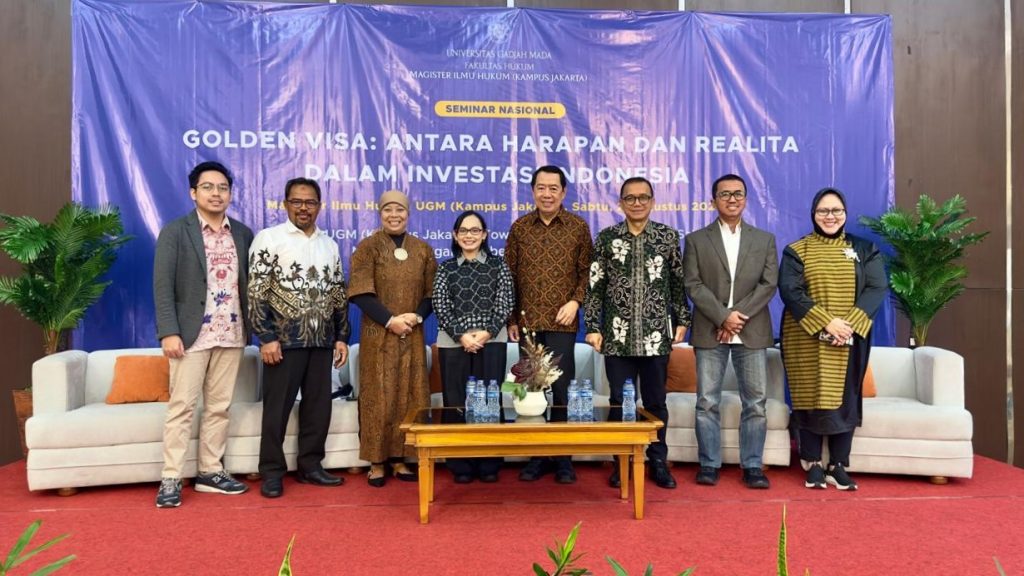
The Master of Law Program at the UGM Faculty of Law (Jakarta Campus) hosted a national seminar titled “Golden Visa: Between Hope and Reality in Indonesian Investment.” The seminar, divided into two sessions, took place online on the UGM Faculty of Law’s Knowledge Channel on YouTube on Saturday, August 23, 2025. The seminar was designed to provide a comprehensive understanding of the legal basis and regulatory framework of the Golden Visa policy in Indonesia, while also analyzing its implications for foreign investment, immigration, and national development.
The national seminar began with opening remarks by Dahliana Hasan, S.H., M.Tax., Ph.D., Dean of the UGM Faculty of Law. In her remarks, Dahliana emphasized that the Golden Visa issue lies at the intersection of legal, economic, and social considerations. According to her, academic forums like this are important for generating practical solutions that can be recommended to the government so that the Golden Visa serves as a catalyst for development rather than creating new problems.
The first session of the seminar was moderated by Harimuddin, S.H., from the Indonesia Ocean Justice Initiative (IOJI). Harimuddin opened the discussion by emphasizing that national development requires collaborative support between the government and the public. According to him, the Golden Visa policy was introduced as an effort to attract foreign investors to boost the national economy, although in practice the challenges faced are far from simple.
The first speaker, Adi Harsono, Chair of APINDO’s Asia-Pacific Committee, offered a critical perspective on the effectiveness of the Golden Visa program in Indonesia. Adi criticized Indonesia’s Golden Visa regulations, which he deemed overly complex and biased toward benefiting large corporations. He cited the case of the Golden Visa granted to national team coach Shin Tae-yong, which he argued was inconsistent with the policy’s original objective of attracting foreign investment. Compared to other countries, Adi noted, the implementation of the Golden Visa in Indonesia remains far from ideal because it has not yet succeeded in simplifying the rules for investors.
In response, Dr. Riyatno, Deputy for Investment Climate Development at the Ministry of Investment/BKPM, explained that the Golden Visa is intended for high-quality investors capable of making a significant contribution to the national economy. He outlined a number of global challenges, such as geopolitical tensions, economic slowdowns, and declining global investment flows, as well as domestic challenges in the form of relatively high investment costs and still-weak legal certainty. Nevertheless, Riyatno emphasized that Indonesia’s appeal remains strong due to its abundant natural resources and vast domestic market.
To round out the discussion, Eko Budianto, Director of Visas and Travel Documents at the Ministry of Immigration and Corrections, outlined the legal basis for this policy: Ministry of Law and Human Rights Regulation No. 22 of 2023, which was updated by Ministry of Law and Human Rights Regulation No. 11 of 2024. Eko explained the program, which covers individual investors, foreign companies, second-home visas, the diaspora, global talent, and honorary visas. According to the data, from its launch through August 4, 2025, 945 Golden Visas have been issued, representing investment commitments totaling more than Rp46 trillion and contributing more than Rp11 billion in non-tax government revenue.
From a sustainable development perspective, the first session emphasized that the Golden Visa supports SDG 8 (Decent Work and Economic Growth) through the creation of new jobs, as well as SDG 9 (Industry, Innovation, and Infrastructure) through technology transfer and industrial capacity building. Thus, the first session of this national seminar conveyed an important message that the Golden Visa should not be viewed merely as an immigration and investment tool, but also as an integral part of Indonesia’s sustainable development strategy, which is aligned with the global SDG agenda and the Indonesia Emas 2045 vision.
Author: Ramzy (MIH UGM Jakarta Campus)
Editor: Public Relations